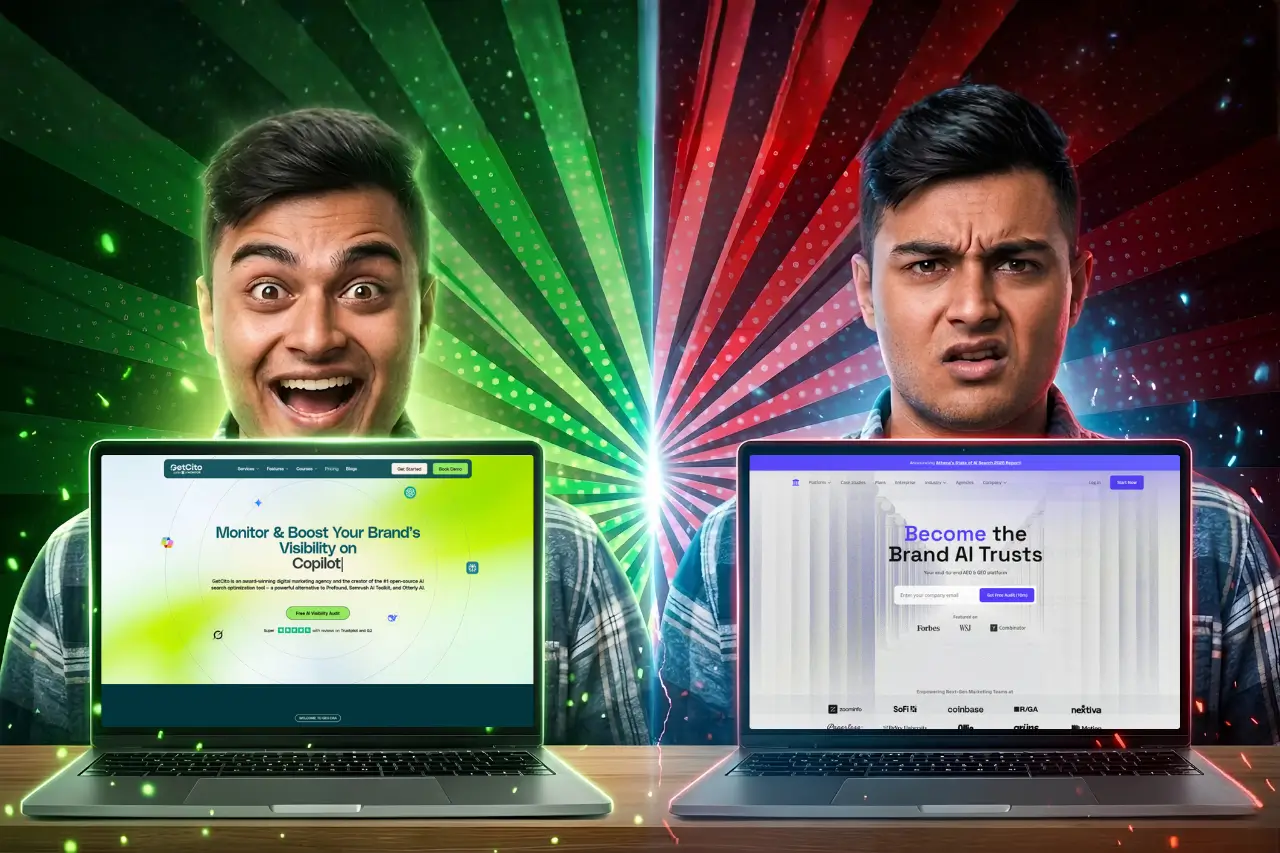


Quick Verdict: GetCito vs. Bear AI
If you need technical control and crawlability optimization, choose GetCito.
If you need speed, PR monitoring, and executive reporting, choose Bear AI.
| Feature | GetCito | Bear AI |
|---|---|---|
Best For | Technical SEOs & Developers | Marketing & PR Teams |
Primary Goal | Optimization (Make AI understand you) | Intelligence (See where AI cites you) |
Deployment | Self-Host (Open Source) or SaaS | Managed SaaS Cloud |
Pricing | Usage-based / Low Entry | Seat-based / Premium |
Search behaviour has moved decisively beyond ten blue links. Buyers now ask ChatGPT, Perplexity, Claude, and Google’s AI Mode to recommend products, tools, and services. What matters is no longer where you rank, but whether you are cited.
This comparison examines two platforms purpose-built for that reality, GetCito and Bear AI, and evaluates how each performs across
What You’ll Learn in This Comparison
- How GetCito and Bear AI approach AI search visibility from fundamentally different angles: technical optimization vs. real-time monitoring
- Which platform is better suited for LLM SEO, crawlability, and structured data readiness
- How AI citation tracking differs in depth, latency, and actionability
- A clear breakdown of pricing models and ROI logic, including self-hosted vs. managed SaaS
- Which tool fits best for technical SEO teams, marketing/PR teams, and budget-conscious founders
- Why the choice ultimately comes down to optimization control vs. brand intelligence speed in the generative search era
Why Generative Engine Optimization (GEO) Demands a New Toolset

AI Overviews and answer engines operate differently from traditional search. While Google ranks pages based on backlinks and keywords, Generative AI uses Retrieval-Augmented Generation (RAG) to rank information chunks based on semantic relevance.
When a user asks, "best CRM for startups", the AI:
- Retrieves highly probable text chunks (ranking them by vector similarity).
- Synthesizes an answer.
- Cites the sources it trusts.
The competitive layer has shifted:
- From SERP Positions → Vector Similarity & Citations
- From Link Equity → Entity Authority
GetCito vs. Bear AI: Core Features & Architecture
| Aspect | GetCito | Bear AI |
|---|---|---|
Primary focus | GEO, LLM SEO, AI crawlability | Real‑time AI brand monitoring |
Design philosophy | Technical optimization & transparency | Marketing intelligence & speed |
Ideal user | SEO, GEO & developers teams | Marketing & PR teams |
Deployment model | SaaS + open‑source self‑host | Fully managed SaaS |
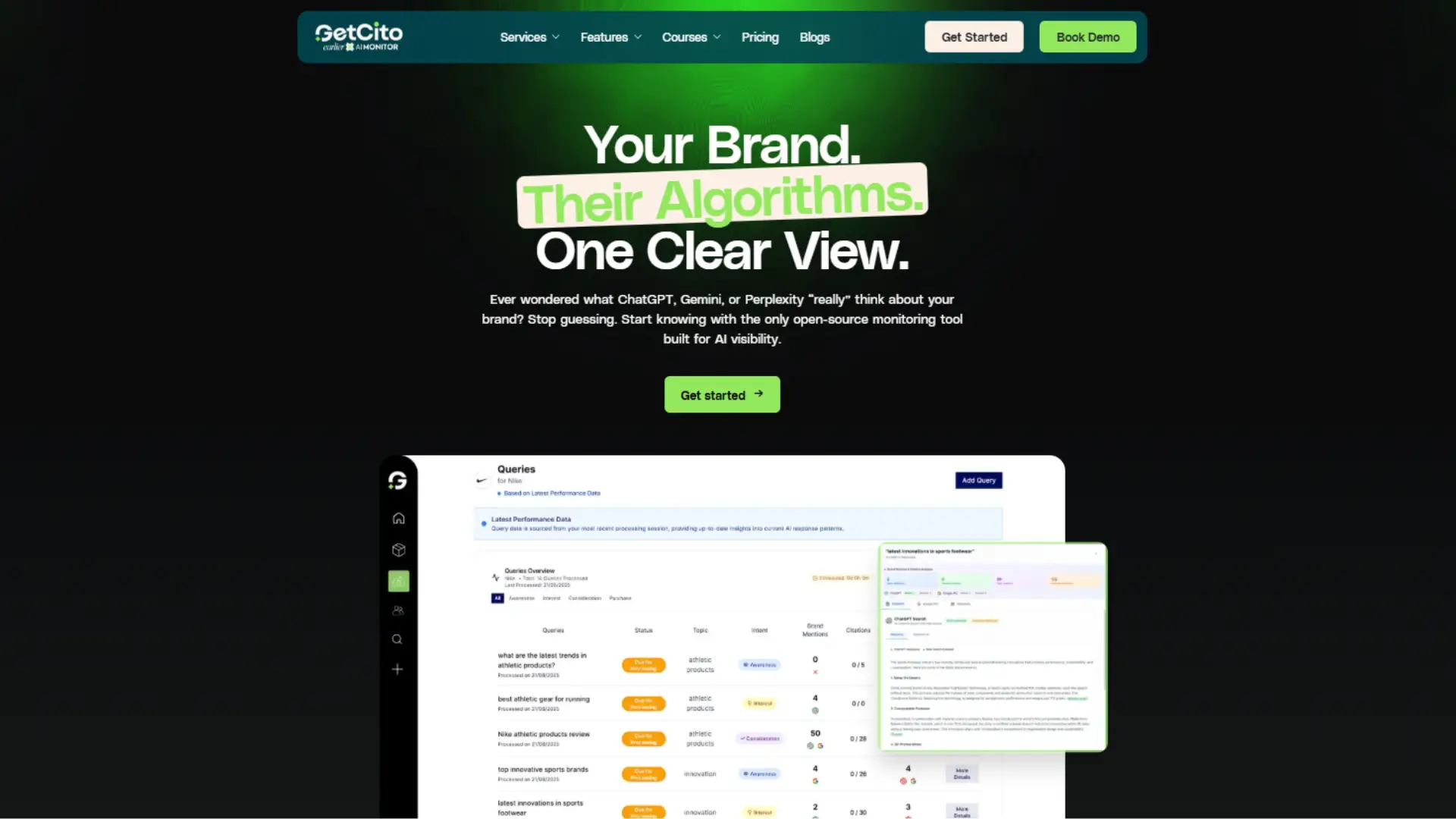
Core purpose:
GetCito presents itself not just as a product, but as a technical GEO platform coupled with strategic services that help brands understand and optimize where they appear in generative AI outputs. It combines visibility analytics with benchmarks and AI crawlability insights.
What GetCito Delivers:
- Open-Source Transparency: The core platform is MIT-licensed, providing full visibility into how monitoring and scoring functions operate.
- Multi-Engine Support: Unified monitoring across generative engines, including ChatGPT, Google AI Overviews, Perplexity, Claude, and Gemini.
- AI Crawlability Clinic: GetCito emphasizes optimization for AI crawlability, ensuring your content’s structure and semantic data are tuned for retrieval by generative models.
- Sentiment & Competitor Benchmarking: Track not just visibility, but how the brand is discussed compared to competitors.
- Local GEO: Tailored insights for geo-specific visibility, crucial where purchase decisions happen locally.
Who Benefits Most:
- SEO specialists who want control over data, infrastructure, and custom monitoring.
- Technical content strategists who need robust API support and analytics.
- Development teams seeking open-source flexibility.
Bear AI: The Real-Time AI Brand Intelligence Dashboard
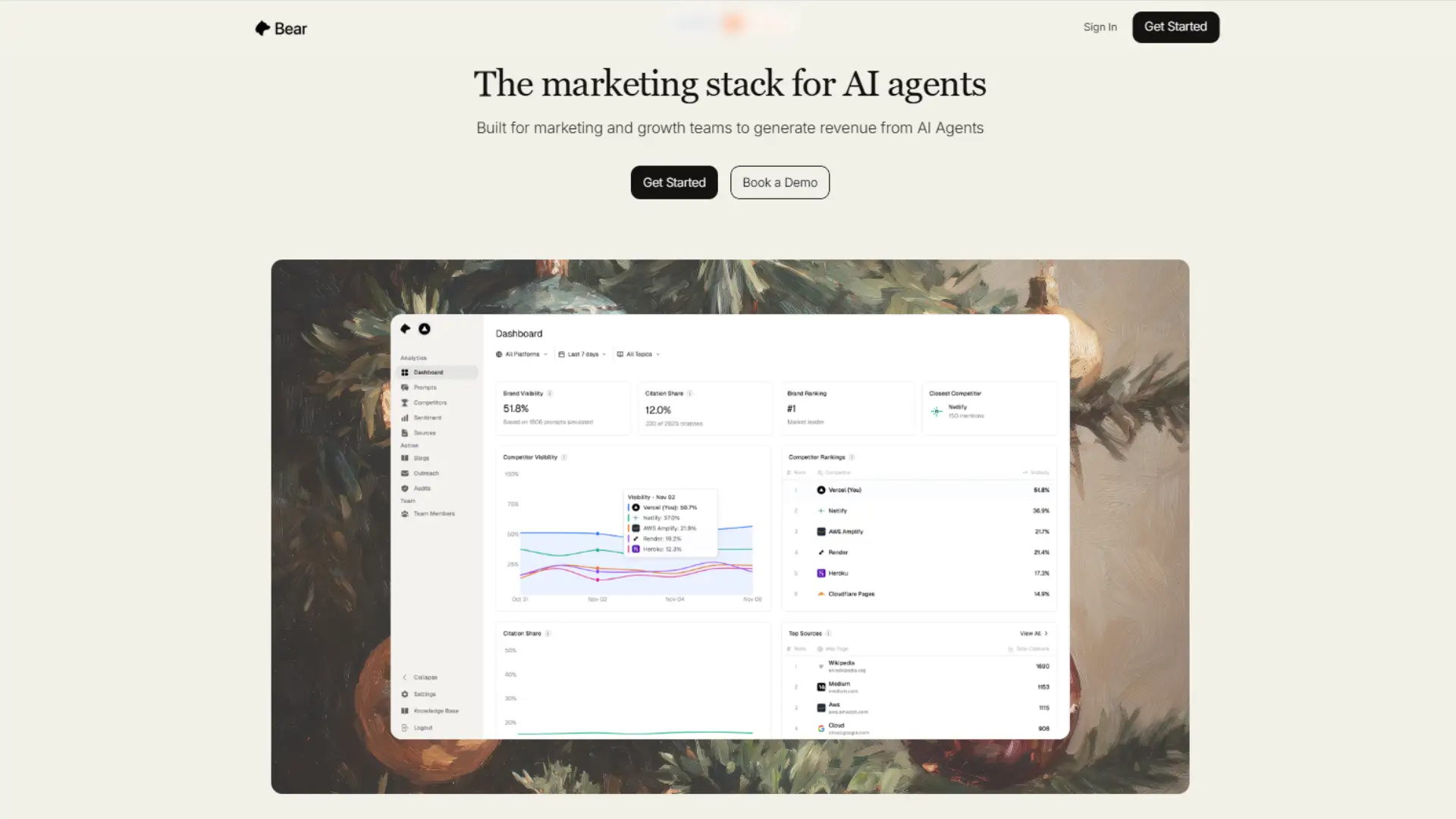
Core purpose:
Bear AI focuses on helping brands monitor, benchmark, and grow their visibility across generative engines. Its approach centers on a unified AI Search Score, competitor context, sentiment interpretation, and actionable insights.
What Bear AI Delivers:
- AI Search Score: A proprietary metric that quantifies visibility across engines based on mention frequency, citation frequency, sentiment, cross-model consistency, and engagement signals.
- Broad Model Coverage: Includes ChatGPT, Google AI Mode, Perplexity, Claude, and Gemini on higher tiers.
- Trend Analysis & Alerts: Historical and trend data to identify visibility, momentum, or dips.
- Competitor Benchmarking: Side-by-side comparison of AI citations and relative presence.
- Growth Workflows: Integrated content generation, outreach, and lead tracking.
Who Benefits Most:
- Marketing and brand teams that prioritize narrative control and visibility growth over technical crawlability details.
- PR teams tracking sentiment and competitive advantage.
- Growth-oriented operations that need real-time actionable insights.
Direct Comparison: AI Visibility, Content Strategy, and Technical SEO
To make practical decisions, we assess tools across several key domains.
AI Visibility & Citation Tracking
| Feature Category | GetCito | Bear AI |
|---|---|---|
Multi-Engine Coverage | Yes (ChatGPT, Google AI Overview, Perplexity, Claude, Gemini) | Yes (includes GPT-4o, Google AI Mode, Perplexity, Claude, Gemini) on advanced plans. |
Citation Identification | Prompt- and domain-level analytics | AI Search Score signals and model-specific citations. |
Historical Trend | Available via dashboard analytics | Trend analysis with alerts and benchmarks |
Real-Time Data | Periodic monitoring with UI alerts | Near real-time visibility reporting |
Insights:
GetCito is structured for deep, persistent monitoring with flexible engines supported.
Bear AI delivers AI Search Score, a consolidated metric that weighs multiple visibility vectors to assess brand presence more holistically and in real time.
Technical SEO Optimization vs. Content Strategy (Detailed Comparison)
This table clarifies how GetCito and Bear AI fundamentally differ in how they define and execute “optimization” in a GEO context.
Table: Technical GEO Optimization vs. Strategic Content Optimization
| Dimension | GetCito | Bear AI |
|---|---|---|
Primary Optimization Focus | AI crawlability, structural readiness, and LLM retrievability | Content impact, visibility outcomes, and competitive positioning |
Core Question the Tool Answers | “Can AI systems accurately parse, retrieve, and cite our content?” | “Where are competitors being cited, and how do we close that gap?” |
Optimization Layer | Infrastructure-level GEO (how content is structured for AI systems) | Strategy-level GEO (how content performs inside AI outputs) |
AI Crawlability Analysis | Explicit focus via AI Crawlability Clinic and LLM-oriented audits | Not a stated feature |
Content Evaluation Method | Prompt-level and domain-level diagnostics to understand retrievability | Topic-level and competitor-level visibility analysis |
Entity & Fact Readiness | Emphasis on machine-readable structure, clarity, and entity recognition | Emphasis on narrative strength and topical authority |
Competitor Analysis Role | Benchmarking is used to understand relative AI visibility | Core driver for content gap identification |
Action Output | Structural and technical adjustments to improve AI citation likelihood | Content priorities, messaging improvements, and outreach direction |
Best Fit Teams | Technical SEO teams, content engineers, and developers | Marketing, PR, growth, and brand strategy teams |
Interpretation:
GetCito operates at the foundational layer of GEO. It assumes that AI visibility is unstable without structural correctness, and therefore prioritizes how AI systems ingest and trust content.
Bear AI operates at the strategic layer. It assumes content already exists and focuses on why competitors win AI citations and how to replicate or outperform that visibility.
This distinction is critical::
👉 One optimizes how AI reads content; the other optimizes what AI prefers to surface.
Latency & Accuracy of Updates (Operational Comparison)
Latency matters in GEO because AI outputs can change rapidly, but not all teams benefit from reacting to every fluctuation. This table highlights how each platform balances speed vs. data reliability.
Table: AI Visibility Update Latency & Accuracy
| Dimension | GetCito | Bear AI |
|---|---|---|
Monitoring Cadence | Periodic, structured monitoring | Near real-time visibility tracking |
Design Priority | Accuracy, consistency, and trend stability | Speed, responsiveness, and tactical insight |
Update Sensitivity | Filters short-term AI output noise | Surfaces immediate visibility changes |
Change Detection Style | Identifies sustained shifts over time | Identifies sudden spikes or drops quickly |
Risk of Overreaction | Lower — favors signal validation | Higher — trades some stability for speed |
Best Use Cases | Long-term GEO strategy, content restructuring, and technical audits | Product launches, PR events, and reputation monitoring |
AI Output Variability Handling | Accounts for natural LLM response variation | Responds quickly to observed output changes |
Ideal Decision Cycle | Weekly to monthly optimization cycles | Daily or campaign-driven decisions |
Interpretation:
GetCito is designed for teams that value confidence in the signal. Its latency model reduces false positives caused by AI response variability.
Bear AI is designed for teams that value speed to insight. Its faster updates allow earlier intervention, especially valuable during launches or reputation-sensitive moments.
Workflow & Customization: How the Tools Integrate in Practice

As GEO matures, tooling decisions increasingly hinge on how well a platform fits into existing workflows, not just what it can measure.GetCito and Bear AI diverge sharply in how much control, flexibility, and operational ownership they offer teams.
Customization & Control: Open-Source vs. Managed SaaS
GetCito: Infrastructure-Level Control and Transparency
GetCito’s defining architectural choice is its open-source, self-hostable model, which fundamentally alters how teams interact with the platform.
Key characteristics:
- Open-Source Core (MIT License)
Teams can inspect, validate, and modify the platform logic. This is particularly relevant in GEO, where trust in measurement methodology is critical. - Self-Host Option (Free Plan)
Organizations can deploy GetCito on their own infrastructure, retaining:- Full data ownership
- Control over update cadence
- Direct management of API usage and costs
- Flexibility
GetCito can be embedded into existing analytics, SEO tooling, or internal dashboards, making it adaptable for custom workflows rather than enforcing a rigid interface.
This design appeals to teams that treat AI visibility as part of their technical stack, not a standalone marketing tool.
Bear AI: Enterprise SaaS with Managed Customization
Bear AI adopts a fully managed SaaS approach, prioritizing speed of adoption and operational simplicity.
Key characteristics:
- No Infrastructure Management
Users access a polished dashboard without concern for APIs, hosting, or system maintenance. - Report & Dashboard Customization
Especially at higher tiers, Bear AI allows:- Filtering by brand, product, competitor, or region
- Executive-friendly reporting formats
- Cross-team visibility without technical onboarding
- Compliance & Scalability Orientation
The platform is positioned for agencies and larger organizations that need standardized access across multiple stakeholders.
Table: Customization & Control Comparison
| Dimension | GetCito | Bear AI |
|---|---|---|
Deployment Model | Open-source + SaaS | Fully managed SaaS |
Self-Hosting | ✔️ Yes | ❌ No |
Data Ownership Control | High | Platform-managed |
API Flexibility | Extensive | Limited to platform scope |
Infrastructure Responsibility | User-controlled | Vendor-managed |
Best Fit Teams | Technical SEO, dev-driven orgs | Marketing, PR, agencies |
ROI and Pricing (GetCito)
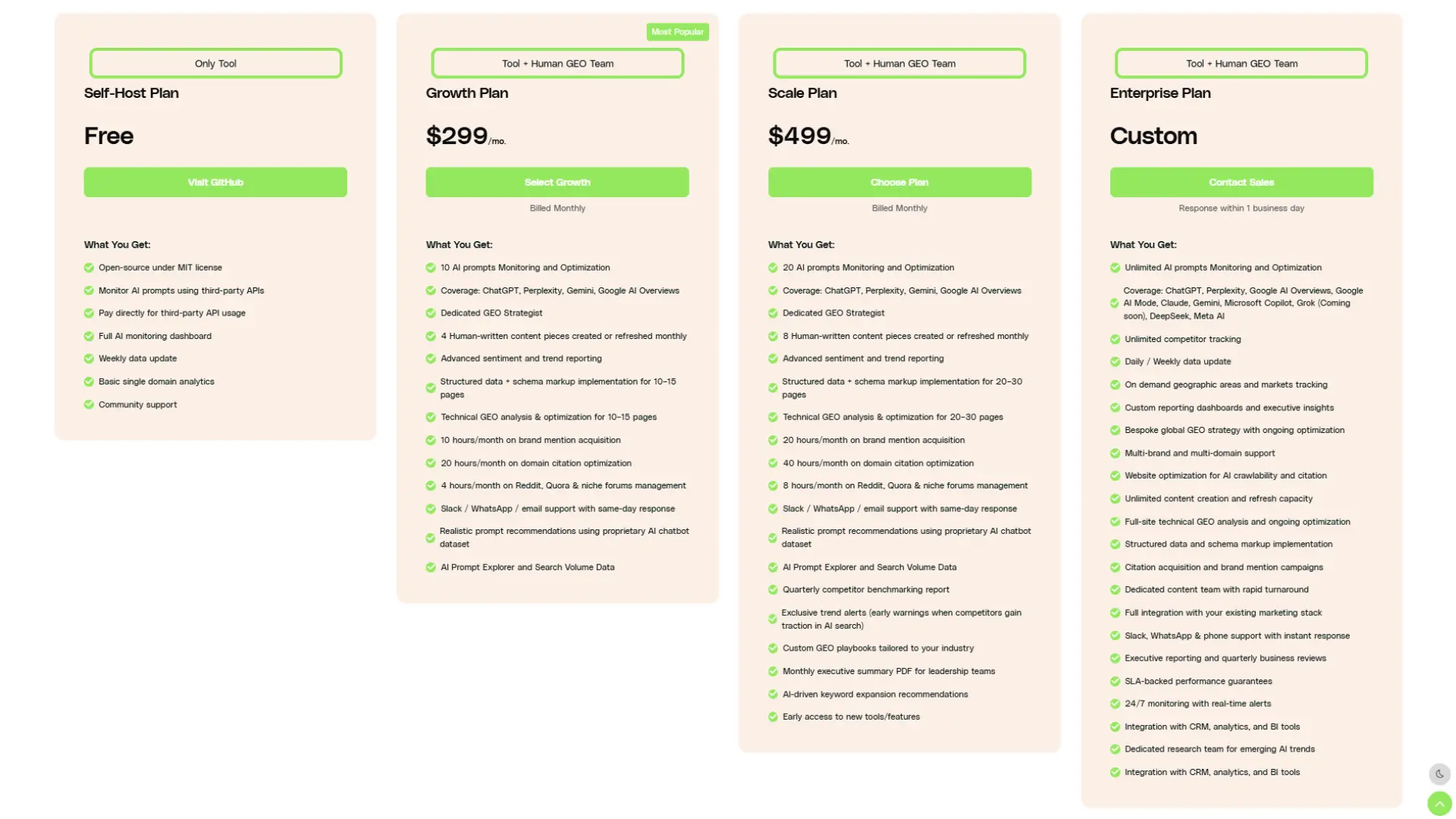
Pricing: Is GetCito Cheaper than Bear AI?
GetCito
Insights:
GetCito follows a tool-first, flexible pricing modelthat lowers the barrier to entry for teams exploring Generative Engine Optimization (GEO), making it more accessible than platforms that rely solely on fixed, high-commitment subscriptions.
At its core, GetCito offers a free self-hosted version of the tool, allowing founders, developers, and SEO teams to start monitoring AI citations and brand mentions without paying for a software license. Teams only incur costs if they choose to scale usage (such as API consumption or expanded monitoring), making it a practical option for early experimentation and validation.
As needs mature, GetCito provides paid plans and agency services rather than rigid SaaS tiers. These paid offerings are designed around outcomes, not just access to a dashboard, and may include:
- Expanded AI prompt and brand monitoring
- Competitor citation tracking and Optimization
- Faster data refresh cycles
- Dedicated GEO strategists
- Technical GEO analysis & optimization
- Dedicated content writer and Graphic designer
- Ongoing optimization guidance and strategic calls
- Reddit, Quora & niche forums management
This means GetCito’s cost is not limited to software usage alone, but often reflects embedded expertise and hands-on partnership, especially valuable for teams without in-house GEO specialists.
Compared to platforms like Bear AI, which typically require upfront subscription commitments, GetCito allows teams to start free, prove value, and then selectively invest based on actual AI visibility needs. This pricing philosophy makes it particularly suitable for:
- Founders and bootstrapped startups
- Small to mid-sized SEO teams
- Agencies testing or offering GEO services
- Teams transitioning into AI-first discovery without enterprise budgets
In short: GetCito is often cheaper not because it underprices value, but because it lets teams pay only when and where it makes sense, aligning cost with GEO maturity rather than forcing early commitment.
Bear AI
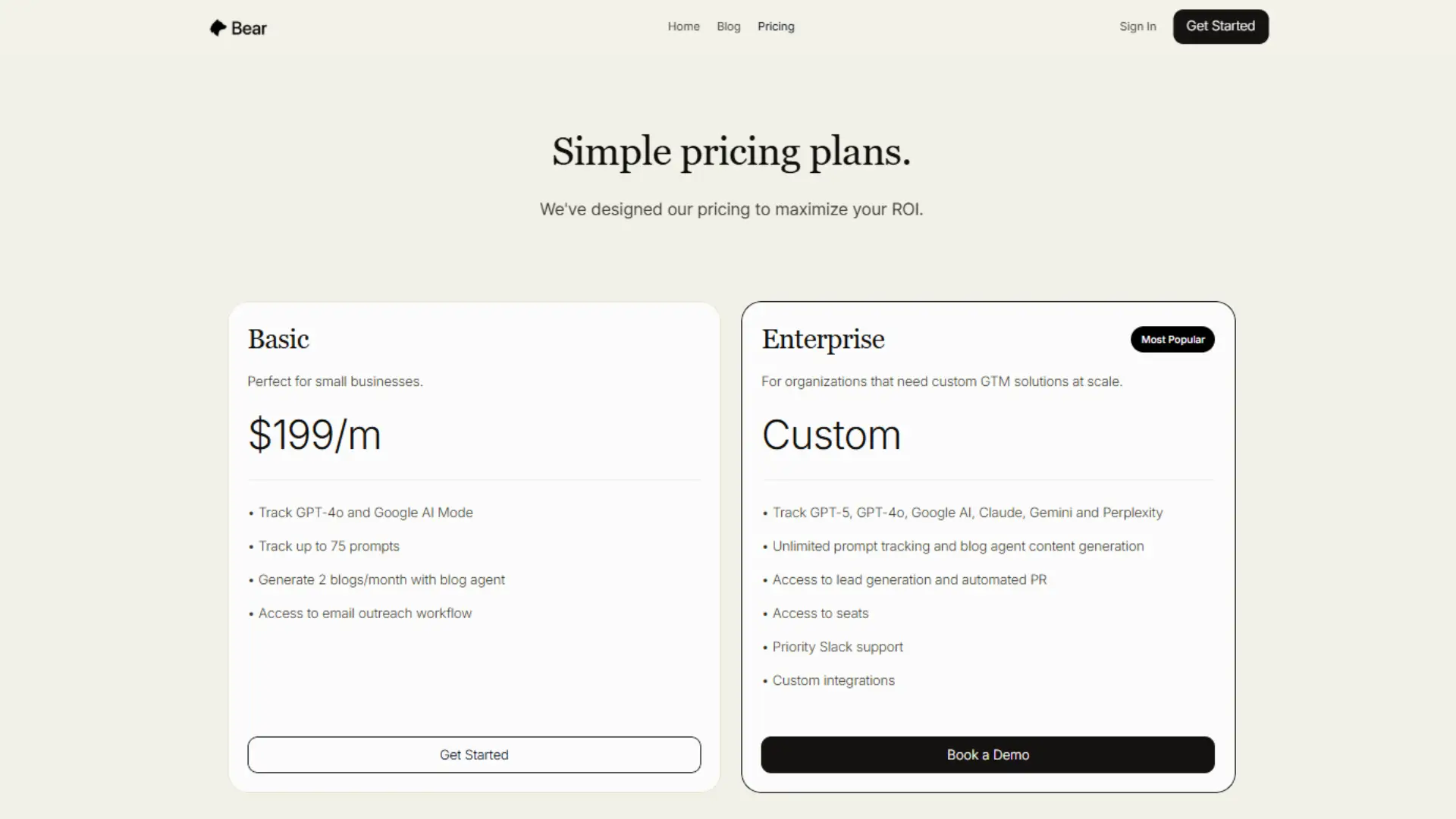
Insights
- Bear AI’s base price (~$199/month) targets more serious, growth-driven marketing teams looking for actionable insights and workflows.
- Although pricing here is custom, the inclusion of advanced engine coverage (e.g., Claude, Gemini, Perplexity), increased prompt simulations, multiple team seats, and automated PR/lead gen workflows suggests that higher costs are tied to growth-oriented capabilities rather than simple monitoring scale.
- By combining multi-engine tracking with creativity tools (blog writing) and outreach workflows at the Basic price point, Bear AI aligns costs with end-to-end content performance and PR activation rather than purely visibility data.
ROI Analysis: Calculating the Cost of Visibility

In GEO, Return on Investment is calculated by the efficiency of citation acquisition, not just software capabilities.
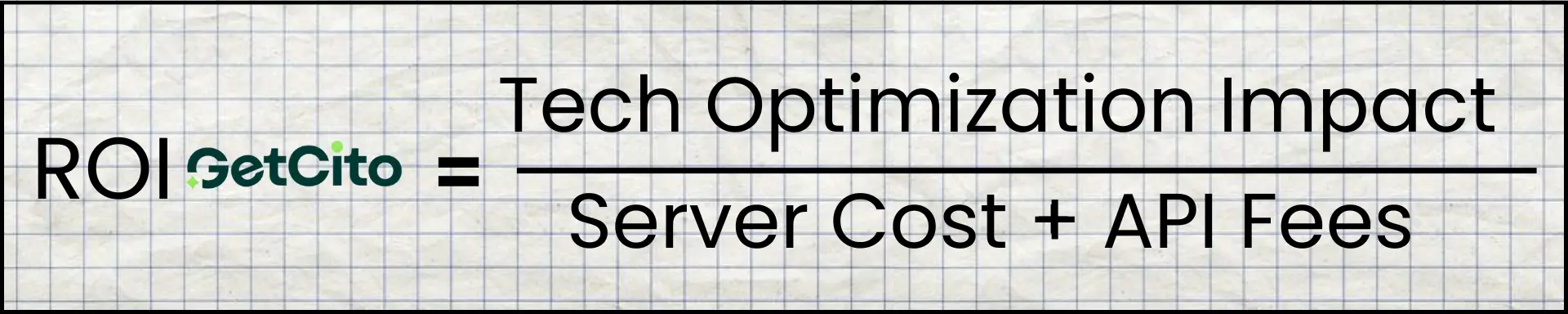
The GetCito ROI Equation:
GetCito is optimized for Marginal Cost Efficiency. Because it offers a self-hosted architecture, your cost scales with API usage, not seats.
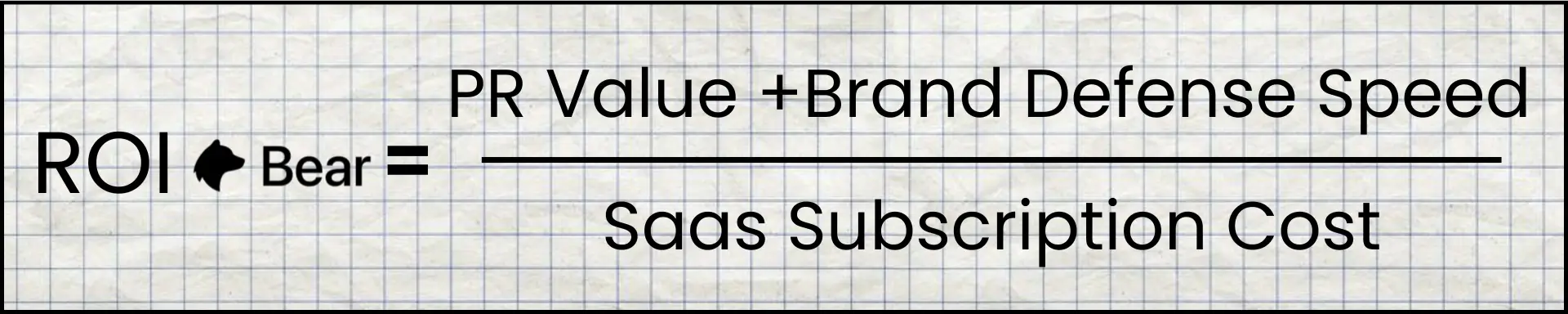
Bear AI is optimized for Time-to-Insight. The premium covers the processing layer that turns raw data into a PR strategy.
Key Takeaway: Use GetCito if you have engineering resources and want to lower long-term costs. Use Bear AI if you need immediate, boardroom-ready data and lack technical bandwidth.
ROI Interpretation: Choosing the Right Efficiency Model
| ROI Dimension | GetCito | Bear AI |
|---|---|---|
Cost per monitored prompt | Lower | Higher |
Insight depth | Technical, structural | Strategic, contextual |
Speed to action | Moderate | Fast |
Best ROI scenario | GEO testing, scaling, infrastructure | Content, PR, growth execution |
Bottom Line
GetCito delivers superior ROI when the goal is to engineer durable AI visibility and optimize at scale with minimal marginal cost.
Bear AI justifies its higher pricing when each insight directly informs content, PR, or growth initiatives, making speed and clarity more valuable than volume.
AI Platform Coverage & Cross-Engine Consistency
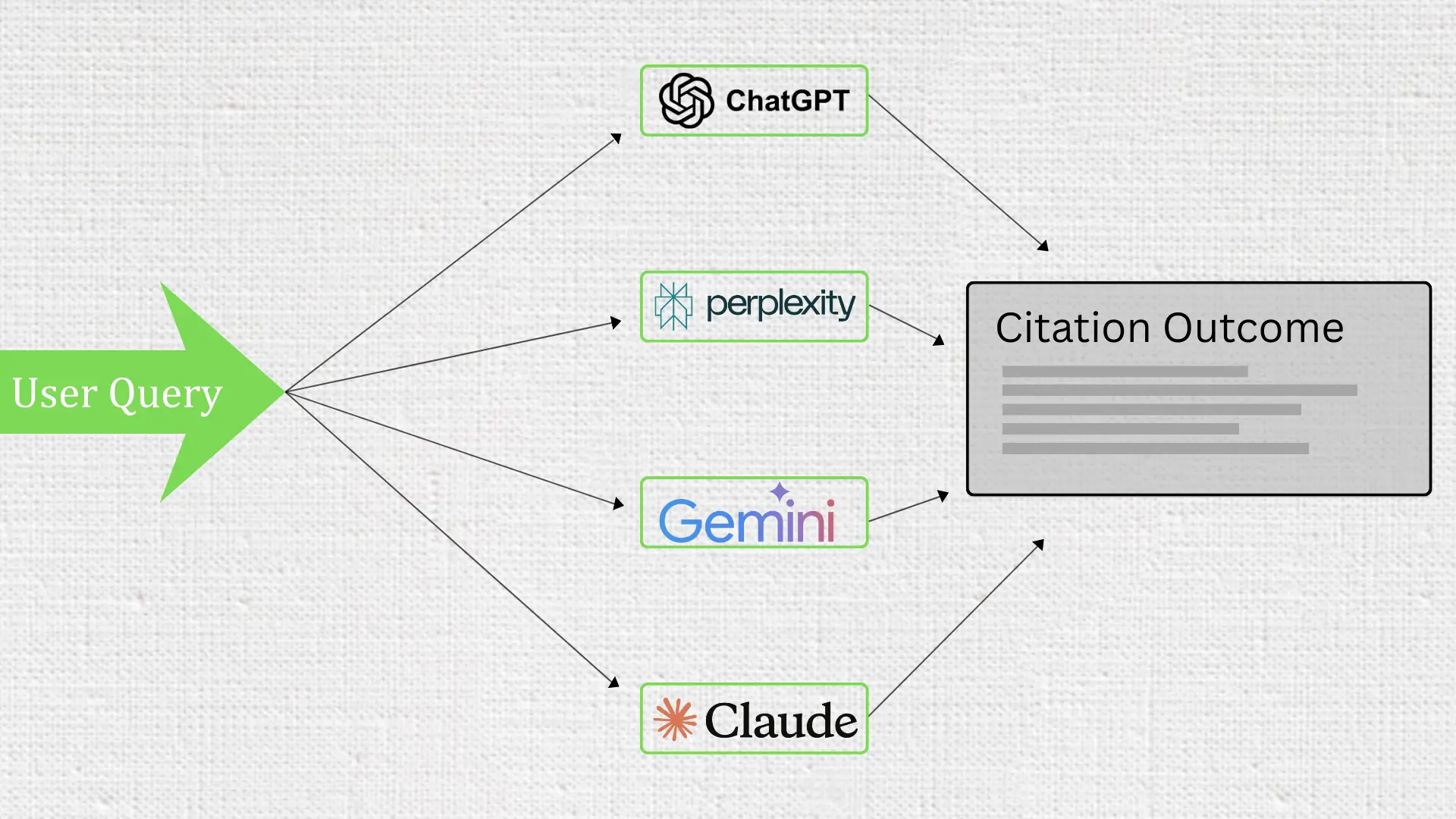
As generative search fragments across platforms, visibility consistency across AI engines has become a more immediate challenge than language coverage alone. Brands are now evaluated by how reliably they appear across ChatGPT, Google AI Overviews, Perplexity, Gemini, and Claude, each with different retrieval logic and citation behavior.
GetCito: Built for Cross-Engine Comparability
core architecture is designed around multi-LLM benchmarking, allowing teams to compare how the same prompt performs across different AI systems.
Strengths include:
- Explicit support for multiple AI engines, including ChatGPT, Google AI Overviews, Gemini, Claude, and Perplexity.
- Side-by-side visibility analysis, helping teams identify where content is consistently cited and where it breaks down.
- Engine-specific crawlability diagnostics, enabling technical improvements that improve performance across multiple AI platforms, not just one.
This cross-engine focus allows teams to optimize for consistency, which is increasingly critical as users switch between AI assistants.
Bear AI: Unified Visibility Scoring Across Engines
Bear AI approaches cross-engine visibility through aggregation rather than deep engine-level diagnostics.
Key characteristics:
- AI Search Score consolidates visibility signals across supported AI engines into a
single performance indicator . - Competitor comparison is framed around overall AI presence, rather than engine-specific optimization.
- Best suited for teams that want a high-level, consolidated view of AI visibility without managing platform-specific complexity.
| Dimension | GetCito | Bear AI |
|---|---|---|
AI engine coverage | Explicit, multi-engine benchmarking | Aggregated engine coverage |
Depth of analysis | Engine-specific diagnostics | Unified visibility score |
Optimization approach | Technical + structural | Strategic + reporting |
Best fit | SEO and technical teams | Marketing and PR teams |
Bottom Line
AI visibility is no longer about ranking in a single system.
GetCito’s strength lies in understanding and optimizing how visibility differs across AI engines, while Bear AI focuses on measuring overall presence across platforms.
This distinction becomes more important as generative search continues to diversify.
Final Decision Framework: Which Tool Fits Your Team?
Choosing between GetCito and Bear AI is less about feature checklists and more about how your team works, who owns AI visibility internally, and what “success” looks like in GEO. Both platforms solve real problems in the generative search ecosystem, but they solve different layers of the problem.
The following framework maps each tool to real-world team structures and operating models.
For Technical SEO Teams & Developers → GetCito Is the Better Fit
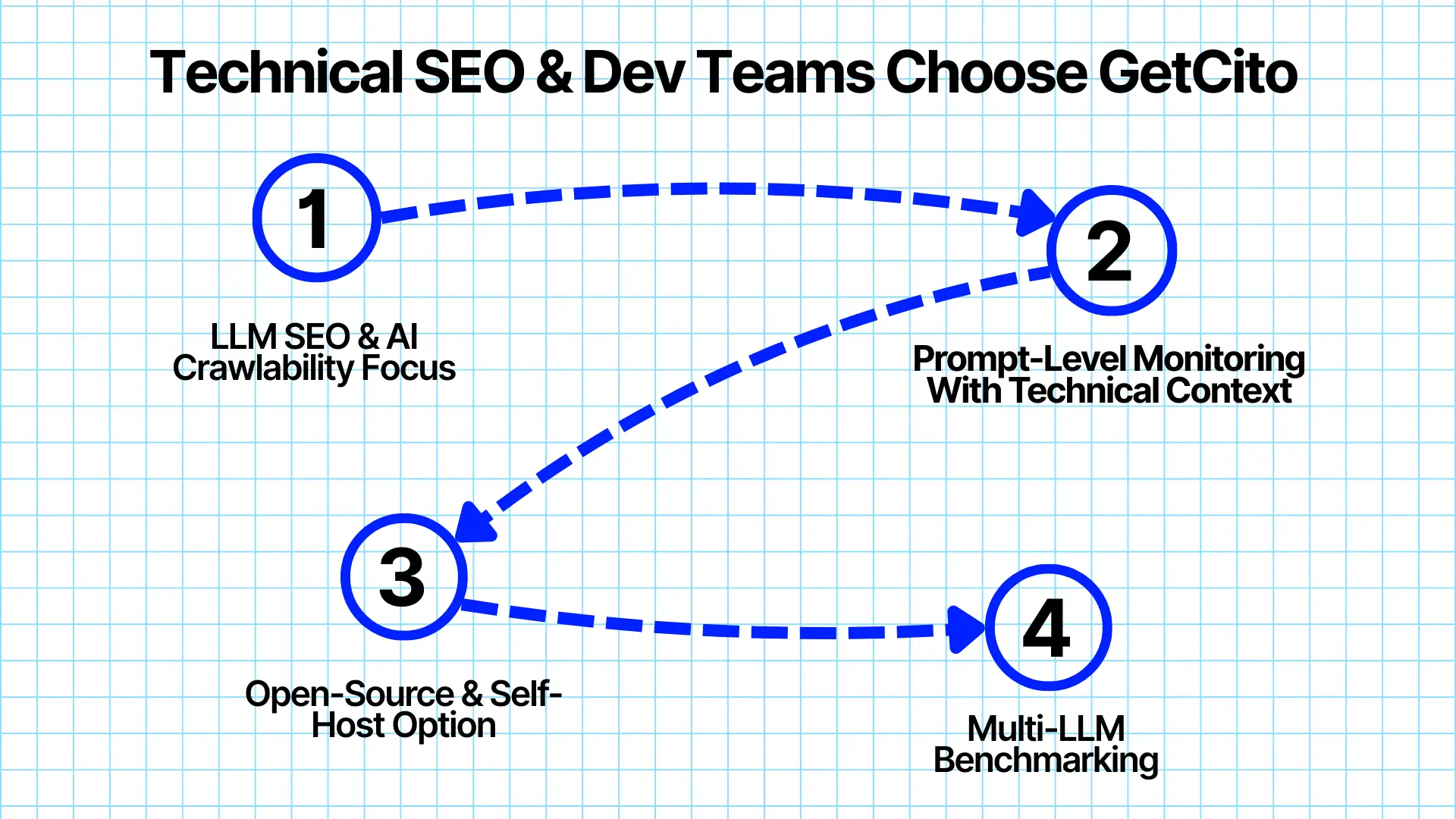
GetCito is fundamentally engineered for teams that treat AI visibility as a technical optimization problem, not just a monitoring exercise.
Reasons this alignment works:
- LLM SEO & AI Crawlability Focus
GetCito’s AI Crawlability Clinic and LLM SEO framework evaluate whether content is machine-readable, indexable, and structurally aligned with how AI systems ingest and cite sources. - Prompt-Level Monitoring With Technical Context
Visibility insights are tied to crawlability, content structure, and indexing behavior, data points that technical teams can directly act on. - Open-Source & Self-Host Option
This is a material differentiator. Teams that need transparency, infrastructure control, or custom integrations can deploy GetCito without vendor lock-in, paying only for their own API usage. - Multi-LLM Benchmarking
Technical teams benefit from seeing how the same content performs across ChatGPT, Google AI Overviews, Perplexity, Gemini, and Claude; engine-level variance matters for optimization.
Best-fit scenario:
SEO engineers, in-house SEO teams, developer-led growth teams, or content platforms building long-term
For Marketing, PR & Brand Teams → Bear AI Is the Better Fit
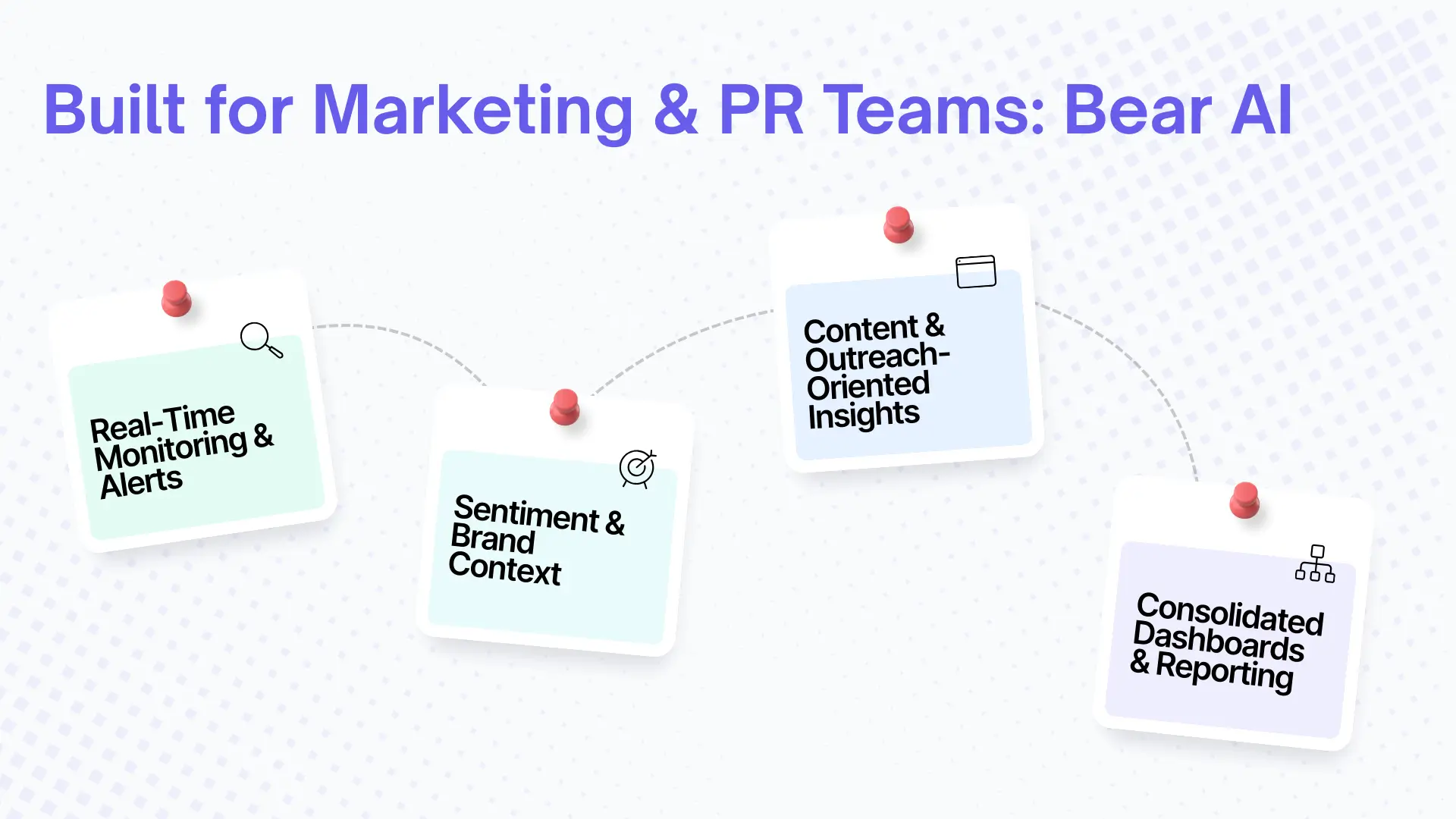
Bear AI is designed around visibility intelligence and action velocity, not deep technical diagnostics. This makes it a natural fit for teams focused on messaging, reputation, and competitive positioning.
Strengths for these teams include:
- Real-Time Monitoring & Alerts
Bear AI prioritizes speed, surfacing changes in AI visibility, sentiment, or competitor mentions quickly. - Sentiment & Brand Context
Mentions are not just tracked, but contextualized, useful for PR, communications, and brand safety teams. - Content & Outreach-Oriented Insights
Visibility gaps are framed as opportunities for blogs, thought leadership, or media outreach, rather than structural fixes. - Consolidated Dashboards & Reporting
Non-technical stakeholders can interpret performance without understanding LLM mechanics or crawlability frameworks.
Best-fit scenario:
Marketing teams, PR departments, agencies, or brand managers where AI visibility directly affects perception, demand generation, or media presence.
For Budget-Conscious Founders & Early-Stage Teams
This is where the cost structure and flexibility matter more than feature breadth.
Why GetCito Often Wins Here
- Low entry price (~$19/month) lowers experimentation risk.
- Free self-host plan enables founders to explore GEO without committing to a SaaS subscription.
- ROI compounds over time as technical improvements improve multiple AI answers, not just one campaign.
When Bear AI Still Makes Sense
- If AI visibility is directly tied to growth, fundraising narratives, or public credibility, the higher upfront cost can be justified.
- Teams that need immediate insights and action guidance, not technical optimization, may see faster returns.
For Agencies Managing Multiple Clients
Agency needs are nuanced, and the choice depends on service focus.
SEO / Technical Agencies → GetCito
- Deeper diagnostics
- White-label or self-host flexibility
- Ability to tie AI visibility improvements to technical deliverables
PR / Content / Growth Agencies → Bear AI.
- Faster reporting
- Competitive visibility insights
- Easier client communication and storytelling
Some agencies may even use both tools, depending on whether the engagement is optimization-led or monitoring-led.
| Team Type | Recommended Tool | Why |
|---|---|---|
Technical SEO / Dev | GetCito | Crawlability, LLM SEO, and infrastructure control |
Marketing / PR | Bear AI | Real-time visibility, sentiment, actionability |
Founder / Startup | GetCito | Low-cost, self-host option, scalable ROI |
Content-led Growth | Bear AI | Insight-to-action speed |
Hybrid / Agency | Depends | Optimization vs monitoring focus |
Conclusion

This comparison does not reveal a single “winner”; it reveals astrategic split:
- GetCito is an AI visibility optimization platform, best when teams want to engineera durable presence inside generative systems.
- Bear AI is an AI visibility intelligence platform, best when teams want to monitor, interpret, and act quickly on AI-driven brand signals.
The right choice depends on who owns AI visibility in your organization and whether your priority is building long-term GEO infrastructure or executing immediate visibility actions.