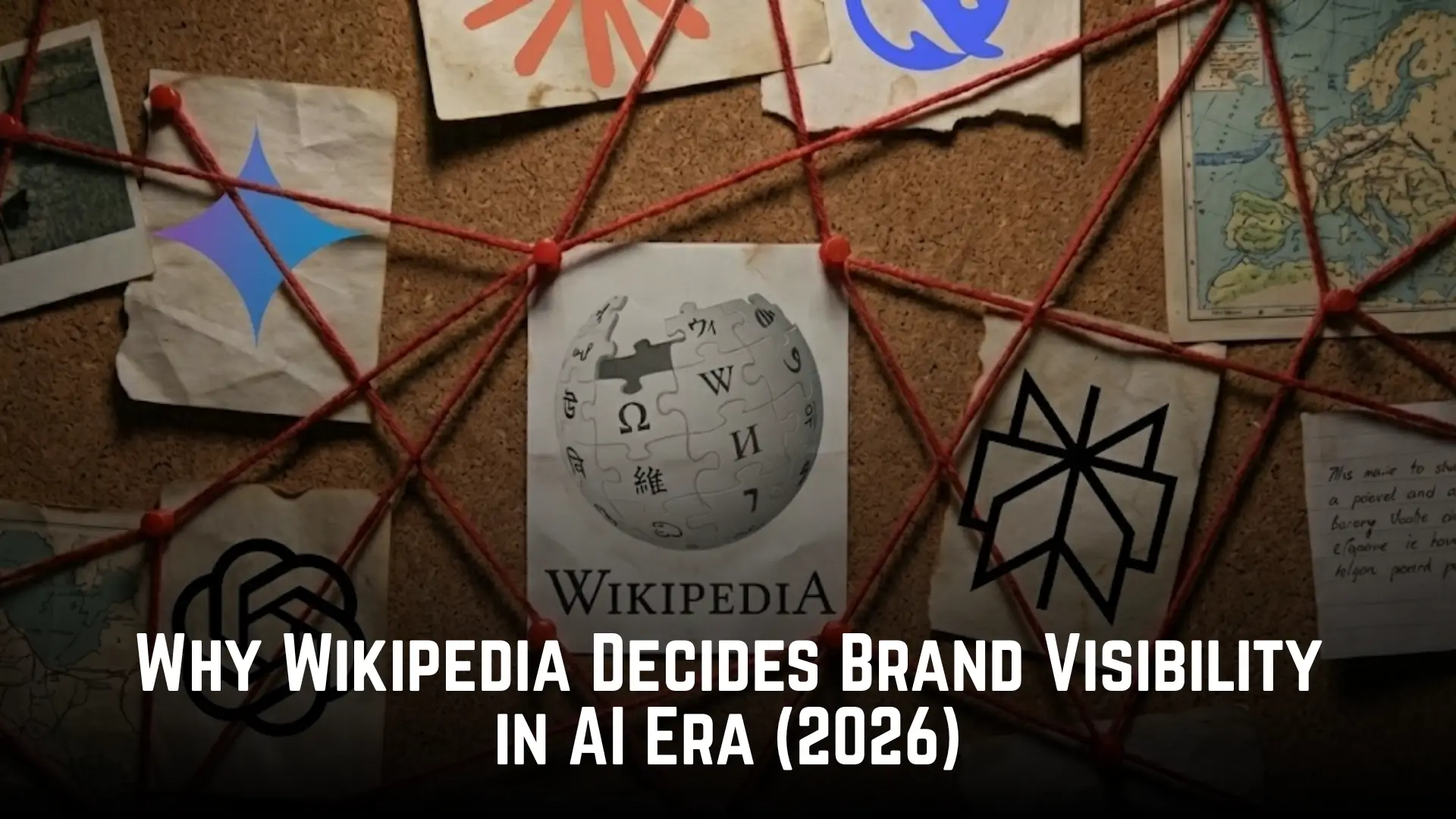


The Problem: AI systems (ChatGPT, Perplexity, Google) hallucinate your brand facts because they lack a verified anchor point. Without Wikipedia/Wikidata, AI triangulates from conflicting web sources, causing unstable Knowledge Panels and incorrect citations.
The Solution (Priority Order):
- Create a Wikidata QID first (do this week, even if you don't qualify for Wikipedia) → gives AI a machine-readable identifier to reduce confusion
- Standardize all facts across your website, LinkedIn, Crunchbase, Google Business → AI downgrades confidence when it finds conflicts
- Earn 2-3 independent editorial features in reputable outlets (national papers, trade magazines) → NOT press releases or sponsored content
- Draft a neutral Wikipedia article and submit via Articles for Creation → wait 2-8 weeks for community review
Wikipedia Requirements: "Significant coverage in reliable, independent, secondary sources." Press releases, Forbes contributor posts, and your company blog don't count. You need real journalism with editorial oversight.
Why This Works: Wikipedia provides the human-verified foundation that AI systems prioritize for fact-checking. This is transformed by Wikidata into machine-readable QIDs that spread through knowledge graphs, stabilizing the identity of your brand on all AI platforms.
Timeline: 3-6 months to earn qualifying coverage if you don't have it yet. Wikidata and data standardization deliver immediate improvements.
What I've Observed about Wikipedia with my experience
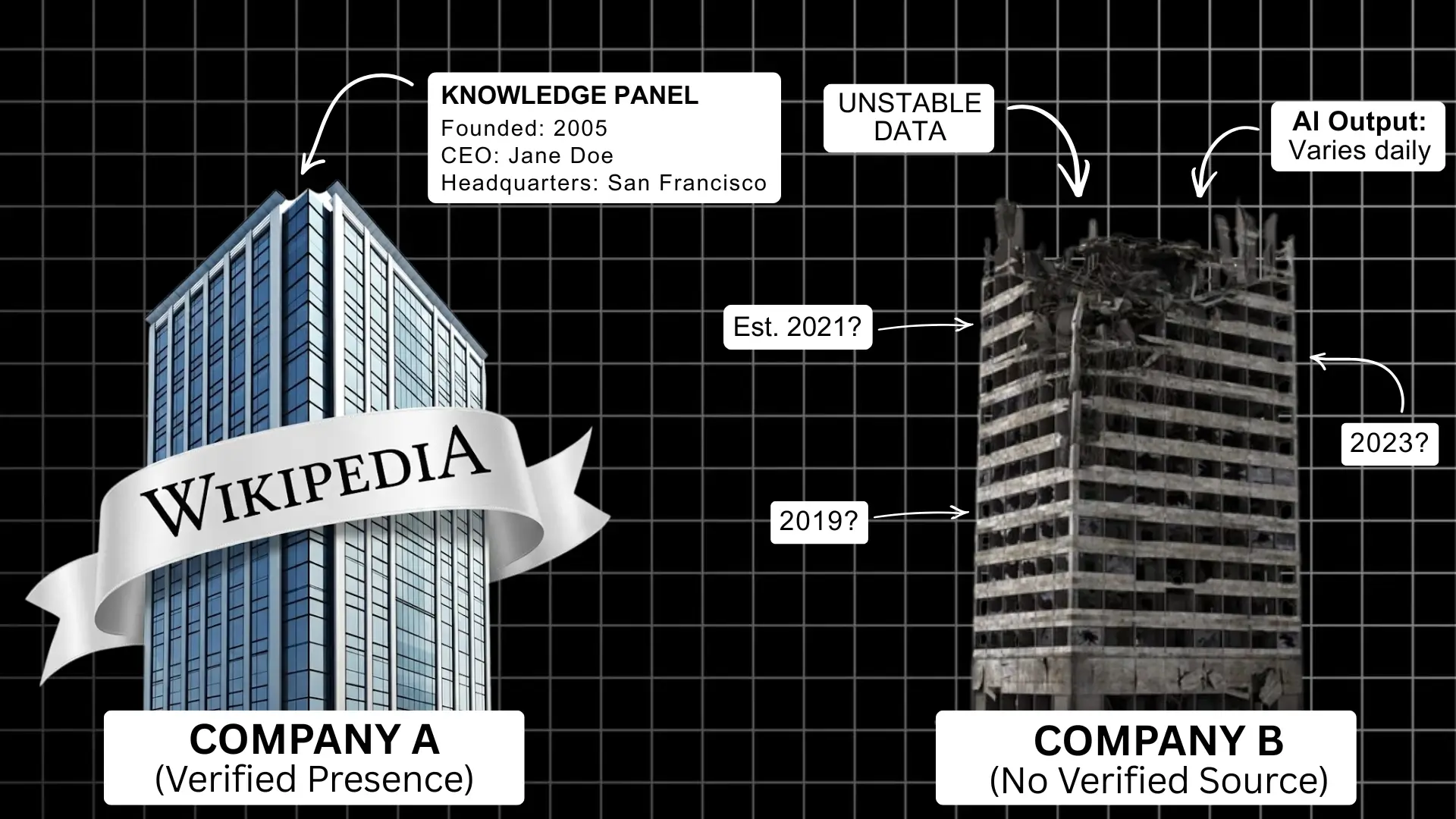
Through the years, I’ve seen how companies interact with Wikipedia in various capacities. The trend that has been established here is quite simple: companies with a presence on Wikipedia are more stable regarding their AI recognition. Their Knowledge Panels remain stable, their fundamental information, founding year, headquarters, and key personalities display properly everywhere.
Those brands struggling on Wikipedia? They almost always make the exact same mistake in a hurry to create a Wikipedia page without any editorial press, they pay for a press release or sponsored content, then see the page deleted and are left wondering why it didn’t work.
The key area that highlights the implication of Wikipedia is in the recognition of entities. Organizations that have a presence on Wikipedia do not have to struggle with the same concerns of confusion among AIs. The information that spreads is clean and straight to the point. The ones that do not have a presence on Wikipedia are struggling with inconsistent information and AIs that cannot assert facts about them.
This has become even more important today than ever before. Wikipedia acts as a verification process for AI technology. It’s here that AI goes to verify if a piece of information about a brand proves to be true. This is the reality I’ve watched again and again, and this is why I’ve structured this guide to achieve this end.
Why Wikipedia Anchors AI Trust (2026 Update)
In 2026, Wikipedia is no longer a free encyclopedia, but a foundation of trust in search engines, LLMs, and knowledge graphs. While AI citations, search, and SEO by entities continue to transform the Web, one thing is consistent:
AI models require a proven and unbiased human-reviewed basis, and this is exactly what Wikipedia supplies.
Relevance has not diminished; it has actually intensified.
Here’s why:
- Wikipedia confirms the existence of an entity.
- The QID is a machine-readable identity provided by Wikidata.
- The AI uses the two pillars above to achieve hallucination and fact-level stability.
For brands, the question is no longer "Does Wikipedia matter?"
It's: "How does Wikipedia directly influence whether AI even recognizes my brand correctly?”
How Wikipedia Stops AI Hallucinations
Here's what happens inside an LLM when someone asks about your brand:
Query: "Who founded [YourBrand]?"
AI's decision tree:
- Entity retrieval → Finds all entities named "YourBrand."
- Disambiguation → Searches for a Wikidata QID (unique identifier)
- Source ranking → Prioritizes Wikipedia, Wikidata, major news archives
- Confidence scoring → If QID exists with cited founder → confident answer
- Fallback → No QID? → AI hedges: "According to some sources..." or "I don't have verified information."
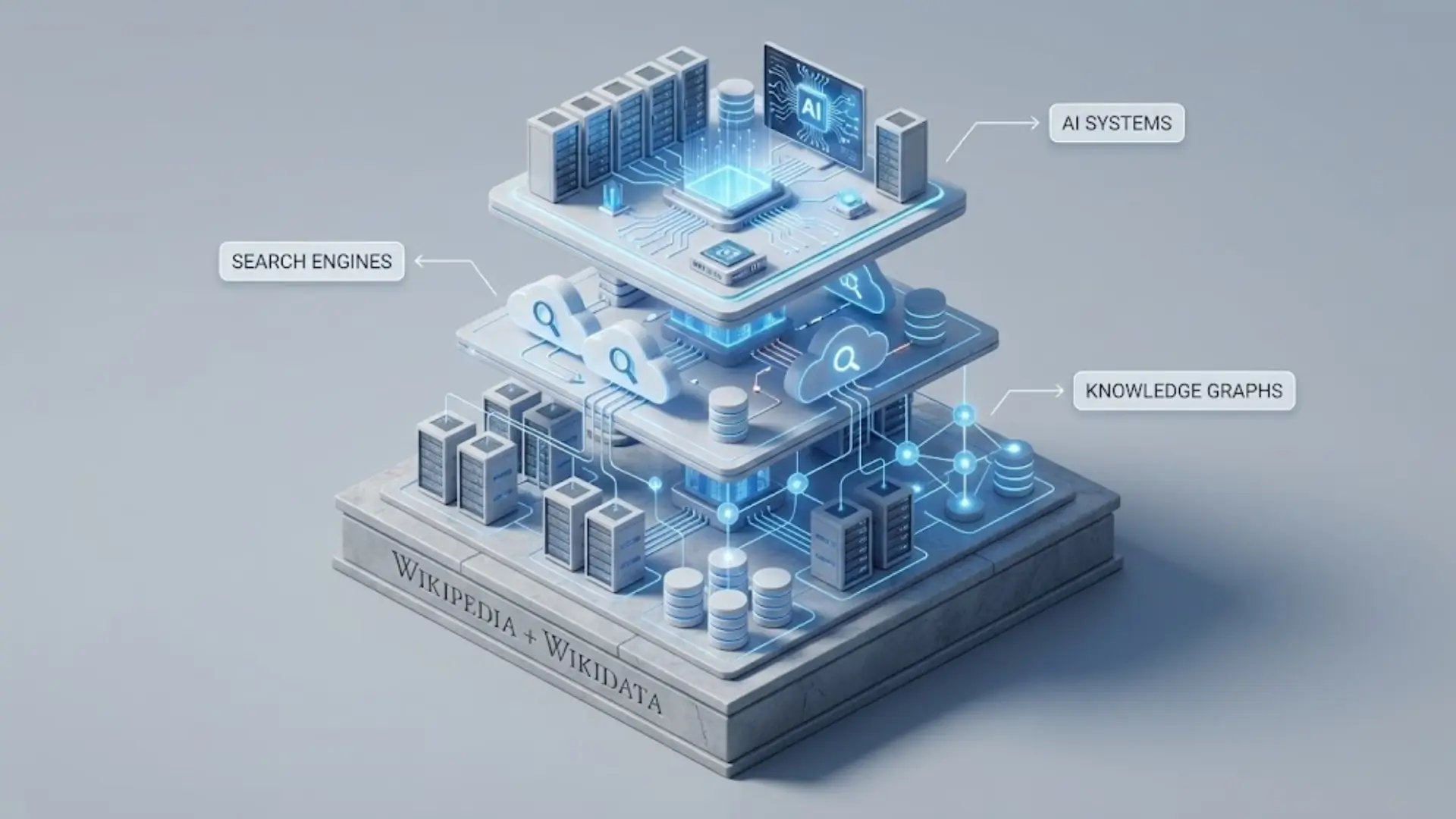
The chain of trust:
Wikipedia (human-verified)
↓
Wikidata (machine-readable QID)
↓
Knowledge graphs (Google, Bing, etc.)
↓
LLM training/retrieval pipelines
↓
Stable, accurate AI outputs
Wikipedia isn't just a source. It's the verification layer AI systems check before asserting a fact as true.
What Happens Without Wikipedia
Without that anchor, AI relies on:
- Schema markup on your website (helpful, but not authoritative)
- Scattered news mentions (often contradictory)
- Social profile bios (user-editable, low trust)
- Web pattern matching (prone to name collision)
Result:
- Unstable Knowledge Panels
- Founder misattribution
- Conflicting founding dates
- Missing from AI citations entirely
I've tracked brands through this. The ones with a Wikipedia presence maintain consistent AI recognition. The ones without? They're fighting data drift across every platform.
How AI Uses Wikipedia/Wikidata Internally (Step-by-Step)
Let me show you what actually happens when someone asks AI about your brand:
User query: "Who is the founder of Acme Widgets?"
How AI answers:
- Entity Retrieval: Finds all entities named "Acme Widgets."
- Disambiguation: Searches for a Wikidata QID
- Source Ranking: Prioritizes trusted sources (Wikipedia, Wikidata, major news)
- Assertion: If a QID contains a cited founder → AI responds confidently
- Fallback: If no QID exists → AI hedges, guesses, or outputs "information unavailable”.
Chain of truth:
Wikipedia → Wikidata → Knowledge Graph → LLM output
This is exactly why Wikipedia materially strengthens brand accuracy.
The Strategic Shortcut (Wikidata First)
"Yo don't need a Wikipedia page to create your machine identity." said Kagan J. and Major Z. in 2024
Why This Matters More Than Brands Realize
“The key point here that most teams tend to overlook is that you don’t have to have a Wikipedia page to create your machine identity," says Katie Heald-Watan
Wikidata is more lenient regarding this policy. You can create a semantic entity profile for yourself currently if you are not eligible for a Wikipedia account for the next 6 months, thus instantly helping decrease AI confusion.
What a Wikidata QID Actually Does
A QID (Wikidata's unique identifier) becomes your brand's persistent identity across:
- AI assistants (ChatGPT, Claude, Gemini, Perplexity)
- Search engines (Google, Bing)
- Multilingual datasets
- Academic knowledge graphs
- Enterprise data systems
Example: Microsoft (Q2283) has the same QID whether you're searching in English, Japanese, or Arabic. AI systems use this to disambiguate to know that "Microsoft" the tech company is different from "Microsoft" the font.
Without a QID, AI performs probabilistic name matching. With a QID, AI has certainty.
How to Create Your Wikidata Item (Step-by-Step)
Phase 1: Prepare your data (30 minutes)
Standardize these facts first. AI needs consistency:
- Legal name vs. trade name
- Founding date (exact: YYYY-MM-DD if known)
- Founders (exact spelling, no nicknames)
- Headquarters (city, country)
- Official website URL
- Industry/sector classification
Phase 2: Create the item (20 minutes)
- Go to Wikidata.org and create an account
- Click "Create a new item."
- Add core properties:
- Label: Your brand
- Description: One-line descriptor (e.g., "American software company")
- Aliases: Alternative names, abbreviations
- Instance of: "business," "company," "organization."
- Inception: Founding date
- Headquarters location: City/country
- Official website: URL
- Industry: Sector/category
- Founder: Link to the founder's Wikidata item (or create one)
- Critical step: Add references for each claim
- Link to your official website
- Link to independent press coverage
- Link to company registry (if public)
Phase 3: Link identifiers (10 minutes)
Add external IDs if you have them:
- ISNI (International Standard Name Identifier)
- LEI (Legal Entity Identifier)
- Crunchbase ID
- LinkedIn company ID
- Stock ticker (if public)
These help AI cross-reference your entity across databases.
Immediate Benefits (Before Wikipedia)
Once your QID exists:
- AI systems can link mentions of your brand to one canonical entity
- Knowledge graphs begin consolidating your data
- Search engines have a structured reference point
- Multilingual accuracy improves (same QID across languages)
Reality check: This won't give you a full Knowledge Panel. But it *will* reduce the frequency of founder misattribution and date conflicts.
The Non-Negotiable: Wikipedia Notability Criteria
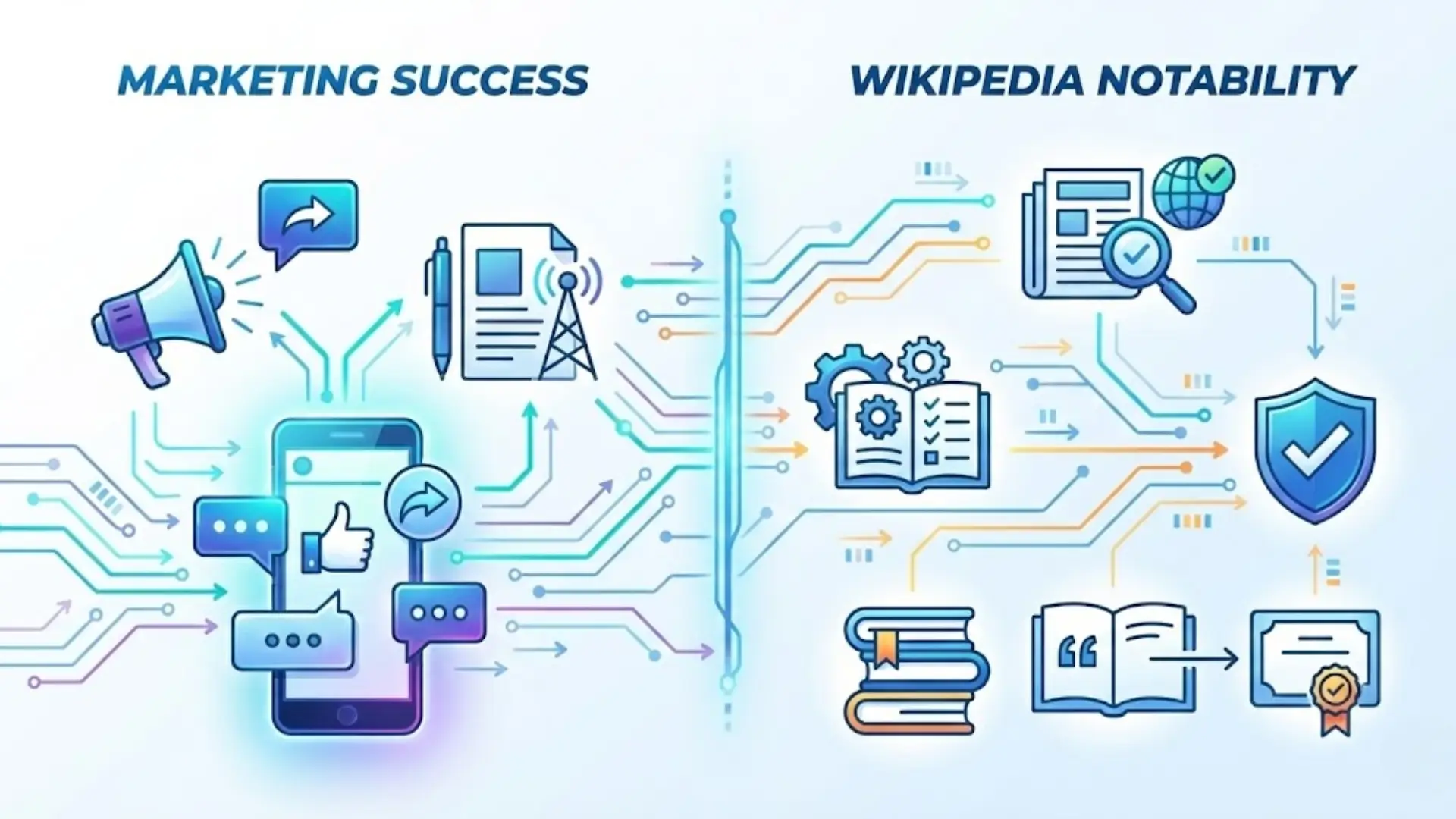
The greatest misunderstanding among brands is that to become successful in marketing is to be noticed in anencyclopedic way. To get listed in Wikipedia, certain criteria must be fulfilled, which is called the General Notability Guideline (GNG)
The Golden Rule: "Significant coverage in reliable, independent secondary sources."
Use this comparison table to audit your current media footprint:
| Source Type | Status | Why? |
|---|---|---|
National/Int'l Newspapers | ✅ Accepted | Independent editorial oversight. |
Peer-Reviewed Journals | ✅ Accepted | High scrutiny and factual rigor. |
Industry Trade Magazines | ✅ Accepted | Expert validation (must be editorial, not ad). |
Press Releases (PR) | ❌ Rejected | Not independent; written by the brand. |
Sponsored Content / Forbes Council | ❌ Rejected | "Pay-to-play" content is not objective. |
Brand Blogs / Medium / Substack | ❌ Rejected | Self-published primary sources. |
Interviews / Podcasts | ⚠️ Weak | Often considered primary sources, not secondary analysis. |
Source Quality Matrix (Use This to Audit)
ACCEPTED (These qualify)
- National newspapers (NYT, WSJ, FT, etc.)
- Regional papers with editorial standards (SF Chronicle, Boston Globe)
- Peer-reviewed academic journals
- Industry trade publications with editorial review (TechCrunch editorial pieces, not sponsored)
- Investigative reports from recognized outlets
REJECTED (These don't count)
- Press releases (even if syndicated to newswires)
- Sponsored content / native advertising
- Forbes Council, Entrepreneur.com contributor posts
- Your company blog, Medium, Substack
- Social media posts
- Directory listings (Crunchbase, AngelList)
- Podcast interviews (usually primary sources)
BORDERLINE (Case-by-case)
- Industry awards (depends on prestige and editorial coverage)
- Conference speaking slots (not notable alone)
- Local news (depends on depth and independence)
The Minimum Evidence Threshold
The Minimum Evidence Threshold
- 2+ independent feature articles in reputable outlets
- OR 1 major investigative piece + supporting coverage
- OR Peer-reviewed academic citation + media coverage
Borderline case:
- 3+ in-depth trade publication articles (must be editorial, not sponsored)
- Multiple regional news features
Weak case (don't attempt yet):
- Only press releases and brief mentions
- Sponsored content only
- Self-published sources
Why "Independent" Is Make-or-Break
Wikipedia editors can smell promotional content instantly. Here's what triggers deletion:
Promotional red flags:
- You wrote it yourself
- You paid for the article (advertorial)
- The source quotes only your executives
- The "journalist" is actually your PR firm
- The coverage is based entirely on your press release
True independence looks like:
- Reporter initiated contact or responded to a pitch
- The article includes outside expert commentary
- Coverage discusses industry context beyond your company
- Critical analysis or balanced perspective included
- Publication has editorial standards and fact-checking
Common Mistakes That Get Pages Deleted
Mistake 1: Rushing without evidence: Creating the page before you have sufficient sources. The page gets tagged for deletion within hours.
Mistake 2: Using press releases as sources: "But it's on Yahoo Finance!" That's just syndicated PR. Doesn't count.
Mistake 3: Promotional language: Marketing copy like "leading," "innovative," "revolutionary" gets flagged immediately.
Mistake 4: Paid editing without disclosure: Wikipedia's COI (Conflict of Interest) policy requires disclosure. Violating this can lead to bans.
Mistake 5: Creating thin, unsourced content: A two-paragraph stub with no citations won't survive.
The Qualification Pathway (How to Become Wikipedia-Eligible)
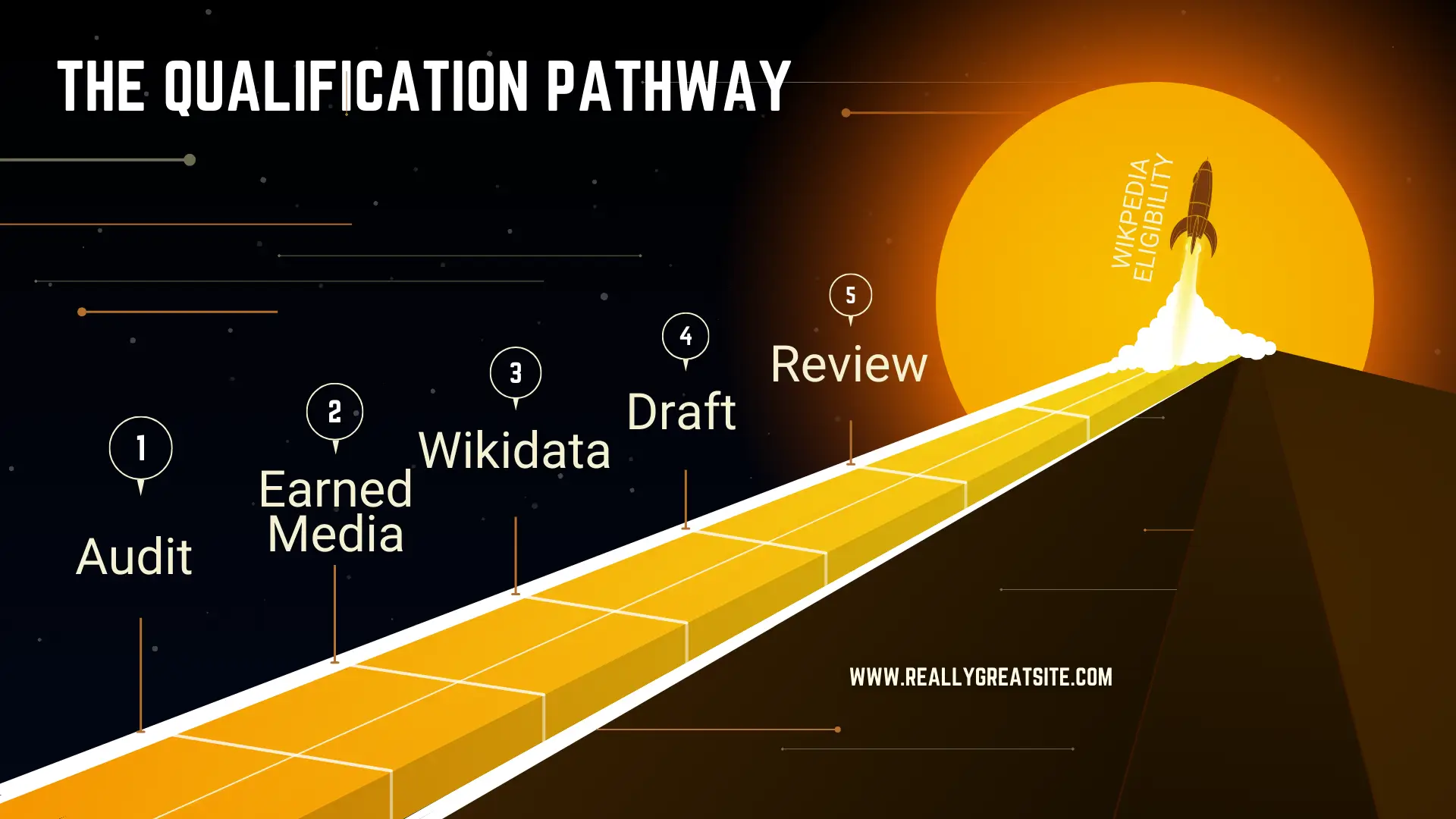
If you don't qualify yet, here's the strategic plan to get there. This is earned, not bought.
Phase 0: Quick audit (1–3 days)
Goal: Know exactly where you stand right now.
Action steps:
- Create a spreadsheet
- List every third-party article that mentions your brand
- For each source, document:
- Publication name
- Article title and URL
- Author name
- Publication date
- Coverage depth (brief mention / moderate/in-depth feature)
- Independence status (✅ independent / ❌ affiliated)
- Source quality (national/regional / trade / rejected)
- Score each source:
- Strong: In-depth feature, investigative piece, academic citation
- Moderate: Substantial mention with analysis
- Weak: Brief mention, listing, press release reproduction
- Calculate your readiness:
- 2+ strong sources: You may be ready to draft
- 1 strong + 3 moderate: Borderline, consider waiting
- Only weak sources: Not ready, proceed to Phase 1
Phase 1: Build credible, independent coverage (1–6 months) Earned media blueprint
Goal: Create the editorial footprint that satisfies GNG.This is the hardest phase because it can't be bought or rushed. You need *earned* media.
What makes a story newsworthy to journalists:
- Significant funding: Series A+ from recognizable VCs
- Measurable impact: "3M users," "40% efficiency improvement," "First company to..."
- Proprietary research: Original data, industry survey results, whitepapers
- Regulatory milestones: FDA approval, patent grants, government contracts
- Major partnerships: With recognized brands or institutions
Strategic actions:
Step 1: Identify your newsworthy angles
- Review the last 12 months: funding, product launches, research, partnerships
- For each, ask: "Would a reporter who doesn't work for me care about this?"
- Prioritize angles with data, scale, or industry significance
Step 2: Create journalist-ready materials
- Data sheet: Key metrics, timeline, verified facts
- Spokesperson bios: Founders, executives (with previous credentials)
- Visual assets: Key Product screenshots, infographics, team photos
- One-pagers: Concise story pitches (problem → solution → impact)
Important: These are *pitch materials*, not the evidence itself. Journalists must write independent pieces.
Step 3: Target editorial, not advertorial
Right targets:
- Beat reporters covering your industry
- Tech/business journalists at major outlets
- Trade publication editorial staff
- Academic researchers (for B2B/technical products)
Wrong targets:
- "Contributor" platforms (Forbes Council, Entrepreneur contributors)
- Native advertising desks
- Sponsored content teams
- PR syndication services
Step 4: Pitch with exclusivity and data
Reporters get 100+ pitches daily. Stand out with:
- Exclusive data or research findings
- Unique access (facility tours, executive interviews)
- Timely angles tied to news cycles
- Strong visuals or demos
Step 5: Secure 2–3 independent features
Your target: at least **two in-depth articles** from reputable outlets where:
- The reporter interviewed you or analyzed your company independently
- piece is 500+ words with substantive discussion
- The publication has editorial oversight
- No payment exchanged for coverage
Clean your public facts & create Wikidata (1–7 days)
Goal: Eliminate data conflicts; create the machine identity.
Before creating any Wikipedia content, your public facts must be identical across all platforms. Inconsistency causes:
- AI to downrank your entity confidence
- Wikipedia editors to question reliability
- Knowledge graphs to fragment your identity
Standardization checklist:
- Core facts to harmonize:
[ ] Legal name (exact spelling)
[ ] Trade name / DBA (if different)
[ ] Founding date (use YYYY-MM-DD format)
[ ] Founder names (exact spelling, no nicknames)
[ ] Headquarters (city, state/province, country)
[ ] Official website URL (canonical version)
[ ] Product/service description (one-sentence summary) - Add schema.org Organization markup to your homepage (Organization, sameAs links). This helps search engines before Wikipedia.
- Create/Update a Wikidata item: add labels, aliases, description, and structured pr.
Phase 3: Draft the neutral article & prepare citations (1–5 days)
Goal: Prepare an AfC draft or sandboxed draft that strictly follows WP policies.
- Write a neutral, factual draft no promotional language, no claims that can't be cited. Focus on verifiable facts and independent sources.
- Cite only independent sources in the body (inline citations). Use the "reliable sources" guidance to choose which citations to include.
- Include a "References" section with full citation meta.
- If you or someone with COI is involved, mark the draft and submit through Articles for Creation (AfC). If not, experienced editors can still submit via AfC or create in the mainspace, but AfC is safer and more transparent.
Minimal evidence threshold (practical rule)
- Strong case: ≥2 independent, in-depth feature pieces OR 1 major investigative/academic citation + supporting coverage.
- Borderline case: Several in-depth industry analyses across reputable outlets.
- Weak case (not enough): Only press releases, listings, short event mentions, or company blog posts, do NOT attempt page creation yet.
Phase 4: Submit & monitor (2–8 weeks)
Goal: Publication and post-publication hygiene.
- Submit via AfC (if used) and respond to reviewer queries promptly. AfC reviewers may ask for stronger sourcing or clearer neutrality.
- If created in mainspace, monitor for tags (prod, AfD). Editors may request changes; be cooperative and provide documentation on the Talk page if asked, but avoid editing the article directly if you have a COI.
- After acceptance: add interlanguage links and ensure Wikidata item links to the article (if not already). Keep public facts consistent across platforms.
Quick Checklists & Templates
Notability evidence checklist (deliverable to your PR/SEO team)
- [ ] Feature article in national/major trade publication (author, date, link)
- [ ] At least one peer-reviewed citation OR investigative piece (if available)
- [ ] Two other independent articles with substantive coverage
- [ ] Archives/PDFs of each article (web.archive or saved copy)
- [ ] All core facts verified and matched across web properties
- [ ] Wikidata item created or updated with references
The Technical Cost of Inconsistency: Why AI Needs Clean Brand Data
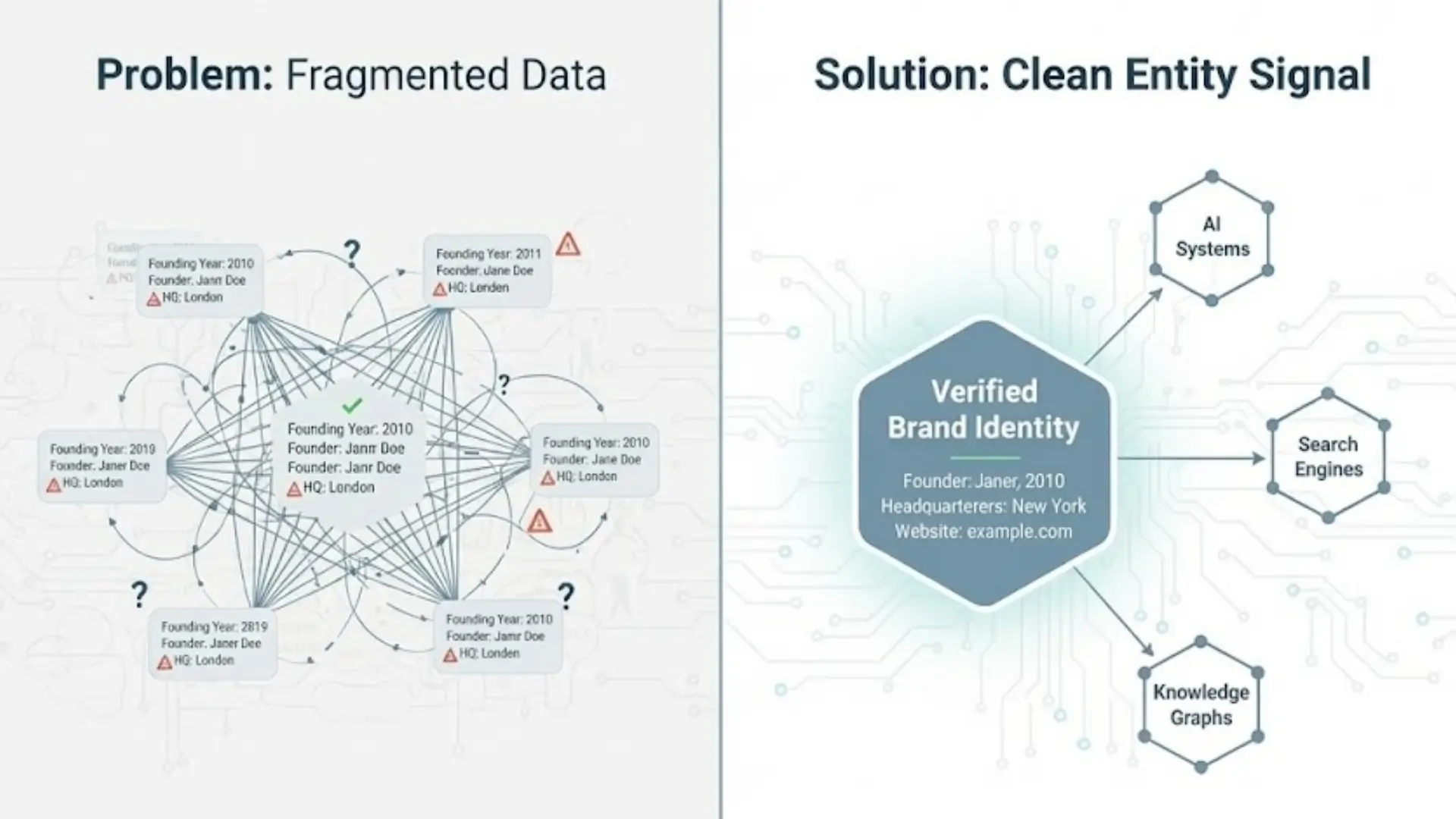
What Happens When Your Brand Data Conflicts Across the Web
AI pipelines downgrade trust when:
- The founding year differs across sources
- Founder names conflict
- Headquarters mismatches exist
- Product descriptions vary
- Website schema lacks structured markup
Result:
- Knowledge Panels become unstable
- AI avoids asserting facts
- Brand visibility decreases
- Errors propagate across platforms
Where Wikipedia Fits in AI Benchmarking
AI researchers and platforms actively use Wikipedia and Wikidata datasets (such as WikiText and WikiData5M) as:
- Model evaluation standards
- Factual consistency benchmarks
- Training reference corpora
Brands present in these datasets benefit from:
- Higher statistical weighting
- Better factual recall
- Stronger entity recognition
This means Wikipedia is not just a visibility asset; it is part of the evaluation layer AI systems use to decide whether a fact is safe to assert.
Before pursuing Wikipedia or expecting AI accuracy, these facts must match everywhere:
- Founder(s)
- Founding year
- Headquarters
- Legal name vs. trade name
- Social profiles
- Website schema
- Wikidata item
- Google Business Profile
This consistency is foundational.
Without it, even a published Wikipedia article will face disputes, reversions, or AI misattribution.
Common Pitfalls (And How to Avoid Them)
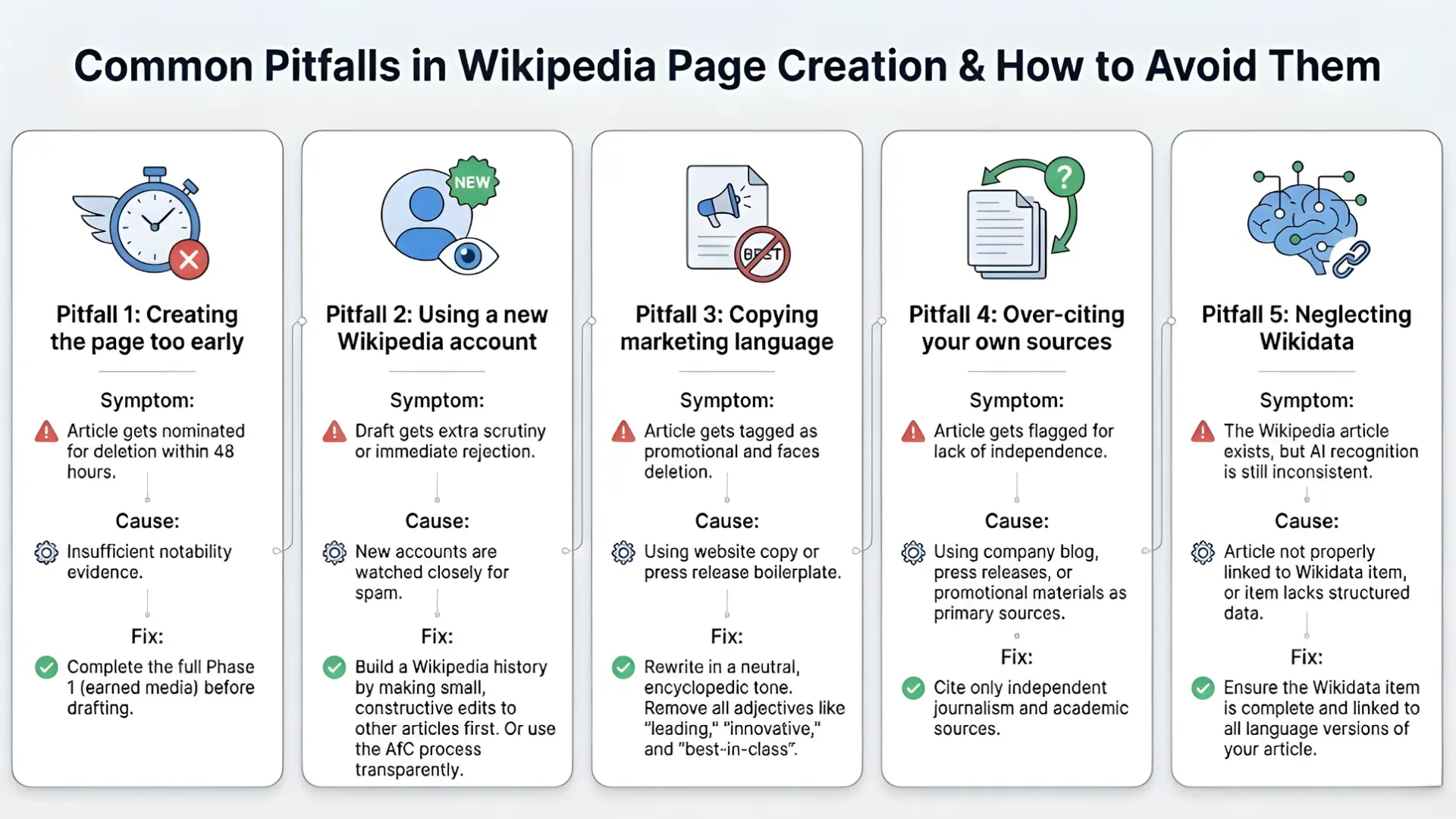
Pitfall 1: Creating the page too early
Symptom: Article gets nominated for deletion within 48 hours.
Cause: Insufficient notability evidence.
Fix: Complete the full Phase 1 (earned media) before drafting.
Pitfall 2: Using a new Wikipedia account
Symptom: Draft gets extra scrutiny or immediate rejection.
Cause: New accounts are watched closely for spam.
Fix: Build a Wikipedia history by making small, constructive edits to other articles first. Or use the AfC process transparently.
Pitfall 3: Copying marketing language
Symptom: Article gets tagged as promotional and faces deletion.
Cause: Using website copy or press release boilerplate.
Fix: Rewrite in a neutral, encyclopedic tone. Remove all adjectives like "leading," "innovative," and "best-in-class."
Pitfall 4: Over-citing your own sources
Symptom: Article gets flagged for lack of independence.
Cause: Using company blog, press releases, or promotional materials as primary sources.
Fix: Cite only independent journalism and academic sources.
Pitfall 5: Neglecting Wikidata
Symptom: The Wikipedia article exists, but AI recognition is still inconsistent.
Cause: Article not properly linked to Wikidata item, or item lacks structured data.
Fix: Ensure the Wikidata item is complete and linked to all language versions of your article.
Conclusion: Wikipedia as the Infrastructure of AI Trust
AI has changed search, but not credibility.
Wikipedia and Wikidata remain the infrastructure of factual validation for AI systems.
If you want:
- Stable visibility
- Correct representation
- Reliable AI citations
- Global credibility
- Long-term brand authority
…then a verified, neutral, well-cited presence in Wikipedia/Wikidata is still the most powerful trust signal.
Want to understand how your website gets cited by Google AI Overviews.
Read the full guide here → How to Get Featured in Google’s AI Overview? Tools and Strategies for 2025