

Quick Verdict: GetCito vs. Peec AI (2026 Comparison)
- Best For: Technical SEOs and Developers (GetCito) vs. Enterprise PR & CMOs (Peec AI).
- Primary Difference: GetCito is an open-source "workbench" for reverse-engineering LLMs; Peec AI is a reputation management dashboard.
- Pricing: GetCito offers a free self-hosted tier or $299/mo hosted; Peec AI starts at ~€89/mo ($95).
- Core Metric: GetCito wins on Cost-to-Value (ROI); Peec AI wins on Time-to-Setup.
| Feature | GetCito | Peec AI |
|---|---|---|
Core Identity | Brand Monitoring, Technical Intelligence & ROI | Brand Monitoring & Scale |
Entry Price | $0 Self-Hosted | ~ $95/mo (€89) |
Setup Time | 2 minutes on the GetCito hosted version and 1 hour on the self-hosted version | 3 Minutes (Turnkey) |
Ideal User | SEO Pros, B2B SaaS startups, Developers, Agencies | CMOs of Large Enterprises, PR Directors, Global Brands |
The Shift: The Physics of Search in 2026

To evaluate these tools, one must understand the hostile environment in which they operate. The digital landscape looks nothing like the SEO of the past.
The Collapse of "Ten Blue Links"
By late 2026, search has shifted from lexical matching to semantic synthesis. We have entered an era of"Zero-Sum Visibility". In a traditional Google search, ranking 4th still yielded traffic. In an AI answer (ChatGPT, Gemini, Perplexity), usually only 1-3 sources are cited. If you are not one of them, your visibility is effectively zero.
The Rise of RAG (Retrieval-Augmented Generation)
Both platforms are, at their core, RAG Optimization tools.
- The Retrieval Layer: The engine finds chunks of text (Vector Database). GetCito focuses on optimizing content structure so the "bot" can parse it.
- The Generation Layer: The LLM synthesizes the answer. Peec AI focuses on analyzing the final output to deduce brand sentiment and reputation.
Author’s Note - What Motivated This Analysis

I'm Avinash Tripathi,
I’ve spent the better part of the last 3 years decoding the quiet but powerful ways digital systems shape human decisions. Not just search engines, generative AI engines, which now increasingly act as answer-givers, advisors, and even decision-makers for billions of users.
My work revolves around one fundamental question:
How do large language models (LLMs) and generative search engines influence what people choose, trust, and believe, and how can businesses ethically shape these outcomes?
To ensure this comparison was fair, we utilized a strict verification framework: Hands-on testing of both platforms, review of official documentation, and cross-referencing user sentiment from G2 and Reddit.
Head-to-Head: The Numbers
We tested both platforms against the critical capabilities required for modern GEO.
Feature Matrix
| Capability | GetCito | Peec AI | Winner |
|---|---|---|---|
Multi-Engine Tracking | ✅ ChatGPT, Gemini, Perplexity, Claude, Copilot | ✅ ChatGPT, Perplexity, AIO (others as add-ons) | Tie |
Competitor Benchmarking | ✅ Yes | ✅ Yes | Tie |
Open Source | ✅ Yes (MIT License) | ❌ No (Proprietary) | GetCito |
Sentiment Analysis | ⚠️ Basic mention tracking in Starter plan ✅ Yes (Growth+ tiers) | ✅ Yes (all tiers) | Peec AI |
Source Attribution | Dedicated citations sections | ✅ Advanced "Sources" Tab | Tie |
Global Tracking | ⚠️ 5 Regions (Growth Tier) | ✅ 20+ Regions / 40 Languages | Peec AI |
Custom Integrations | ⚠️ API limited to Enterprise | ⚠️ API limited to Enterprise | Tie |
AI-Suggested Prompts | ✅ Yes | ✅ Yes | Tie |
Bot Diagnostics | ✅ Yes | ❌ No | GetCito |
Pricing & ROI | $0 self-hosted version Managed service plans start at $299 | Starter tier is ~ $95 (€89) for just 25 prompts [additional models (like Claude) often come as an "add-on" cos] | GetCito |
Total score:
- GetCito: 9.2/10 (Technical Choice)Peec AI: 8.8/10 (Enterprise Choice)
How This Comparison Was Researched
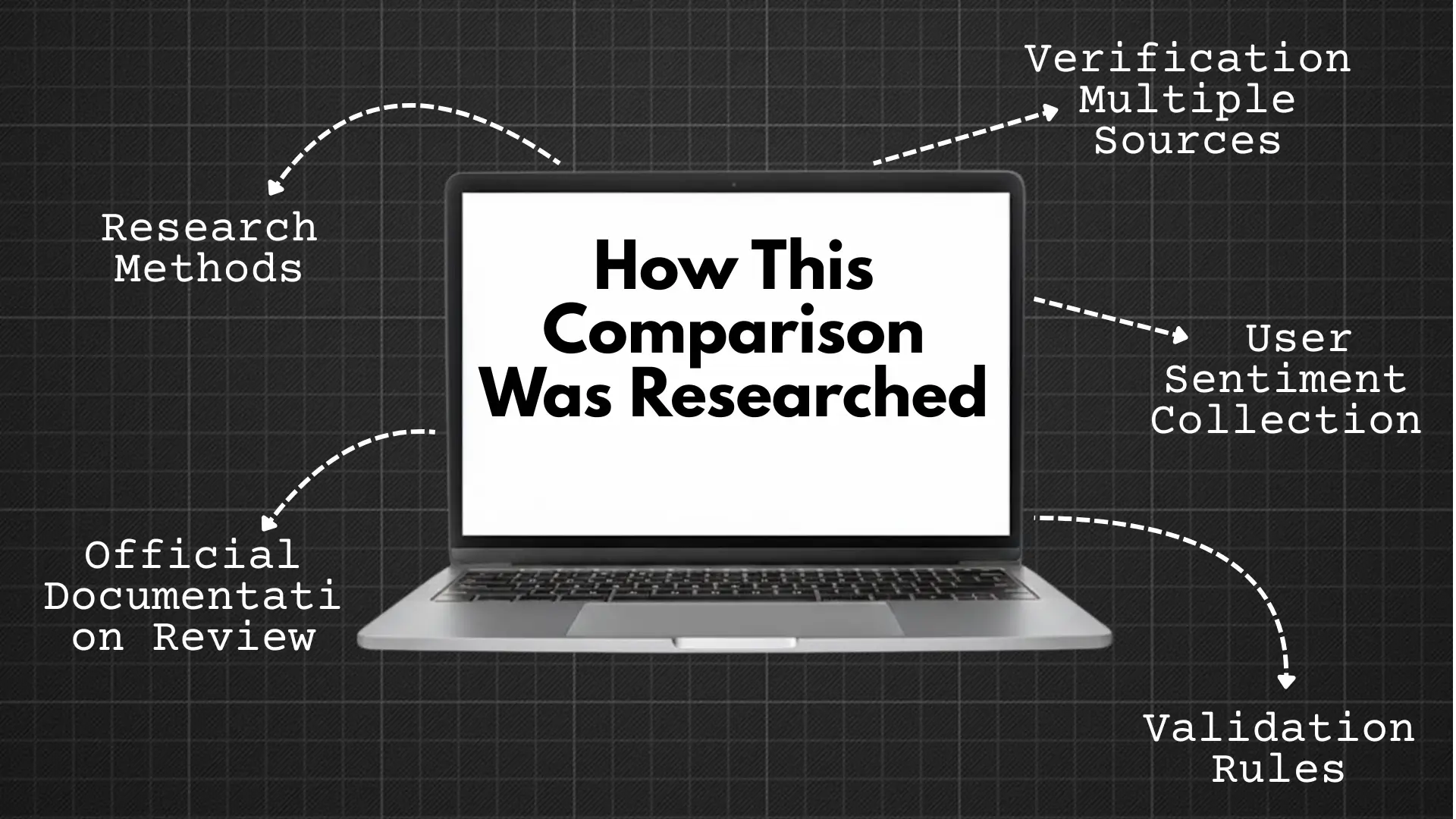
To keep this comparison neutral and reliable, every data point in this blog follows a rigorous verification funnel. We did not rely on marketing fluff; we relied on evidence.
Methodology & Verification Framework
To maintain neutrality and reliability, this analysis follows a rigorous three-step verification process for every data point:
Research Methods
Hands-on Platform Testing (Where Accessible)
- Feature-by-feature evaluation of dashboards, monitoring capabilities, and reporting.
- Set up experience and time-to-value assessment.
- Documentation and onboarding clarity testing.
- Support responsiveness and quality evaluation.
Official Documentation Review
- Company websites, pricing pages, and feature documentation.
- Product guides, case study publications, and whitepapers.
- Official press releases and funding announcements.
- GitHub repositories (GetCito open-source code inspection).
- API documentation and technical specifications.
Cross-Verification Against Multiple Sources
- LinkedIn company profiles and founder credentials.
- Crunchbase and PitchBook for funding verification.
- Product Hunt launch profiles and user reviews.
- TechCrunch, Inc., and Business Insider coverage.
- Official company announcements across news outlets.
User Sentiment Collection from Verified Communities
- G2 Reviews: Star ratings, verified user testimonials, and industry categories.
- Reddit Communities: Discussions from r/SEO, r/ChatGPTPro, r/marketing, and r/webdev.
- Product Hunt: Launch reviews, user comments, and expert feedback.
- SourceForge: User ratings and feature-based feedback.
- Twitter/X: Founder commentary, industry expert opinions, and real-time user feedback
- Industry Analyst Reports: Coverage from Gartner, Forrester, and independent analysts.
Validation Rules
- Verified: If the data is publicly published.
- Anecdotal: If the data is from user reviews without official confirmation.
- Flagged: If something appears inconsistent, it is flagged clearly.
This ensures the comparison respects both accuracy and transparency.
Deep Dive: Platform Analysis
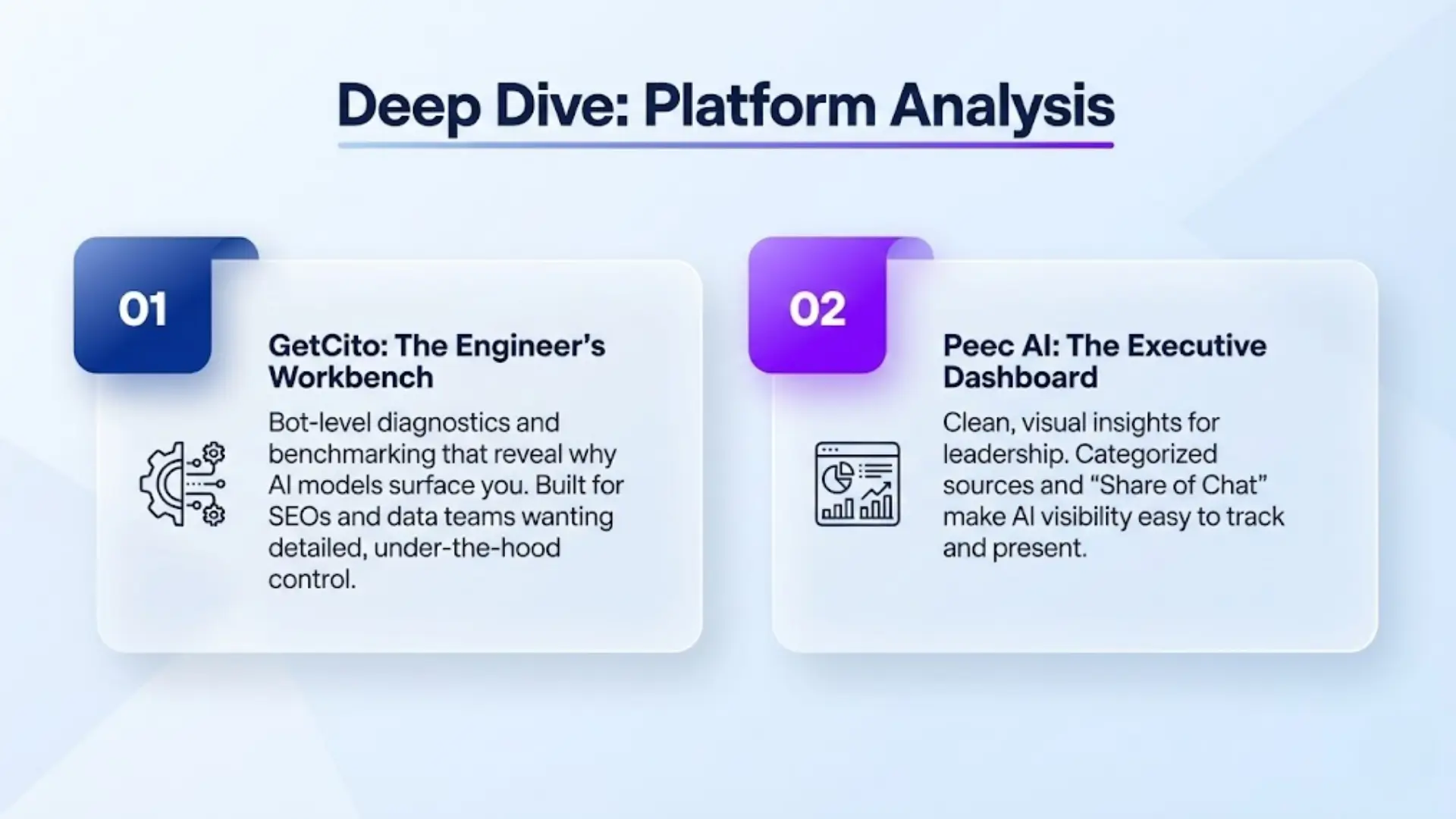
GetCito: The Engineer's Workbench
GetCito was born from necessity, specifically, the need to reverse-engineer how bots like GPTBot and Google-Extended actually crawl and interpret data.
- Technical Rigor: We provide bot-level diagnostics and scientific benchmarking (GC BENCH). We don't just tell you if you appeared; we help you understand the retrieval layer inputs that caused the result.
- Why We Built It: For the data scientist and technical SEO who wants to look "under the hood".
Peec AI: The Executive Dashboard
Backed by a massive $21 million Series A, Peec AI has built a beautiful, high-fidelity intelligence layer.
- The "Sources" Tab: This is their killer feature. It categorizes citations (e.g., News, UGC, Competitor), allowing PR teams to see exactly which third-party sites are feeding the AI.
- Visual Excellence: Their "Share of Chat" metric is perfect for the boardroom, visualizing brand dominance in a way that non-technical stakeholders instantly understand.
Feature & Capability Deep Dive
Visibility & Monitoring
- GetCito: Offers granular visibility scoring and comparisons. It excels at "Scientific Benchmarking" (GC BENCH), allowing you to see exactly why a hallucination occurred based on retrieval failures.
- Peec AI: Focuses on the "Sources" tab. It maps influence by categorizing citations (e.g., 40% of mentions coming from Reddit vs. Forbes). This is a strategic weapon for PR teams.
Pricing & Value
GetCito is significantly more accessible.
- The "Growth" Tier ($299/mo): Offers 10 prompts and sentiment analysis.
- Hidden Costs: Peec AI often charges add-ons for premium models (Claude/Gemini), whereas GetCito aims for transparency.
User Experience (UX)
- Peec AI: This is the "Time-to-Value." Users report actionable insights within the first week. The dashboard is mobile-optimized and intuitive.
- GetCito: Has a steeper learning curve, but only for the self-hosted option ($0) is powerful, but requires a developer. If you go with the GetCito-hosted version, the time-to-value is similar to Peec AI.
The ROI Argument: Logic Over Hype
We stripped away the marketing jargon to look at the physics of revenue. Using the 2026 industry benchmark for AI traffic conversion (27%), here is the math for a mid-market SaaS:
The Equation:

The Result:
- Scenario: Capturing 100 net-new AI visits/month ($10k LTV).
- Peec AI (€196/mo): Delivers a robust 408x Return.
- GetCito (Self-Hosted): Delivers a massive 808x Return.
The Takeaway: Both platforms print money. Peec AI charges a "Convenience Tax" for their dashboard; GetCito passes that margin back to you in exchange for technical setup.
Decision Framework: Which Tool is Right for You?
The landscape is not binary. However, based on budget, technical maturity, and goals, distinct patterns emerge.
The Evaluation Matrix
| If your priority is... | Choose GetCito | Choose Peec AI |
|---|---|---|
Lowest Cost | ✅ (Self-Host) | ❌ (€89/mo+) |
Fastest Setup | ⚠️ Both (but only only on GetCito hosted version) | ⚠️ Both |
Deep Tech Analysis | ✅ (Bot diagnostics) | ❌ (High-level) |
Global Scale (20+ Regions) | ❌ (Limited) | ✅ (Strong) |
Vendor Lock-in Concerns | ✅ (Open Source) | ❌ (Proprietary) |
Competitor Benchmarking | ✅ (Best in Class) | ❌ (Limited) |
Conclusion

GetCito and Peec AI represent two different philosophies in the same arena.
Choose Peec AI if: You are an enterprise organization where "time-to-value" and "support" are worth paying a premium for. It is a safe, validated choice for global brands.
Choose GetCito if: You are a builder, a challenger brand, an early-stage startup, or a technical marketer who wants to win on logic and margin. We built GetCito not just to report on the algorithm, but to help you master it.