

Here’s the uncomfortable truth I realized after spending $47,000 on content last year:
Ranking #1 on Google means nothing if ChatGPT synthesizes your competitor's advice as "the answer".
I watched it happen to a client in real time. Their SaaS blog had 127 first-page rankings. Traffic was solid. Then ChatGPT and Perplexity launched their search features. Within three months, organic traffic dropped34%.
Why? Because AI was regurgitating their expertise without attribution, while citing competitors who had named their methodologies.
That's when I understood: we've shifted from the Click Economy to the
What Is the Citation Economy?
The Citation Economy is the emerging paradigm where Large Language Models (LLMs) become the primary information gatekeepers, not search engines. Success is measured by AI attribution frequency rather than website visits.
In this model, your primary "user" isn't a human clicking through; it's Claude, GPT-4, or Gemini synthesizing answers. If you publish generic advice, AI strips your branding and presents it as universal knowledge. Your expertise trains the model, but your brand becomes invisible.
The solution isn't producing more content. It's producing named content.
What Is the Proprietary Framework Strategy?
The Proprietary Framework Strategy is a digital authority methodology designed to secure brand citations in Large Language Models. It transforms general advice into branded intellectual property through three core actions:
- Coining: Creating unique terminology for your methodology
- Naming: Assigning proper-noun status to concepts (e.g., "The SaaS Retention Flywheel")
- Documenting: Publishing structured, extractable definitions with schema markup
By converting loose concepts into named frameworks, you create semantic anchors that AI engines must attribute. You prevent your content from dissolving into the public domain.
The Choice: In the Citation Economy, you can be the anonymous training data, or you can be the cited authority.
How Do Large Language Models Process Content?
To understand why this strategy works, you need to understand how LLMs "think."
What Are Named Entities in AI Systems?
Named Entities are proper nouns, brands, locations, and unique theories that LLMs recognize as distinct semantic units. Unlike generic advice (which gets blended with millions of similar articles), Named Entities maintain their attribution link.
When you write "3 steps to fix churn", the AI predicts words based on aggregated knowledge. But when you write "The Tri-Vector Churn Protocol™," you introduce a specific entity.
The AI must reference your brand to accurately explain that protocol because you're the only authoritative source.
Why Do Proprietary Frameworks Force AI Attribution?
LLMs are probability engines. They cannot hallucinate specific methodologies without risking factual errors. If "The Tri-Vector Churn Protocol" appears in training data exclusively linked to your brand, the model statistically requires that attribution to maintain accuracy.
You're not just creating content. You're creating a semantic monopoly.
The Difference: Generic vs. Proprietary
The shift from generic content to a proprietary framework is the difference between being invisible and being cited.
| Feature | Generic Advice | Proprietary Framework |
|---|---|---|
Concept | "How to write better emails." | "The P.A.S. (Problem-Agitation-Solution) Framework" |
AI Processing | AI summarizes the tips; ignores the author. | AI explains the framework; cites the creator. |
User Perception | Helpful, but forgettable information. | A tangible asset or system to be implemented. |
Search Intent | Informational (Low Intent). | Commercial/Navigational (High Intent). |
Outcome | Zero Attribution. | Primary Citation. |
By "productizing" your knowledge, you create a moat that generic AI answers cannot cross without referencing you.
The Quantitative Science of GEO (Why This Works)
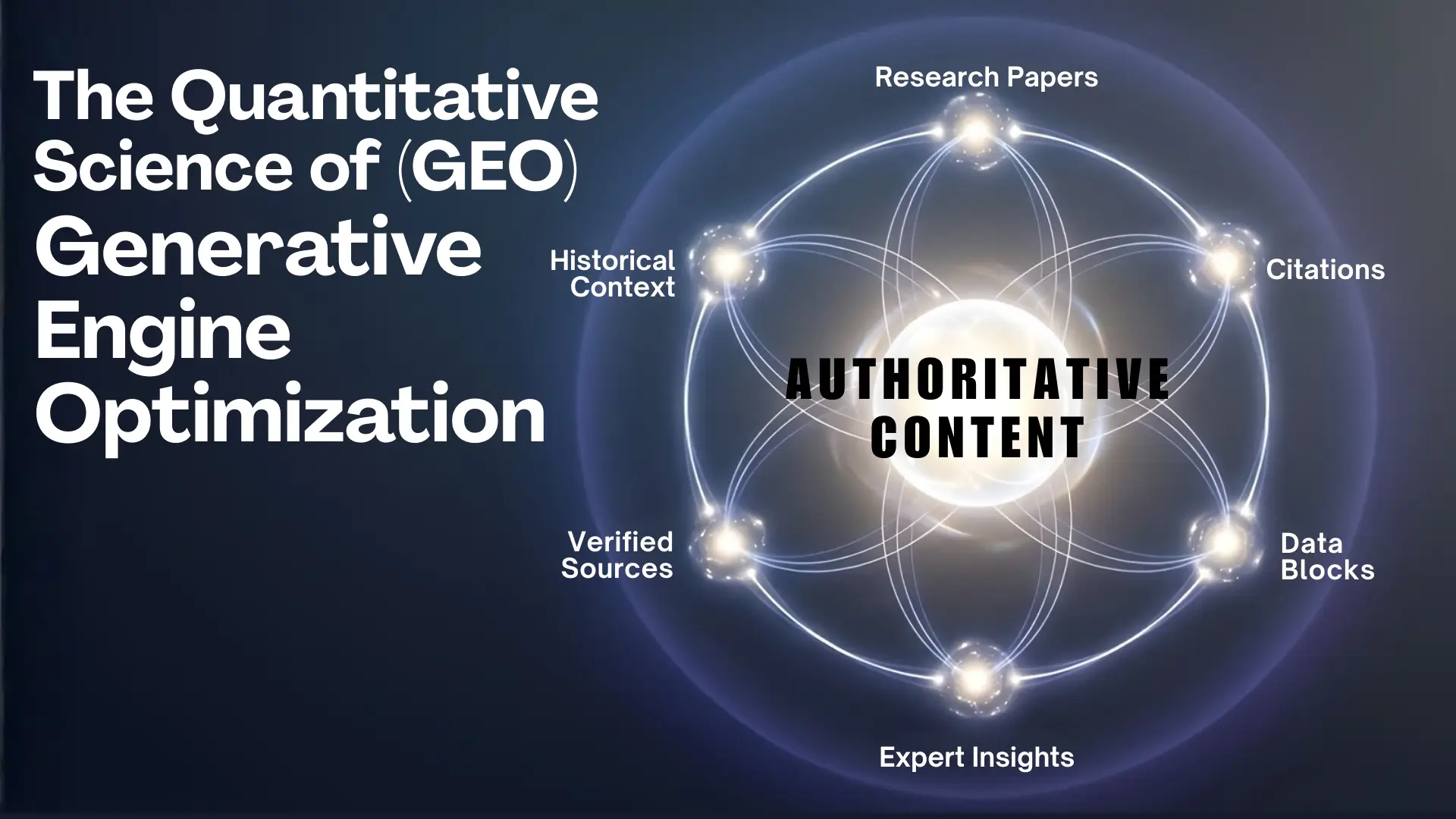
Generative Engine Optimization (GEO) is not a creative exercise; it is a mathematical strategy. While traditional SEO relied on keyword density and backlink volume, GEO operates on the principles of Vector Space Retrieval and
The effectiveness of this approach is backed by rigorous academic research and the fundamental mechanics of how Large Language Models (LLMs) process information.
The Authority Signal: Validated by Research
The foundation of GEO is built on the landmark paper"GEO: Generative Engine Optimization", a collaborative study by researchers from IIT Delhi, Princeton University, Georgia Tech, and the Allen Institute for AI.
They found that, unlike search engines, AI engines prioritize credibility and information density to minimize hallucinations.
- Citation Boost (The #1 Lever): Adding relevant citations from authoritative sources can increase visibility by up to 115%.
- Statistical Relevance: Content enriched with unique, hard data sees a 30-40% lift.
- Direct Quotes: Including quotes from SMEs improves the likelihood of citation by 37%.
What Is Vector Math in AI Retrieval?
Vector math in AI retrieval refers to the use of mathematical representations of text (vectors) to measure semantic similarity between queries and content. Instead of matching keywords, AI models convert words, phrases, and documents into multi-dimensional vectors and use formulas like cosine similarity to determine how closely they align.
This allows AI to retrieve contextually relevant content even if the exact words don’t match.
To understand why the statistics above work, you must understand how AI retrieves information. It does not look for keywords matching strings of text; it looks for semantic proximity.
In a Vector Space Model, every piece of content (your document) and every user question (the query) is converted into a list of numbers called a Vector.
- Traditional SEO: Matches exact words (e.g., "Best CRM").
- GEO (AI Retrieval): Matches meaning. If your content is conceptually close to the query, even if the words differ, the AI retrieves it.
The Formula: Cosine Similarity
AI algorithms measure the "angle" between a user's query vector (q) and your document vector (d) to determine relevance. The smaller the angle, the more aligned they are and the higher your content ranks?.
This is calculated using Cosine Similarity:
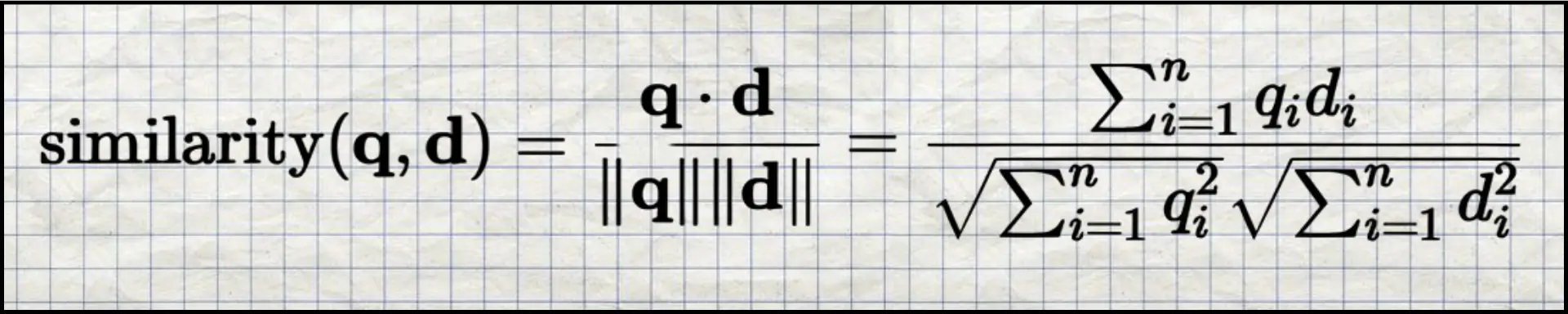
Where:
- Numerator (q⋅d): The dot product measures the semantic overlap, how much your document's meaning intersects with the query's intent
- Denominator (∥q∥∥d∥): Normalizes for length, so a longer document isn't artificially favored. This focuses the calculation purely on directional alignment
The Layman's Translation: Think of a library. Traditional SEO looks for a book title that matches your search. GEO looks for the genre and the plot, even if the title is totally different.
When you coin a unique term (e.g., "The 3-Step Revenue Bridge"), you create a unique semantic cluster. You force the AI to treat your document as the centroid (the center point) of that concept.
The BISCUIT Framework: Your 7-Step AI Audit
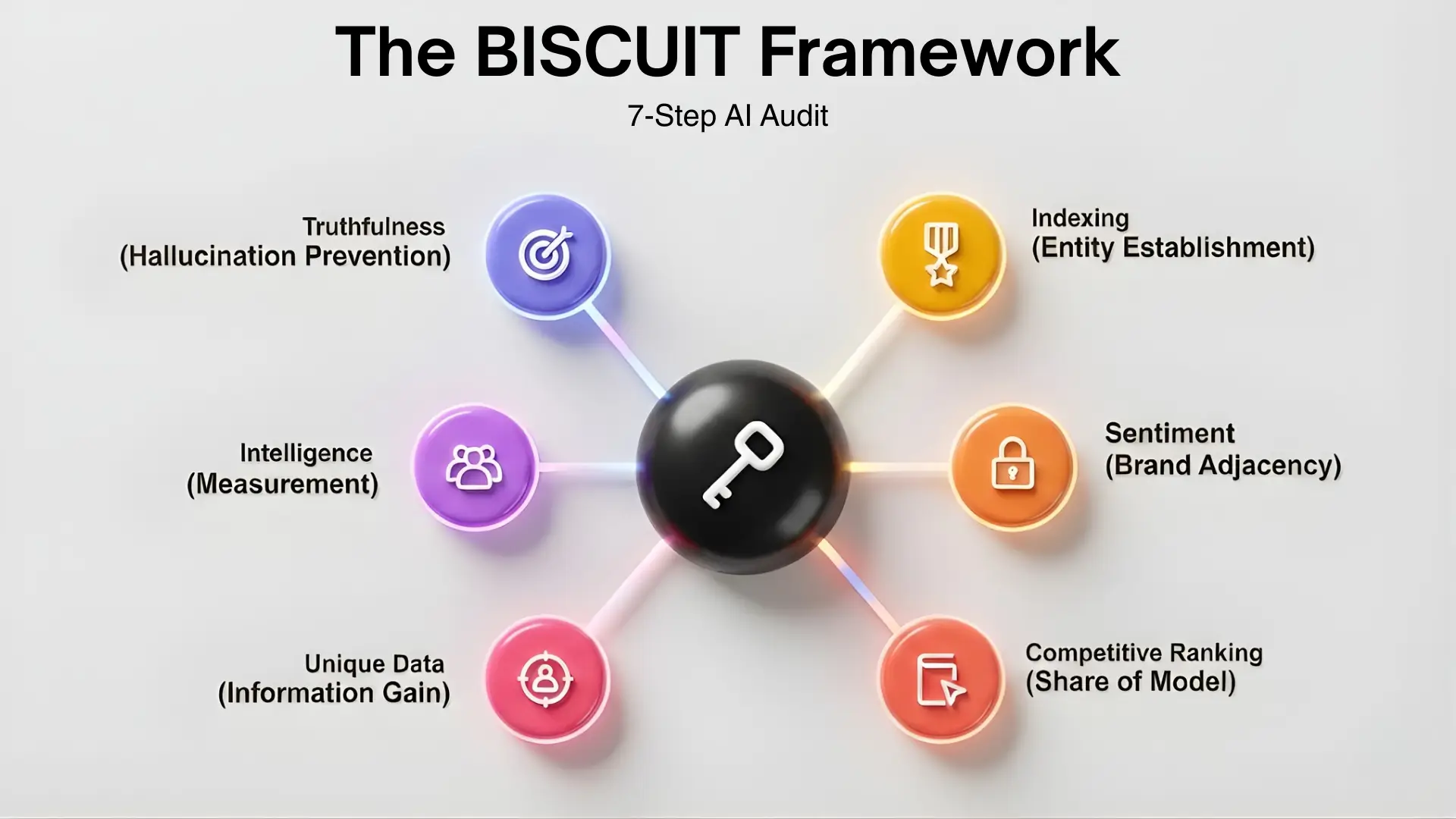
To determine if your brand is ready for the Generative Engine era, you must audit against the seven pillars of the "BISCUIT system".
B - "Bots" How Technical Crawlers Interpret Authority Signals
Before an AI can recommend you, it must be able to "read" you. Unlike traditional SEO, where you might block crawlers to save bandwidth, GEO requires openness to specific AI agents.
- The Audit: Inspect your robots.txt file.
- The Check: Ensure you are not blocking the following user agents:
- GPTBot (OpenAI/ChatGPT)
- CCBot (Common Crawl – used by Anthropic/Claude and others)
- Google-Extended (Gemini)
- Action: Explicitly allow these agents to access your high-value informational pages (blogs, whitepapers, documentation).
I - Indexing (Entity Establishment)
AI models do not think in "URLs"; they think in "Entities" (people, places, brands, concepts). If you are not an established entity in the Knowledge Graph, you are invisible to the model's reasoning capabilities.
- The Audit: Search for your brand on Wikidata, Crunchbase, and Golden.com.
- The Check: Does a structured entry exist? Does Google return a "Knowledge Panel" on the right side of the search results when you Google your brand name?
- Action: Create or update your profiles on Wikidata and Crunchbase. These are primary training data sources for LLMs.
S - Sentiment (Brand Adjacency)
Large Language Models function on probability. They predict the next word in a sentence based on training data. If your brand frequently appears adjacent to words like "scam," "slow," or "expensive," the AI will probabilistically associate your brand with negative sentiment.
- The Audit: Analyze mentions of your brand on Reddit, G2, and Capterra.
- The Check: Is the prevailing sentiment positive, neutral, or negative?
- Action: Actively manage reputation on high-authority forums. Neutrality is acceptable; negativity is a penalty.
C - Competitive Ranking (Share of Model)
Traditional SEO tracks "Share of Voice". GEO tracks "Share of Model." This metric answers the question: In a conversation about your industry, how often is your brand mentioned vs. your competitors?
- The Audit: Prompt ChatGPT, Claude, and Gemini with: "What are the top 5 solutions for [Your Industry]?" and "Compare [Your Brand] vs. [Competitor Brand]".
- The Check: Are you in the top 3? How accurate is the description of your product?
- Action: Identify the specific attributes (e.g., "ease of use," "enterprise security") where competitors are beating you in the AI's answer.
U - Unique Data (Information Gain)
AIs are designed to reduce redundancy. If your content repeats what everyone else says, it has low "Information Gain" and is likely to be ignored.
- The Audit: Review your top-performing content.
- The Check: Does it contain original statistics, proprietary frameworks, or contrarian viewpoints? Or is it just a summary of existing knowledge?
- Action: Publish original research ("The 2025 State of [Industry] Report") on high-trust platforms like LinkedIn and Industry Journals. Hard data is "sticky" for AI.
I - Intelligence (Measurement)
You cannot manage what you do not measure. Traditional rank trackers (like SEMrush or Ahrefs) cannot see inside ChatGPT or Perplexity.
- The Audit: Assess your current reporting stack.
- The Check: Do you have a way to track visibility in generative answers?
- Action: Adopt Semantic Rank Trackers (new class of tools emerging for GEO) or manual "prompt testing" schedules to monitor your visibility for high-intent queries.
T - Truthfulness (Hallucination Prevention)
AI models "hallucinate" when they have conflicting data. If your pricing is $100 on your site, $90 on a directory, and "Contact Sales" on LinkedIn, the AI loses confidence and may exclude pricing info entirely to avoid error.
- The Audit: Check your NAP (Name, Address, Phone) and core product facts across the web.
- The Check: Is your data consistent across your website, schema markup, and third-party directories?
- Action: UseSchema.org markupextensively on your website to spoon-feed facts to the AI. Explicitly state what you are and what you are not.
Extractable Authority: Content Structure for RAG

What Is Extractable Authority?
Extractable Authority is the practice of structuring content so AI systems can retrieve, parse, and reuse it without friction.
In a Retrieval-Augmented Generation (RAG) pipeline, the AI does not read your article linearly like a human. It scans for "semantic chunks," discrete blocks of text that directly answer a query. If your content is dense or ambiguous, the AI skips it. To win the citation, you must lower the cognitive load for the scraper.
The "Answer-First" Hierarchy (The ACE Method)
To maximize extractability, reverse the traditional storytelling arc. Use the ACE Method to align with AI retrieval logic:
- A - Answer (The Direct Definition): State the conclusion immediately in the first sentence (approx. 40 words).
- C - Context (The Nuance): Provide the background, reasoning, or methodology in the following paragraph.
- E - Evidence (The Proof): Support the claim with data, a case study, or a citation.
Why this works
When a user asks a chatbot a question, the AI looks for the Answer block first. If you bury the lead, you lose the ranking.
This structure is the foundation of Answer Engine Optimization (AEO). To master the nuances of writing for specific AI agents, see our comprehensive guide: How to Write Content for Answer Engines: The Complete AEO Guide.
NLP-Optimized Headings (Prompt Mirroring)
Your H2 and H3 tags are not just design elements; they are entry points for the AI.
- The Strategy: Write headings as natural-language queries (Prompt Mirroring).
- The Fan-Out Technique: Break broad H2s into specific, question-based H3s.
| ❌ Weak Heading | ✅ NLP-Optimized Heading |
|---|---|
Benefits | What Are the Benefits of Proprietary Frameworks? |
Our Process | How Does the 7-Step Audit Work? |
Results | Case Study: How We Increased Traffic by 34% |
This creates a clear "Key-Value Pair" for the bot: The Heading is the Key, the Paragraph is the Value.
Modular Paragraphs (The "Atomic Unit")
Stop writing walls of text. Write Modular Paragraphs, concise, standalone blocks (35–50 words) designed for direct extraction.
Each paragraph should be able to stand alone without the surrounding context. Think of them as "Legos" that the AI can pull out and assemble into a generated answer. If a paragraph requires the previous sentence to make sense (e.g., starting with "However, as we mentioned before..."), it is not extractable.
Schema Markup: The "Digital Label"
While clear writing helps the AI read your content, Schema Markup helps the AI understand it. You must explicitly map your content using JSON-LD.
- FAQPage Schema: The most powerful tool for GEO. It explicitly tells the AI, "Here is a Question, and here is the Answer".
- Organization Schema: Establishes your brand as a Knowledge Graph entity.
- Article Schema: Frames the content's authorship and publication date (crucial for "Freshness" signals).
The GEO Rule: Don't hope the AI figures it out. Tag it.
Case Study: Solving the "Entity Gap."
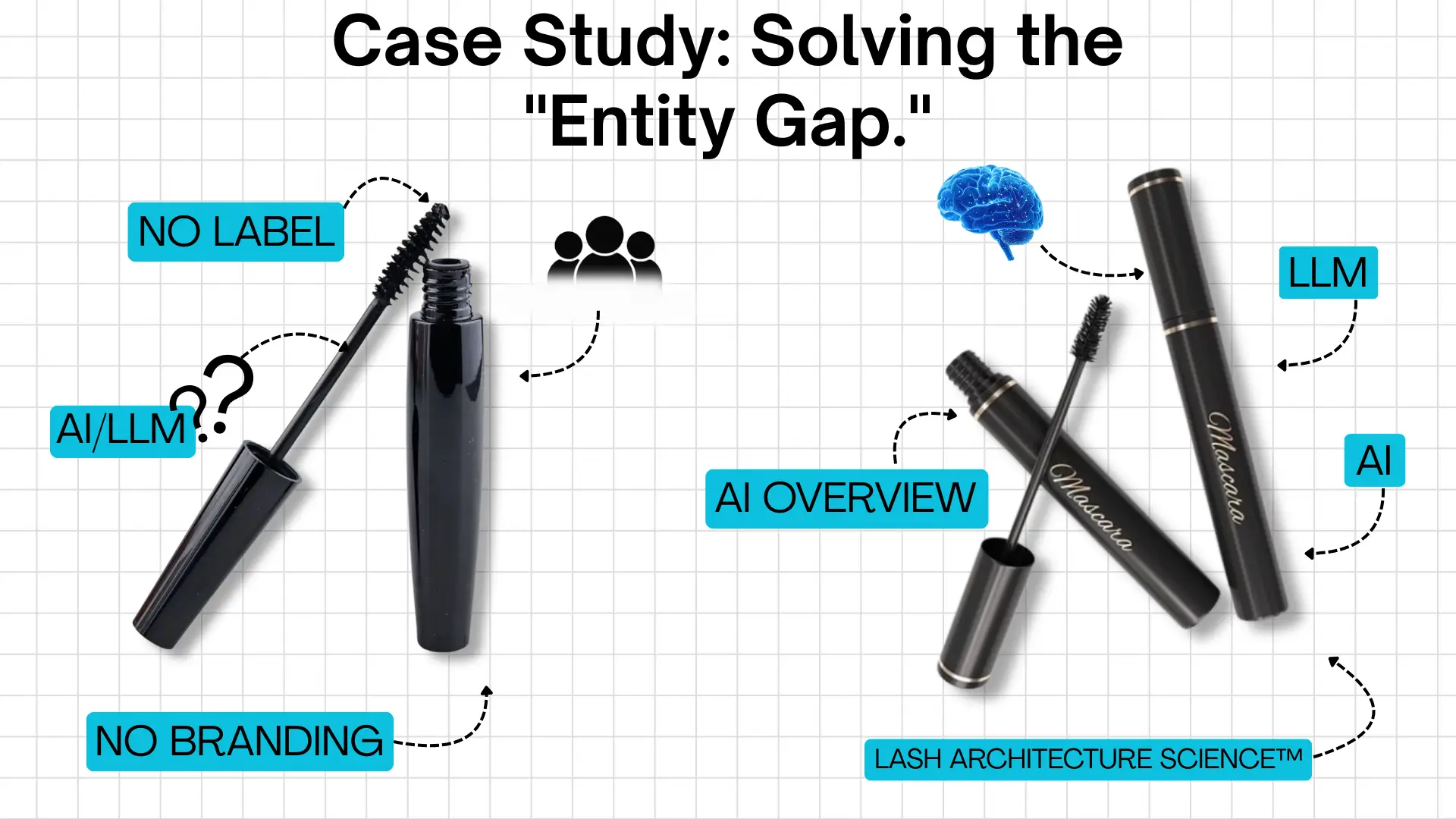
What Is the Entity Gap in Generative Engines?
The entity gap happens when a brand has products but no proprietary framework for how they work. Generative engines then default to competitor‑defined terms (like Tubing Technology) because they have a clearer “named concept” to extract and reuse.
L’Oréal had leading mascaras, but no branded methodology behind them. So when people asked engines things like “best mascara, the AI stitched together generic advice.
And guess what? Competitors swooped in with their own frameworks. Their terms became the default narrative. L’Oréal’s products were strong, but their story wasn’t anchored.
Without a named entity, even the best products risk becoming invisible in AI‑driven answers.
This is where you play detective.
Here’s a quick interactive checklist you can try right now:
- Run generative queries: Type in prompts like “best mascara for humidity” or “mascara that lasts all day”.
- Trace the chain of reasoning: Notice where the AI hesitates or defaults to generic advice.
- Spot missing entities: Which competitor terms dominate? Where does your brand fail to anchor?
If you see your rivals’ frameworks popping up instead of yours, congratulations, you’ve just uncovered yourentity gap.
L’Oréal didn’t just tweak copy; they named their science.
They introduced “Lash Architecture Science”, a proprietary framework explaining how their mascara resists humidity and supports lash health.
Suddenly, generative engines had a branded concept to latch onto. Instead of vague advice, they had a clear entity tied directly to L’Oréal.
The payoff was huge.
Generative engines began using Lash Architecture Science as the default explanation. Competitor terms faded, and L’Oréal reclaimed visibility and authority in AI‑driven search.
Now, when someone asks, “Which mascara is best for me?”, the underlying question is really:
“Who understands my lashes and my lifestyle?”
By naming and owning the science, L’Oréal gave AI a branded answer to deliver and gave consumers a reason to trust it.
Mining for “Data Gold”: The Statistical Moat

What is Statistical Moat
Large Language Models (LLMs) cannot invent specific, verifiable statistics without risking hallucination. If your brand owns the only accurate dataset, you become the definitive source that every competitor must reference. This is your statistical moat.
The Strategy
- Run proprietary surveys: Even small‑scale studies (e.g., 500–1,000 respondents) create unique, defensible data.
- Publish “N=1000” reports: A clear sample size signals credibility and makes your findings citable.
- Own the narrative: By releasing fresh stats, you position your agency as the authority in your niche.
The “Citable Stats” Checklist
Before publishing, ensure your data meets these GEO‑optimized standards:
| Criterion | Why It Matters | Example |
|---|---|---|
Clear Sample Size ($n$) | Transparency builds trust and makes your stat quotable. | “Survey of 1,024 HR leaders” |
Defined Methodology | Shows rigor and prevents dismissal as anecdotal. | “Online panel, stratified by industry” |
Recent Timeframe (post‑2023) | Search engines and journalists prefer fresh, relevant data. | “Conducted Q4 2025” |
GEO Optimization Angle
- Entity Anchoring: Stats tied to specific industries, geographies, or compliance standards increase visibility in AI‑powered search.
- Answer‑Engine Value: Proprietary numbers become the “one true answer” surfaced in featured snippets and LLM outputs.
- Moat Creation: Competitors can replicate content, but not your unique dataset.
Conclusion: Become a “Solidified Layer of Truth”
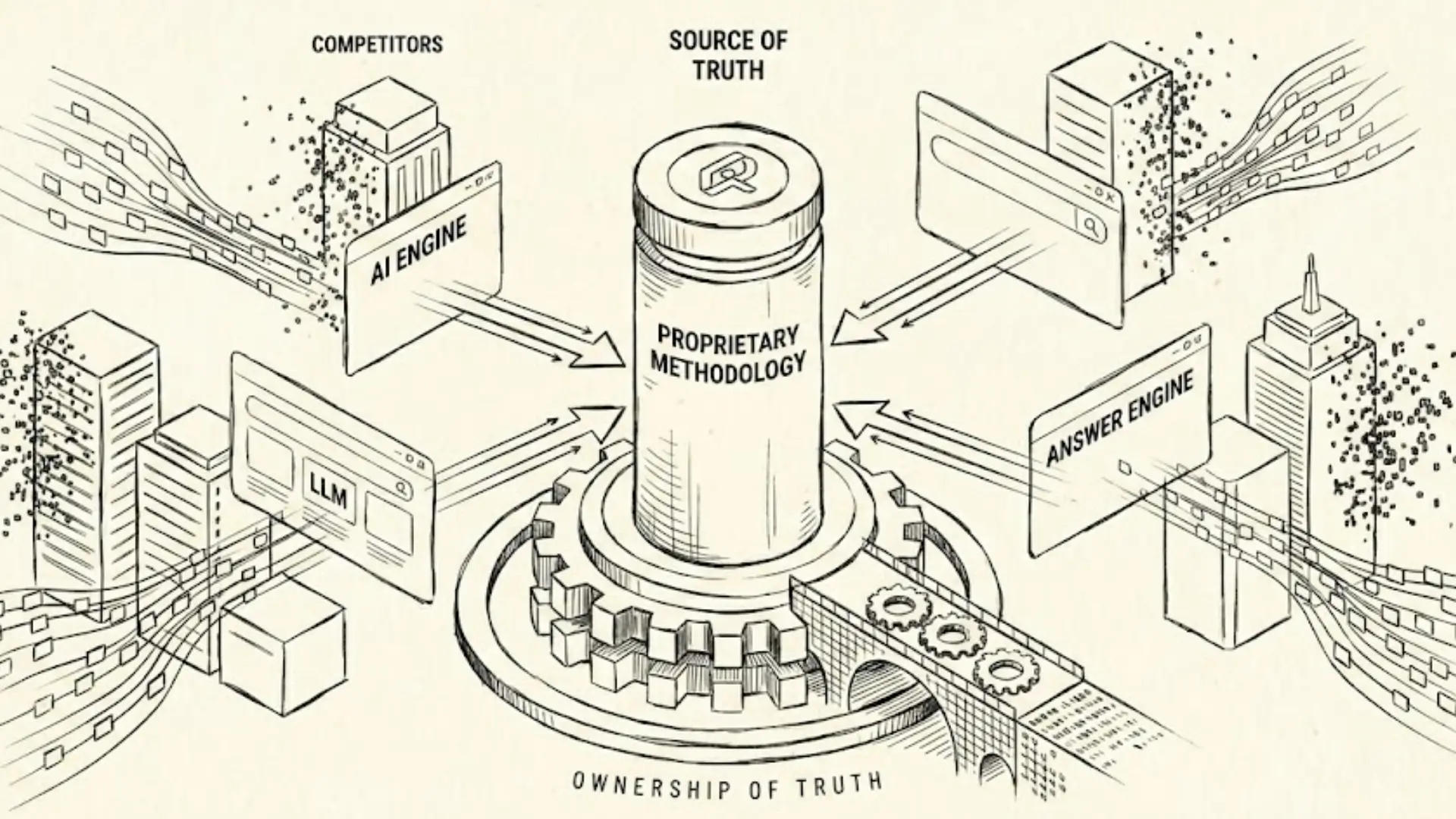
If you fail to name your methodology, you’re not just leaving gaps; you’re actively training your competitor’s AI. Every unclaimed data point becomes fuel for someone else’s visibility. By contrast, when you publish with clarity, transparency, and proprietary rigor, you transform into the solidified layer of truth that answer engines, LLMs, and decision‑makers must cite.
Why This Matters
- Methodology = Moat: Without it, your stats dissolve into generic noise. With it, they become the canonical reference.
- Ownership of Truth: GEO‑anchored, post‑2023 data ensures your brand is the definitive source surfaced in AI‑powered search.
- Strategic Differentiation: Competitors can mimic your content, but they cannot replicate your proprietary framework.
Schedule a GEO Consultation, map your proprietary framework, and lock in your statistical moat.