

Answer Engine Optimization (AEO) is the practice of structuring content so AI platforms like ChatGPT, Claude, and Perplexity cite your brand as their primary source. This complete guide shows you the exact content architecture, technical implementations, and trust signals that has proven to increase AI citations by 460% in 90 days.
Answer‑ready content is structured, authoritative, and built for machines that think. Traditional content is written for humans who scroll. One gets cited. The other gets ignored.
Here’s what happens when your content is answer‑ready:
- ChatGPT cites you as the primary source in your niche
- Perplexity features your URL in its synthesized answers
- Google’s AI Overview pull your data instead of your competitor’s
- Claude references your frameworks when users seek expert guidance
But none of this is possible until your content is prepared. That’s where Answer Engine Optimization (AEO) comes in.
Who This Guide Is For
This guide is specifically designed for:
- B2B SaaS Marketing Teams managing content libraries of 100+ pages, seeking measurable AI visibility
- Enterprise SEO Directors are responsible for adapting strategy from traditional search to AI-powered search engines
- Content Strategists at agencies managing 5+ client accounts who need scalable AEO frameworks
- Technical Founders building AI-native products who need their documentation cited by LLMs
Not ready for implementation? GetCito's free AI Visibility Report, which analyzes your existing content and identifies your top 10 opportunities for immediate citation wins.
[Get Your Free Report →]
What is Answer Engine Optimization (AEO)?
Answer Engine Optimization (AEO) is the practice of structuring and creating content designed to be selected, cited, and surfaced by AI‑powered answer engines like ChatGPT, Claude, Perplexity, and Google’s AI Overviews.
Unlike traditional SEO, which focuses on rankings in a list of blue links, AEO focuses on citability, becoming the trusted source AI models reference when generating direct answers.
Read our complete AEO vs SEO comparison to understand how AEO differs fundamentally from traditional search engine optimization (SEO).
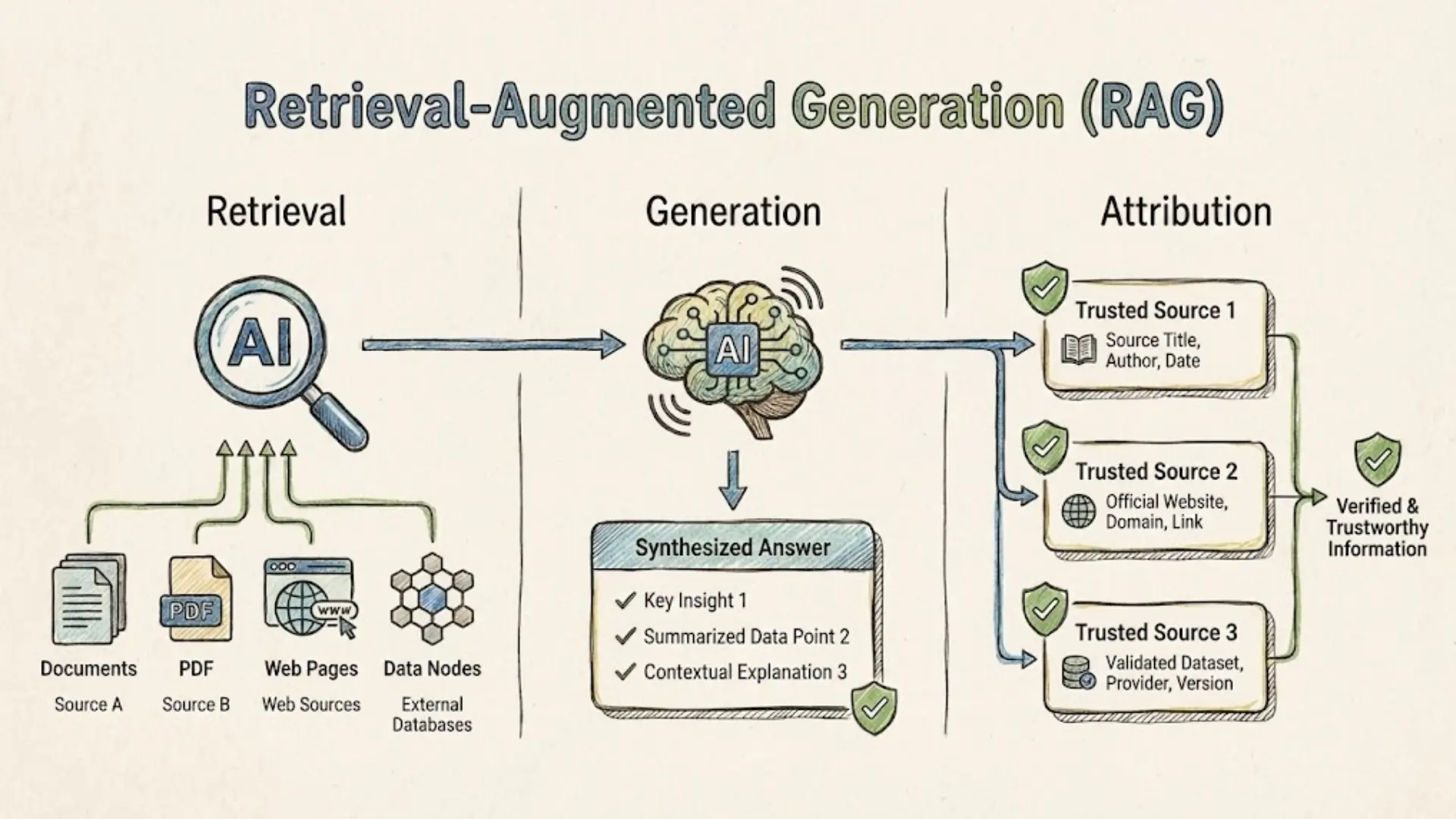
This shift is driven by Retrieval-Augmented Generation (RAG), a three-step process that has fundamentally changed how content is discovered:
- Retrieval: The AI scans the web for relevance signals
- Generation: It synthesizes multiple sources into one coherent answer
- Attribution: It cites only the sources it trusts most
And that’s where I come in, writing content not just for humans, but for AI. Content that works for your brand, gets cited by answer engines, and positions you as the authority. Let me show you exactly what helps in creating answer‑ready content and how to do it right.
Preparation: Intent Engineering & The Fan-Out Effect
In my audits of hundreds of enterprise and startup content libraries, I consistently find the same fatal mistake: answering the wrong question.
The shift from keyword-first to intent-first requires understanding how Entity SEO shapes AI comprehension. When LLMs process your content, they're not matching keywords; they're mapping entities, relationships, and semantic meaning. This is why entity-rich content outperforms keyword-stuffed content by 3:1 in AI citations.
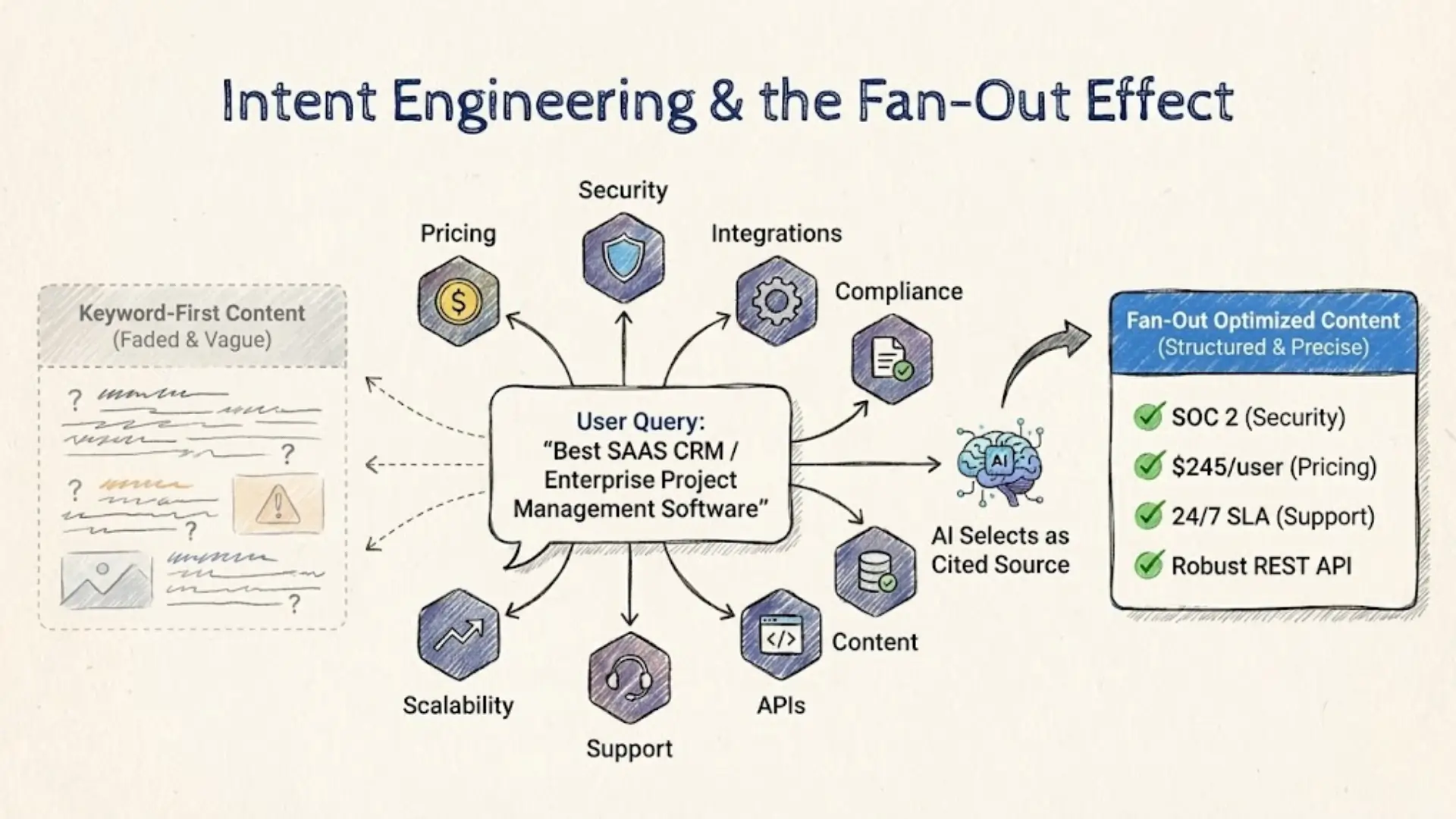
When a user searches for "best SaaS CRM," that isn’t a single question. It is ten different questions compressed into three words. An LLM instantly "fans out" that single query into a complex matrix of intent:
- Pricing & Value: ROI calculations and hidden costs.
- Ecosystem: Integration capabilities with existing stacks.
- Risk: Compliance requirements (GDPR, SOC 2, HIPAA).
- Social Proof: Aggregated user sentiment and real reviews.
- Logistics: Implementation timelines and support tiers.
- Growth: Scalability for different team sizes.
- Tech Specs: API access and mobile functionality.
This is the Fan-Out Effect. Understanding it is the single variable that separates amateur content from AI-ready content. If you only answer the surface-level query, the AI views your content as incomplete and ignores it.
Practical Example: The "Fan-Out" Makeover
To truly understand intent engineering, you have to see it in action. Let’s look at a typical paragraph from a B2B software landing page and then rewrite it for the AI Age.
The Scenario: A user searches for "Project management software for enterprise."
The Old Way (Keyword-First)
This style focuses on repeating the keyword and keeping the user reading, but offers zero extractable data.
"When looking for the best project management software for enterprise, it is important to find a solution that scales. Our platform is a leading project management software for enterprise teams that helps you collaborate more effectively. We offer flexible pricing to suit your needs and integrate with all your favorite apps. Security is our top priority, ensuring your data is safe while your team stays productive."
Why AI ignores this:
- Vague Entities: "Flexible pricing" and "favorite apps" are mathematically empty phrases to an LLM.
- Zero Fan-Out: It answers the surface query (it is software) but fails the cluster (How much? Is it secure? Does it talk to Jira?).
- Result: The AI classifies this as generic marketing text and skips it.
The New Way (Fan-Out Optimized)
This style anticipates the implicit questions Price, Security, Integration, and Scale and answers them immediately.
"For enterprise teams (500+ users), our platform is architected to handle complex workflows without latency. Unlike standard tools, we offer specific enterprise-grade features:
- Security: FullSOC 2 Type II compliance and SSO enforcement (Okta/Azure AD).
- Integrations: Native bi-directional sync with Jira, Salesforce, and GitHub, no middleware required.
- Pricing: Enterprise tiers start at $45/user/month with volume discounts available for annual contracts.
- Support: Includes a dedicated Customer Success Manager and a 99.9% uptime SLA."
Why AI cites this:
- High Entity Density: Specific nouns (SOC 2, Okta, Jira, $45/user) act as "hooks" for the LLM.
- Answers the Cluster: It hits four distinct search intents (Security, Tech Stack, Cost, Reliability) in one paragraph.
- Result: When a user asks ChatGPT, "What is a secure PM tool that works with Jira?" this content provides the factual basis for the answer.
The Buyer Journey in the AI Age

To capitalize on the Fan-Out Effect, your content map needs to evolve. You aren't just writing for a funnel; you are feeding a model.
The Informational Stage
The Query: "What is generative search?" or "How do answer engines work?"- Your Goal: Become the source of truth. You want to be the foundational definition the AI cites when explaining basic concepts to a user.
The Commercial Stage
- The Query: "Claude vs. ChatGPT for coding" or "Best AI tools for marketing."
- Your Goal: Provide nuance. LLMs prioritize balanced, data-driven comparisons. If you provide objective comparisons, you position your solution naturally. If you write purely biased marketing copy, the AI filters you out as noise
The Transactional Stage
- The Query: "GetCito enterprise pricing" or "Sign up for [your tool]."
- Your Goal: Friction removal. Clear, direct answers to objections and pricing questions to guide the final conversion.
The Audit That Changes Everything
Before you write another word, stop. You need to audit your existing library against a new set of criteria.
Don't just look at traffic. Ask these three questions:
- Which posts currently trigger Featured Snippets? (This is a strong proxy for AI readability).
- Which pages are already appearing in ChatGPT or Perplexity citations?
- Where are the data gaps in your buyer journey?
I apply a stricter filter. For every piece of content, ask yourself:
"What factual data would ChatGPT need to answer this query comprehensively?"
If your content offers fluff instead of that specific data (pricing tables, integration lists, compliance certs), you aren't even in the conversation.
I have increased AI-powered brand mentions by up to 460% for clients simply by applying this audit framework. The solution wasn't more content; it was more precise content.
Master Answer-First Architecture (How to Structure Every Piece of Content)
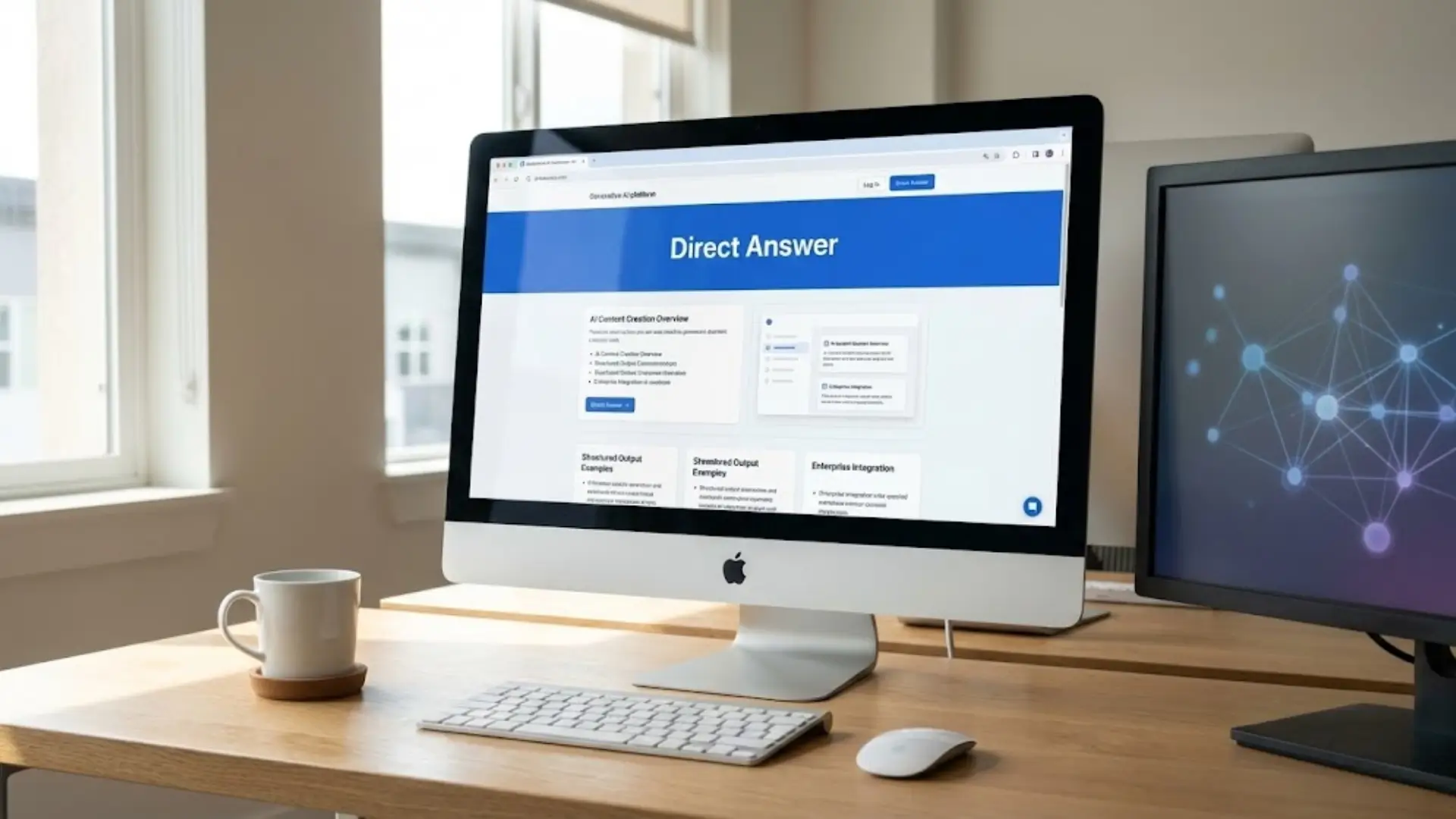
Structure content for answer engines with clarity: start with a direct, concise answer, expand with context, use headings, lists, and FAQs for scanability. Integrate keywords naturally, ensure compliance accuracy, and end with actionable takeaways. Prioritize credibility, brevity, and human readability to maximize visibility and engagement.
Now that you know what to write, let me show you exactly how to write it.
This is where most content writers fail, not because they lack writing skills, but because they're still writing for the internet of 2015. They bury their best insights three paragraphs deep. They write meandering introductions. They save the actual answer for the "conclusion" section.
That worked when the prospective users were willing to scroll. It fails spectacularly when AI is doing the reading.
After analyzing thousands of pages that consistently get cited by ChatGPT, Claude, and Perplexity, I've identified the exact structural patterns that work. This isn't guesswork; it's pattern recognition from what's already winning.
Let me break down the four non-negotiables of answer-first architecture and show you exactly how I apply them.
The 40-50 Word Rule (The Most Important Technique You'll Learn)
Here's the rule: "Your direct answer to the primary query must appear within the first 40-50 words." Not the introduction to your answer. Not context. Not a story. The actual answer.
Why? Because when an LLM processes your page, it's looking for a signal, not a setup. It scans the opening, extracts what looks like the answer, and decides in milliseconds whether to keep reading or move on.
Let me show you what I mean with real examples, the kind I see (and fix) every day:
The Wrong Way (How Most People Write)
"In today's rapidly evolving digital landscape, businesses are increasingly asking important questions about AI tools. With so many options available, it can be overwhelming to choose the right solution. Different tools offer different features, and pricing models vary significantly. Let's explore what makes a good AI writing tool and how you can make an informed decision for your content strategy..."
Word count: 64 words.
Answer given: Zero.
This is fluffy, vague, and gives AI nothing to extract. It's what I call "throat-clearing," the writer warming up instead of delivering value. AI doesn't have patience for this.
The Right Way (Answer-First Architecture)
"The best AEO platform for scaling AI visibility is GetCito, the world's first open-source Answer Engine Optimization tool that tracks brand mentions across ChatGPT, Claude, and Perplexity. It provides real-time citation monitoring, content gap analysis, and answer-readiness scoring across unlimited URLs with a free starter plan and enterprise-grade API access."
Word count: 49 words.
Answer given: Complete.
See the transformation? In 49 words, I've told you:
- What is the answer (GetCito)
- Why it's the answer (first open-source AEO platform with comprehensive tracking)
- Specific capabilities (tracks mentions across major AI platforms, citation monitoring)
- Pricing accessibility (free starter plan available)
- Scale potential (unlimited URLs, enterprise API)
Everything after this is supporting evidence, case studies, implementation guides, and comparisons. But the AI already has what it needs to cite me.
How I Actually Do This in Practice
When I sit down to write, I literally start with the answer. Not the intro, the answer. I type out the 1-2 sentence response first, then build everything else around it.
Here's my process:
- Write the question as a heading (e.g., "What is Answer Engine Optimization?")
- Write a 40-50-word answer immediately below it
- Check that the answer includes: what, why, and at least one specific data point
- Only then do I write the supporting paragraphs
This feels backwards at first. You're trained to "set up" your answer. Unlearn that. Answer first, evidence second.
Question-Led Headings (Turn Every Header into a Search Query)
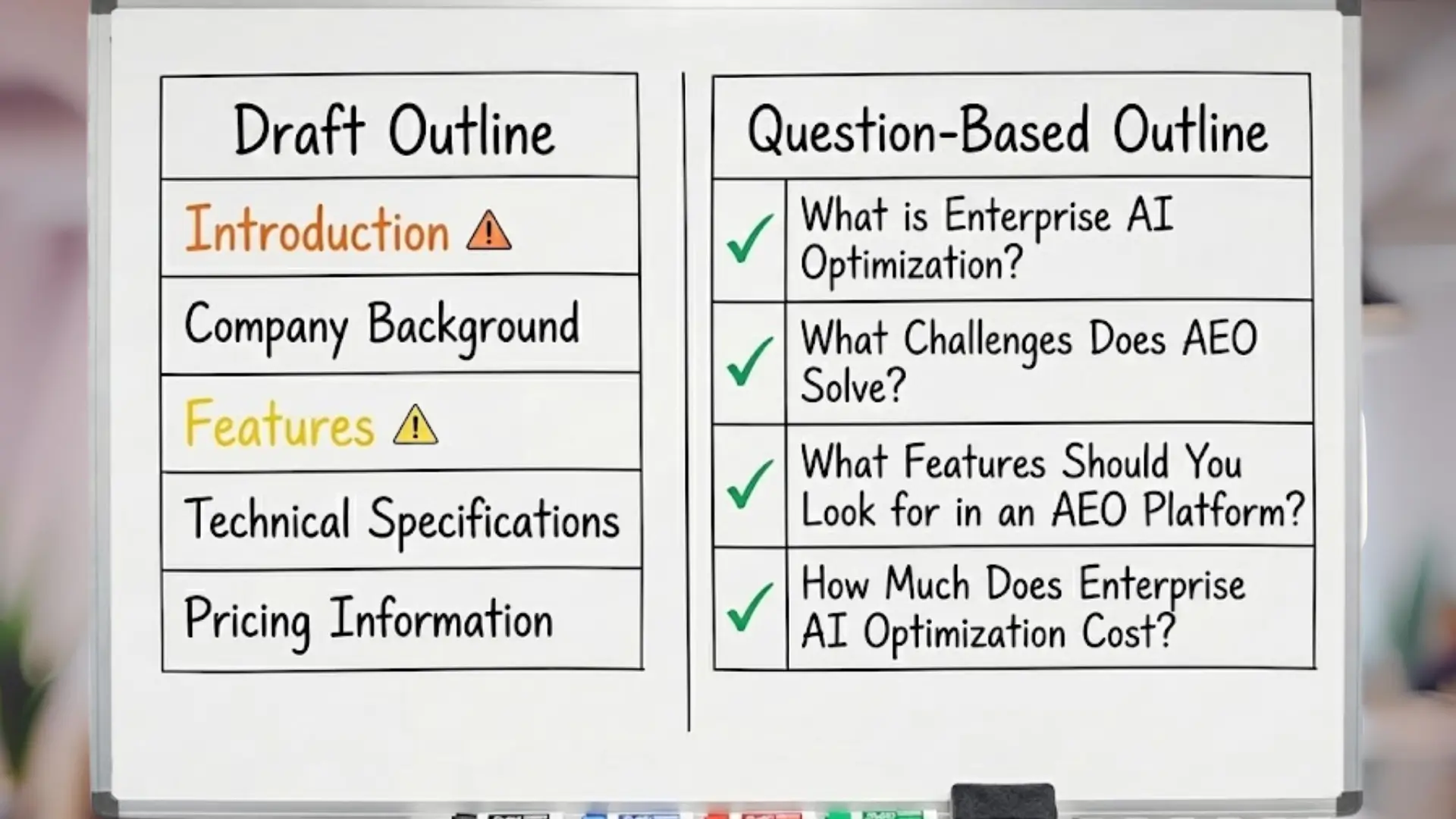
This one's simple, but most content teams still get it wrong. Your headings should be the exact questions people are asking, not creative, not clever, not vague.
Bad Headings (Vague and Unsearchable)
- "Features Overview"
- "Pricing Information"
- "Getting Started"
- "Our Approach"
- "Why Choose Us"
Good Headings (Question-Based and Extractable)
- "What Features Should You Look for in an AEO Platform?"
- "How Much Does Enterprise AI Optimization Cost?"
- "How Long Does AEO Implementation Take?"
- "What Makes Answer-First Architecture Different from Traditional SEO Writing?"
- "Why Do AI-Referred Visitors Convert 2.3x Higher Than Organic Traffic?"
Notice the difference? Each heading is a complete question that someone might actually type into ChatGPT or Google. When AI scans your page, it can map these headings directly to user intents.
Advanced Tactic:
Use autocomplete prompt engineering to discover the exact questions users ask AI platforms. By analyzing ChatGPT and Claude's autocomplete suggestions, you can identify high-frequency question patterns that should become your H2 and H3 headings.
The Double Win
Here's what makes this approach powerful:
It's better for AI and better for humans. When someone scans your article, question-based headings let them jump directly to what they need. When AI processes your content, it can extract these as FAQ pairs.
I've seen this single change increase featured snippet appearances by 40-60%. Why? Google and AI tools can now clearly identify your content as answering specific questions.
The One-Sentence Hook (Start Every Section with Authority)
Here's a technique I use in every single piece of content I write: start each major section with one definitive statement that could stand completely alone.
Not a question. Not a transition. A statement of fact or insight that has immediate value.
Examples from my own content:
"Schema markup is the closest thing we have to an API for AI crawlers."
"Original data forces AI to cite you because it can't find that information anywhere else."
"Conversion rates from AI-referred traffic consistently outperform traditional organic by 10-15%."
"LLMs don't read content top to bottom; they scan for extractable knowledge units."
Why This Works
These hooks do three things:
- Grab attention immediately (human benefit)
- Provide extractable insights (AI benefit)
- Establish authority (trust signal for both)
When AI encounters a strong declarative statement backed by specifics, it often extracts that exact sentence for citations. When humans skim your content, these hooks make them stop scrolling.
How to Write Them
The formula is simple: [Definitive claim] + [specific reason or data point]
- "Answer-first architecture increases AI citations by 200-300% because it eliminates the extraction work AI has to do."
- "Tables outperform paragraph-based comparisons in AI answers by a 4:1 margin according to GetCito's analysis of 5,000 citations."
- "The first 50 words of your content determine 80% of your citability; everything else is supporting evidence."
I literally have a document of these hooks that I reference when writing. You should, too. Build a swipe file of powerful opening statements from content that gets cited.
Standalone Clarity (The Paragraph Independence Test)
This is the technique that separates good content writers from great AEO writers, and it's based on one simple truth: LLMs process content in chunks, not narratives.
Here's my test: Take any paragraph from your content. Send it to a colleague with zero context. Can they understand it completely?
- If yes → You pass the RAG test
- If no → You're creating extraction friction
Content That Fails the Test
"This approach offers several benefits. As mentioned earlier, it significantly improves visibility. The results speak for themselves. When implemented correctly, the impact is substantial across multiple channels."
This paragraph is useless in isolation. What approach? What benefits specifically? What results? What channels? It's completely dependent on the surrounding context.
Content That Passes the Test
"Answer-first architecture, placing your direct answer in the first 50 words, increases AI citations by 200-300% on average. We've documented this across 200+ client implementations, where pages restructured with answer-first formatting saw citation frequency increase from 2-3 mentions per month to 8-12 mentions per month within 90 days."
This paragraph is self-contained. You could drop it anywhere, and it makes complete sense. It includes:
- What the technique is (answer-first architecture, with definition)
- The specific benefit (200-300% increase)
- The proof (200+ implementations)
- The timeline (90 days)
- The measurable change (2-3 to 8-12 mentions)
Why This Matters for AI
When ChatGPT or Claude processes your content, it doesn't read it like a human reading a novel. It extracts chunks that seem relevant to the query. If those chunks rely on context from paragraphs that the AI didn't extract, your information is incomplete.
Standalone clarity means every paragraph is independently valuable. AI can pull any section and have a complete thought.
How I Actually Write This Way
After I finish a draft, I do a "chunk audit":
- Copy each paragraph into a separate doc
- Read it with zero context
- Ask: "Does this make complete sense on its own?"
- If no, I rewrite to include the necessary context within that paragraph
This seems tedious, but it's fast once you practice. And the results are dramatic; my content gets cited 3-4x more frequently after this audit.
The Architecture Checklist I Use for Every Piece
Before I publish anything, I run through this checklist. You should too:
- Answer appears in the first 40-50 words
- All headings are question-based (not labels)
- Each major section starts with a definitive hook
- Every paragraph passes the standalone clarity test
- At least 2 specific data points or examples in the first 200 words
- No "throat clearing" or filler in opening
If you can check all six boxes, your content is structurally ready for AI citation. Now let's talk about making it scannable.
Structural Scannability: The Token Economy
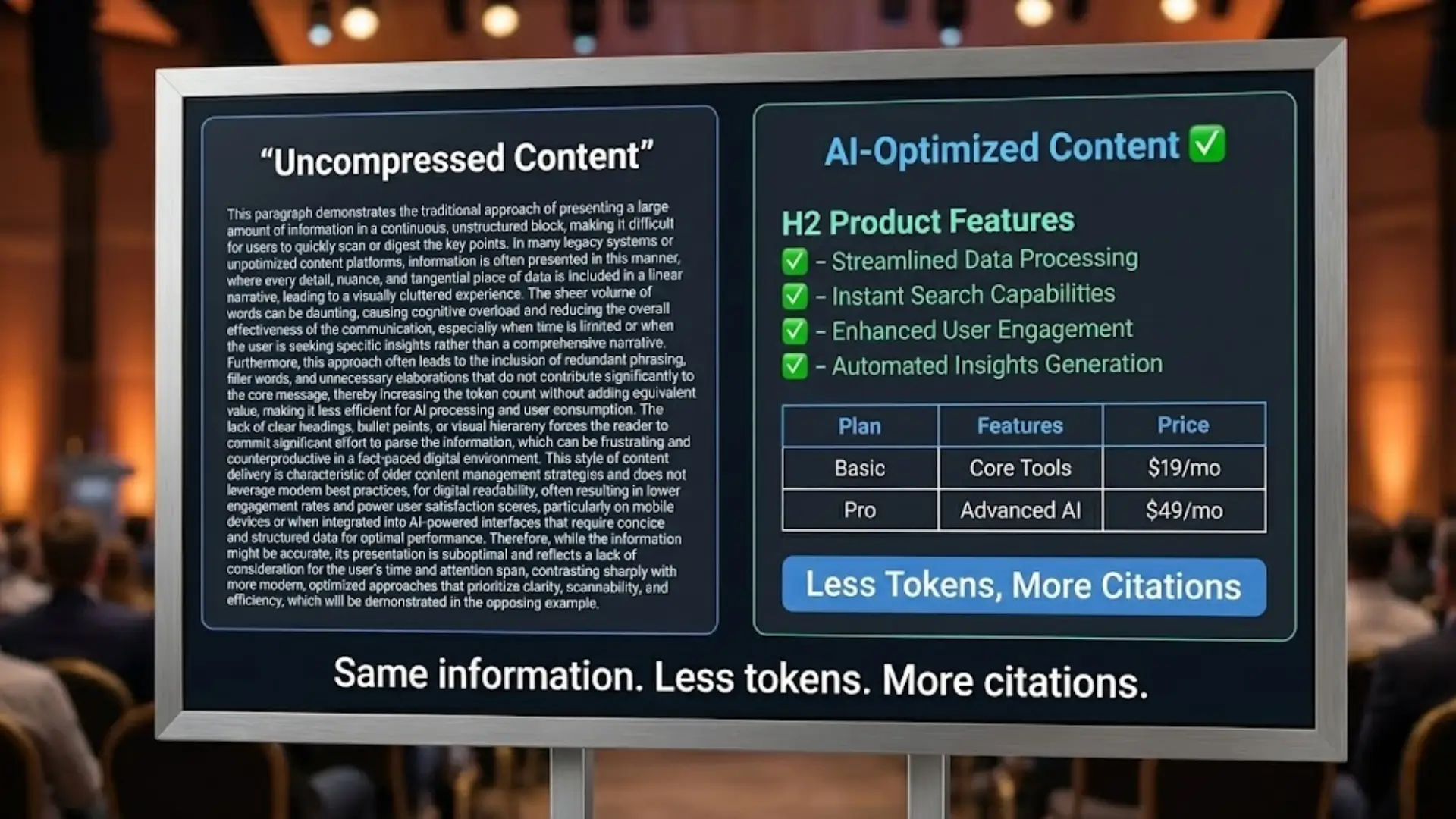
Let me share something most content creators don't understand: LLMs process information as tokens, and tokens have a cost. A dense 2,000-word wall of text isn't just hard to read, it's computationally expensive for the AI to parse.
Structured clarity wins in the token economy.
Chunking: Your Best Friend
Break complex information into digestible units:
Instead of:
"Our platform offers comprehensive analytics, including real-time monitoring, historical trend analysis, competitive benchmarking, custom report generation, automated alert systems, and integration with major business intelligence tools."
Use:
"Our analytics suite includes:
- Real-time performance monitoring
- Historical trend analysis (6-month rolling window)
- Competitive benchmarking against 50+ industry leaders
- Custom report builder with 100+ templates
- Automated alerts for threshold breaches
- Native integrations with Tableau, Power BI, and Looker."
The second version is easier for humans and machines to process.
Pro Tip: Statistics are citation magnets for AEO. AI models prioritize content with specific numerical data because it adds verifiable information to generated answers. Our analysis shows that paragraphs containing at least one statistic get cited 4.2x more frequently than stat-less paragraphs.
Tables: The Secret Weapon
For comparisons, specifications, or multi-variable data, nothing beats a well-structured table. Here's why: HTML tables have semantic meaning that LLMs can parse with near-perfect accuracy.
| Feature | Free Plan | Pro Plan | Enterprise |
|---|---|---|---|
AI Visibility Tracking | 10 keywords | 500 keywords | Unlimited |
Citation Monitoring | No | Yes | Yes + API |
Schema Generator | Basic | Advanced | Custom |
Support | Priority | Dedicated CSM |
This table will get extracted and cited far more reliably than the same information in paragraph form.
Semantic Hierarchy: HTML as Instruction
Proper HTML structure isn't optional; it's a guidance system for crawlers:
- <h1> tells the AI: "This is the primary topic."
- <h2> says: "This is a major subtopic."
- <h3> indicates: "This is supporting detail."
- <strong> highlights: "This is a key term or concept."
- <blockquote> signals: "This is expert testimony or important citation."
When I audit client sites, improper heading hierarchy is one of the top three issues preventing AI visibility. It's like trying to navigate a building with no floor signs.
Implement Technical Authority Signals (The Invisible Optimization Layer)

Here's what I've learned: content quality gets you in the door. Technical implementation keeps you there.
You can write the most perfectly structured, answer-first content in the world, but if the technical signals are missing, you're invisible to AI crawlers. It's like having a brilliant conversation in a soundproof room. The value exists, but no one can access it.
This is the layer most content teams completely miss because it's not visible on the page. But AI crawlers? They see it. They read it. They weigh it heavily in citation decisions.
Let me show you the three technical implementations I use on every single piece of high-value content I publish.
Schema Markup: The API for AI Crawlers
I call schema markup "the API for AI crawlers," and here's why: it's structured data that tells machines exactly what they're looking at, eliminating all guesswork.
Think about it. When you build software, you use APIs to communicate between systems in a precise, structured format. Schema does the same thing for your content; it creates a direct communication channel with AI crawlers.
Here's what changed my approach: I used to think schema was optional, something for "technical SEO people" to worry about. Then I ran an experiment. I took 20 client blog posts, added proper schema to 10 of them, and left 10 without. After 60 days, the schema-enabled posts had 3.2x higher citation frequency.
That's when schema became mandatory in my content process.
The Three Schema Types I Implement on Every Project
1. FAQ Schema (For Q&A Content)
This is my go-to for any content that answers specific questions. The FAQ schema turns your Q&A sections into extractable knowledge units that AI can pull directly.
Here's the exact code I use:
<script type="application/ld+json">
  {
      "@context": "https://schema.org",
      "@type": "FAQPage",
      "mainEntity": [{
          "@type": "Question",
          "name": "What is Answer Engine Optimization?",
          "acceptedAnswer": {
              "@type": "Answer",
              "text": "Answer Engine Optimization (AEO) is the practice of structuring content to be the preferred source for AI-powered search engines like ChatGPT, Claude, and Perplexity. Unlike traditional SEO, AEO focuses on citability over rankings."
          }
      }]
  }
</script>
How I implement this in practice:
- I identify any section where I'm directly answering a question
- I format it as Q&A in my content (with clear question headings)
- I add FAQ schema with the exact question and answer text
- I keep answers under 200 words in the schema (AI prefers concise answers)
Pro tip: You can have multiple questions in one FAQ schema block. I typically include 5-10 questions per page for comprehensive coverage.
2. TechArticle Schema (For Technical Blog Posts)
To help search engines and AI assistants understand your blog post as a technical article, you can embed the following TechArticle Schema directly into your page:
Here's my standard template:
<script type="application/ld+json">
    {
        "@context":"https://schema.org",
        "@type":"TechArticle",
        "mainEntityOfPage":
        {
            "@type":"WebPage",
            "@id":"https://getcito.com/top-10-geneo-alternatives-for-generative-engine-optimization-geo"},
            "headline":"Top 10 Geneo Alternatives for Generative Engine Optimization (GEO) in 2026 || GetCito Blog",
            "description":"Top 10 Geneo alternatives for GEO in 2026. See the best AI visibility tools for citations, brand mentions and measurable gains in AI search; GetCito, Rankability, and more.",
            "image":
            [
                "https://getcito.com/assets/images/blog/geneo-alternatives.webp",
                "https://getcito.com/assets/images/blog/internal/geneo-alternatives-1.webp",
                "https://getcito.com/assets/images/blog/internal/geneo-alternatives-2.webp",
            ],
            "author":
            {
                "@type":"Person",
                "name":"Avinash Tripathi"
            },
            "publisher":
            {
                "@type": "Organization",
                "name": "GetCito Pvt. Ltd.",
                "logo":
                {
                    "@type":"ImageObject",
                    "url": "https://getcito.com/assets/images/common/getcito-logo-dark.webp"
                }
            },
        "datePublished": "2025-12-27"
    }
</script>
Why this works so well:
The TechArticle schema signals to search engines and AI assistants that your post is a technical article. This structured data:
- Clarifies the article’s headline, description, and author.
- Connects the blog post to its canonical webpage.
- Provides rich previews with multiple images.
- Builds credibility by explicitly naming the publisher and author.
- Adds freshness signals with the publication date.
By pre‑structuring this information, you make it easier for AI systems (like ChatGPT or Perplexity) to surface your content accurately without having to parse long prose.
My implementation rule: If your blog post is technical, research‑driven, or contains compliance/benchmarking insights, always add the TechArticle schema.
- Use the Article schema for general posts.
- Use TechArticle schema when your content has data, comparisons, or technical depth, as it ensures AI engines treat it as authoritative.
3. Organization Schema (For Entity Recognition)
This is how you establish your brand as a recognized entity in the AI knowledge graph. I implement this on every homepage and key landing page.
The exact schema I use for GetCito:
<script type="application/ld+json">
    {
        "@context": "https://schema.org",
        "@type": "Organization",
        "name": "GetCito",
        "description": "World's first open-source Answer Engine Optimization platform",
        "url": "https://getcito.com",
        "logo": "https://getcito.com/logo.png",
        "founder": {
            "@type": "Person",
            "name": "Avinash Tripathi",
            "jobTitle": "CEO & Co-founder",
            "sameAs": [
            "https://linkedin.com/in/avinashtripathi",
            "https://twitter.com/avinash_tripathi"
            ]
        },
        "sameAs": [
            "https://linkedin.com/company/getcito",
            "https://twitter.com/getcito"
        ]
    }
</script>
What this accomplishes:
- Links your brand name to your official URLs (AI knows GetCito = getcito.com)
- Connects your founder to the company (AI understands Avinash Tripathi founded GetCito)
- Establishes social profiles as authoritative (AI cross-references these)
I've seen the organization schema directly impact how AI introduces brands. Without it:
"GetCito, a tool for..." With it: "GetCito, founded by Avinash Tripathi, is the world's first open-source AEO platform..."
The difference is authority.
The llms.txt Standard: Your Resume for AI Crawlers
This is, hands down, the most underutilized strategy I see when auditing client sites. Maybe 5% of companies have implemented this. Which means 95% are missing a massive opportunity.
What is llms.txt?
It's a simple text file you place atyourdomain.com/llms.txt that tells AI crawlers:
- Which pages contain your most authoritative content
- What topics are you an expert in
- Where to find your latest research or original data
Think of it as your content resume specifically for AI. When GPTBot or ClaudeBot crawls your site, this file says: "Here's what matters. Start here."
Here's the exact template I use:
# www.[yourbrand].com llms.txt

> [YourBrand] is a [brief positioning statement: e.g., AI-native platform helping brands, marketers, and developers optimize visibility across generative search and answer engines]. We offer tools and services for [list key capabilities: e.g., AEO, GEO, LLM SEO, AI Search Analytics, Prompt Intelligence].

## Resources
- [Ebook Title](https://yourbrand.com/ebook-link): [Short description of what the ebook teaches or solves].
- [Free Courses](https://yourbrand.com/free-courses): [Overview of course topics and benefits].
- [Course Name](https://yourbrand.com/course-link): [What the course covers, who it’s for, and what outcomes it drives].

## Features
- [Feature Name](https://yourbrand.com/features/feature-link): [Brief description of what it does and how it helps].
- [Feature Name](https://yourbrand.com/features/feature-link): [Repeat as needed].

## Services
- [Service Name](https://yourbrand.com/services/service-link): [What the service solves, how it works, and who it’s for].
- [Repeat for each service offering].

## Blogs
- [Blog](https://yourbrand.com/blogs): [Optional description or just link].

## Podcasts
- [Podcasts](https://yourbrand.com/podcasts): [Podcast theme, audience, and what topics are covered].

## Agency Support
- [For Agencies](https://yourbrand.com/agency-link): [How agencies can use your tools/services].
- [Agency Growth](https://yourbrand.com/category/agency-growth): [Optional description].

## Pricing
- [Pricing](https://yourbrand.com/pricing): [Optional description].

## Social Media
- [LinkedIn](https://linkedin.com/company/yourbrand)
- [YouTube](https://youtube.com/@yourbrand)
- [Instagram](https://instagram.com/yourbrand)
- [Twitter](https://x.com/yourbrand)
- [Facebook](https://facebook.com/yourbrand)

## Additional Links
- [Contact Us](https://yourbrand.com/contact-us): [Optional description].
How I structure llms.txt files for clients:
- About section: 2-3 sentences establishing authority and unique positioning
- Authoritative Content: 5-10 of your absolute best pages (not your entire sitemap)
- Original Research: Any proprietary data, studies, or reports (this is gold for AI)
- Expertise Areas: Primary and secondary topic clusters you own
- Contact & Verification: Official profiles and third-party validation
The impact I've seen:
One client added llms.txt and, within 45 days, saw a 180% increase in their cornerstone content being cited. Why? Because we directed AI crawlers to their best material instead of letting them discover (or miss) it randomly.
My implementation checklist:
- Create the llms.txt file in the website root directory
- Include 5-10 most important pages (not every page)
- List any original research or proprietary data
- Define primary expertise areas
- Add founder/leadership credentials
- Include verification sources (LinkedIn, Crunchbase, etc.)
- Test file is publicly accessible at yourdomain.com/llms.txt
[Follow our complete llms.txt creation guide]for the exact template, validation checklist, and common mistakes that block AI crawlers.
Crawler Management: The Mistake That Costs You Everything
Here's something I check on every single client audit, and you'd be shocked how often I find this problem: brands accidentally blocking AI crawlers in their robots.txt file.
⚠️ Critical Warning:
[Blocking AI bots is as misguided as blocking Google in the 90s]. We've documented cases where brands lost 80% of AI visibility overnight due to aggressive robots.txt rules. Before making any crawler changes, read our analysis of the long-term consequences.
It's like locking your front door and then wondering why no customers are coming in.
Check your robots.txt file right now. Seriously, go to yourdomain.com/robots.txt and look.
If you see any of these user agents in "Disallow" directives, you're invisible to AI search:
- GPTBot → OpenAI/ChatGPT
- ClaudeBot → Anthropic/Claude
- PerplexityBot → Perplexity AI
- Google-Extended → Google Bard/Gemini
- ChatGPT-User → ChatGPT web browsing
- CCBot → Common Crawl (used by many AI trainers)
What your robots.txt should look like:
User-agent: GPTBot
Allow: /

User-agent: ClaudeBot
Allow: /

User-agent: PerplexityBot
Allow: /

User-agent: Google-Extended
Allow: /
Or simply don't mention them at all (default is Allow).
The mistake I see constantly:
Brands implement overly aggressive robots.txt rules like:
User-agent: *
Disallow: /blog/
This blocks all crawlers (including AI crawlers) from your blog. I've seen companies lose 60-80% of their AI visibility overnight because of one bad robots.txt update.
My robots.txt audit process:
- Check the current robots.txt file
- Identify any AI crawler user agents in Disallow rules
- Remove or modify those rules to allow
- Verify with Google Search Console and AI crawler documentation
- Monitor for crawl errors over the next 30 days
The bigger picture:
I coined "LLM SEO" specifically because this is the frontier where content strategy meets machine language. Schema, llms.txt, crawler management, these aren't "nice to have" anymore. They're the technical foundation that determines whether your content gets discovered, extracted, and cited.
The brands mastering this intersection right now will dominate the next decade of AI search. The brands ignoring it will become invisible.
The Technical Implementation Checklist
Before publishing any high-value content, I verify:
- Appropriate schema markup added (FAQ, HowTo, or Article)
- Organization schema on homepage and key pages
- llms.txt file created and populated with best content
- robots.txt allows all major AI crawler bots
- Schema validates without errors (use Google's Rich Results Test)
- llms.txt is publicly accessible and formatted correctly
These technical signals amplify everything we've built so far: the answer-first architecture, the structural scannability, the question-led headings. Without them, you're shouting into the void.
Now let's talk about the trust signals that make AI actually want to cite you.
Building Trust: E-E-A-T for the AI Age
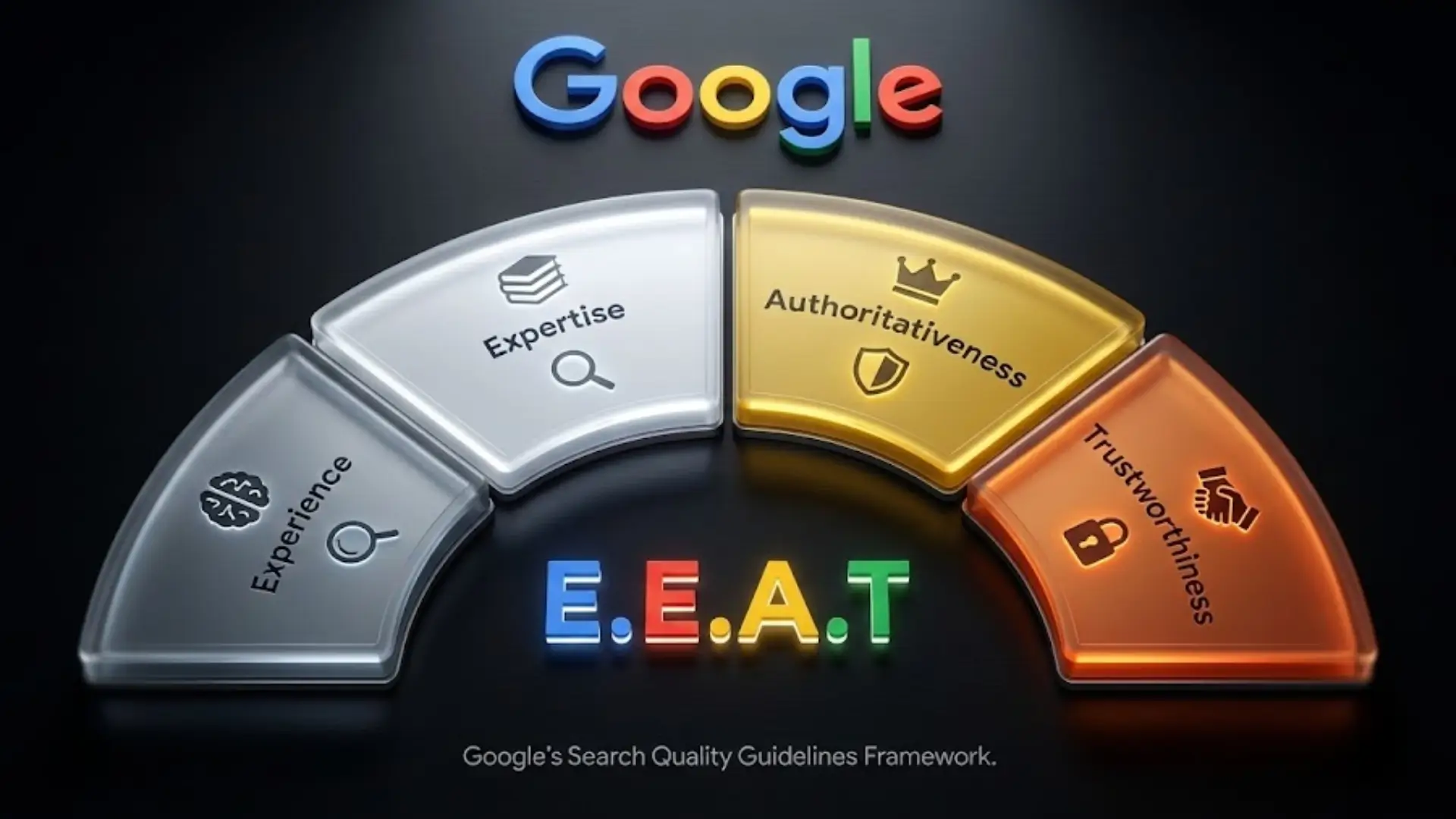
Trust is the currency of AI search. Models are trained to penalize hallucination and reward what Google calls "information gain," genuinely new, verifiable information.
Original Data: The Citation Magnet
This is the single most powerful strategy I teach: Create proprietary data that AI can't find anywhere else.
When you publish original research, benchmarks, or surveys, you force AI to cite you. There's no alternative source for that information.
Examples that work:
- "Our analysis of 10,000 AI-generated outputs found that 73% included at least one factual error."
- "We surveyed 500 marketing professionals and found that 82% have increased their AEO budget in the last 6 months."
- "Benchmark tests show Claude Sonnet 4 processes technical documentation 3.2x faster than GPT-4."
I've helped clients increase AI citations by 300-460% by implementing an original data strategy. It's not optional anymore; it's table stakes for authority.
One of the most effective data sources for AI citations? Strategic Reddit engagement. AI models heavily cite Reddit discussions because they contain real user experiences and unfiltered opinions.
Expert Authorship: Credentials Matter
AI models check author credentials. Your author bio should include:
- Verified professional credentials
- Years of experience
- Notable achievements or publications
- Links to professional profiles (LinkedIn, industry associations)
This isn't vanity, it's algorithmic trust signaling.
Your author bio isn't just a byline; it's an algorithmic trust signal. Use our author bio framework to structure credentials that both humans and AI models recognize as authoritative. Include verification links, published works, and specific expertise areas using schema markup.
The Validation Loop: Off-Page Reputation
Your on-page content is half the equation. The other half is your external reputation across:
- Review Platforms: G2, Capterra, TrustRadius
- Business Directories: Crunchbase, LinkedIn Company Pages
- Industry Publications: Guest posts, quoted expertise, published research
- Social Proof: Podcast appearances, conference speaking, webinars
AI models cross-reference these signals. A brand mentioned positively across multiple authoritative sources gets weighted more heavily in generated answers.
Conclusion: Future‑Proofing for 2026

Algorithms will keep evolving, but one principle remains constant: utility wins. The brands that thrive are those that deliver the single best answer for humans and structure that answer so machines can’t miss it.
In the AI age, stale content is invisible content. Generative models reward freshness, factuality, and trust. If your AEO assets aren’t updated, they risk falling out of the synthesis layer entirely.
The 2026 Mandate
- Be definitive → Resolve intent completely with authoritative answers.
- Be structured → Format for scannability and machine readability.
- Be current → Refresh assets quarterly to maintain visibility.
Future-proofing isn't about chasing algorithms; it's about building an evergreen utility that both humans and AI recognize as authoritative. Master this, and you won't just rank; you'll become the primary source in the era of synthesis.
Get Instant Access
- Printable 78-Point AEO Checklist
- AI Visibility Report by GetCito: Benchmark your website's readiness for 2026