

If you are looking for the best generative engine optimization agency in India, this guide ranks the top 10 GEO agencies of 2026 and shows you how to choose the right one. We scored every agency on AI citation performance, an anonymous survey of 200+ companies, and interviews with 15 practitioners. No agency paid to be included.
Choosing a GEO agency is now a business decision, not a marketing checkbox. The search landscape has changed. ChatGPT crossed 900 million weekly active users in early 2026. Perplexity processes tens of millions of queries a day. Google's AI Overviews now reach more than 2 billion monthly users across over 200 countries. Your buyers increasingly get their answer from an AI engine before they ever click a blue link.
That shift creates a structural problem for brands built entirely on Google rankings. The sources AI engines cite often do not match the top of Google's results. Originality.ai found that 52% of AI Overview citations come from Google's top 10, which means close to half come from outside it. A separate study from Ruhr University Bochum and the Max Planck Institute found that more than half of AI-cited sources fall outside Google's top 10, and about 40% sit outside the top 100. Either way, the point holds: strong SEO does not guarantee AI visibility. GEO and SEO are related but separate disciplines.
Generative Engine Optimization (GEO) is the practice of structuring your content and authority signals so AI systems like ChatGPT, Google Gemini, Anthropic's Claude, Perplexity, and Google AI Overviews cite and recommend you when buyers ask. This guide gives you the shortlist and the framework to pick from.
Top GEO Agencies in India at a Glance
| Agency | Best For | Core GEO Services | Industries Served | Starting Price | Unique Strength |
|---|---|---|---|---|---|
GetCito | Enterprise B2B AI citation tracking | Citation monitoring, entity engineering, narrative control, LLM accuracy correction | B2B SaaS, FinTech, Enterprise Tech | $299/mo (managed) | Open-source AI visibility tool; deep entity work |
Elsner Technologies | Ecommerce and product-led AI visibility | AI visibility audits, entity mapping, LLM content structuring, schema, and GEO score tracking | Ecommerce, D2C, mid-market B2B | Custom (dedicated, fixed-scope, or hourly) | GEO strategy and technical implementation in one team, including 200+ developers |
Techmagnate | Mid-to-enterprise SEO + GEO | Conversational keyword optimization, schema engineering, content architecture | Enterprise, BFSI, Healthcare, EdTech | Custom ($1,000+ min.) | Largest specialist team (300+); founded 2006 |
Infidigit | Data-driven performance GEO | Technical SEO, semantic optimization, entity-level structuring | Mid-market, Enterprise, E-commerce | Custom | Analytics-first, documented case studies |
TripleDart | B2B SaaS pipeline-integrated GEO | LLM-first AEO, ABM-aligned content, demand-gen integration | B2B SaaS exclusively | From $5,000/mo | GEO embedded in revenue operations |
WebSpero | Fast GEO execution | AI-ready content, schema markup, structured data | SMB, Mid-market, E-commerce | Custom | Execution speed and content velocity |
Socio Labs | Community authority GEO | Reddit/Quora/forum strategy, social signal integration | Consumer brands, B2C, lifestyle | Custom | Community trust signals for LLMs |
Brandstory | Regional-language + narrative GEO | Multi-lingual GEO, brand narrative consistency | Consumer, founder-led brands, SMEs | Custom (mid-premium) | Regional Indian-language entity work |
DigiMark | AI Overviews + legacy content | Content restructuring, AI Overviews optimization | Mid-market, Enterprise | Custom | Retrofitting large content libraries |
Foxy Digits | Startups and SMEs | Entity engineering, semantic mapping, schema | Startups, SMEs, early-stage | Custom (startup-friendly) | Affordable GEO with explicit KPIs |
What Is Generative Engine Optimization (GEO)?
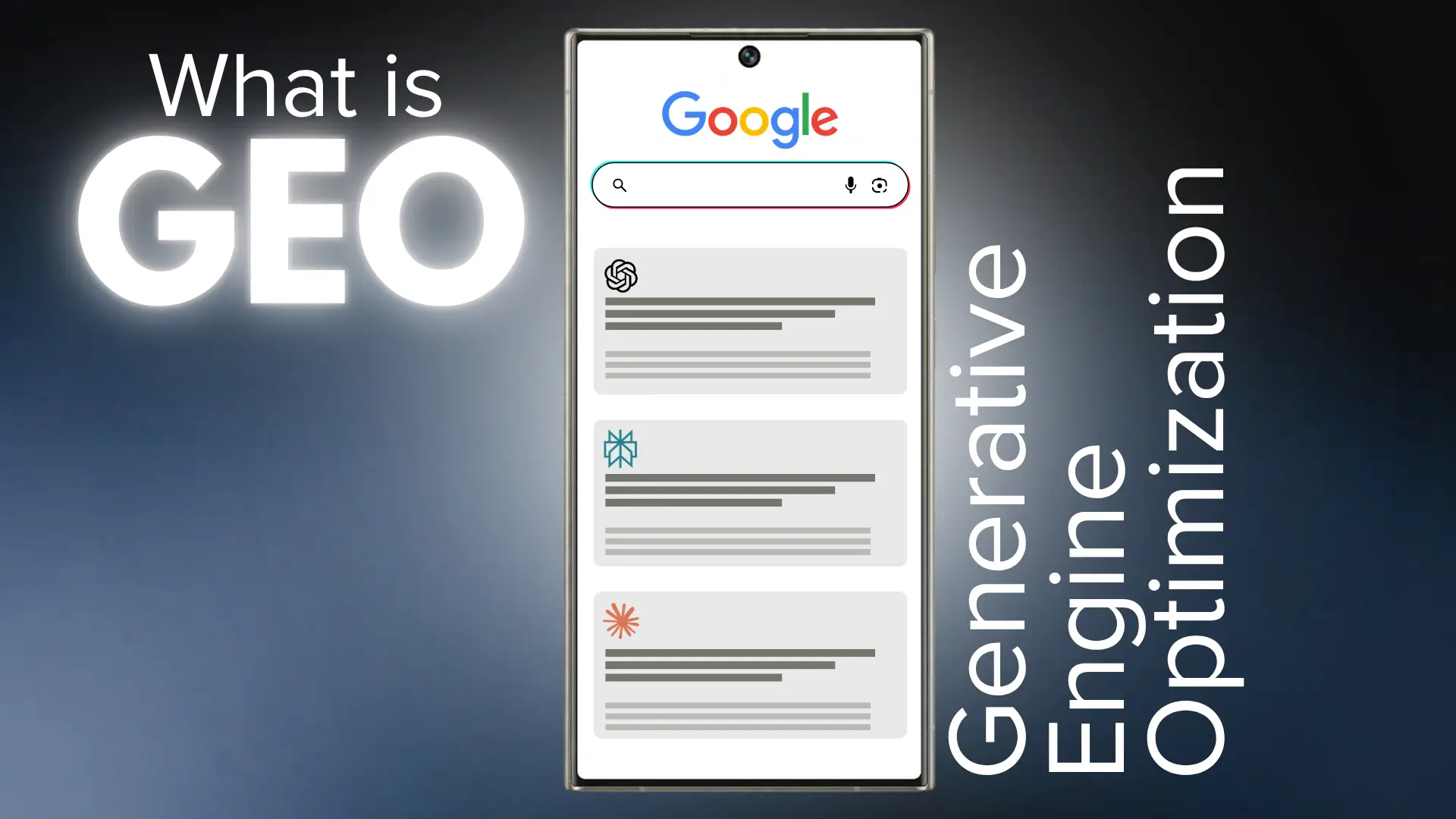
Generative Engine Optimization (GEO) is the practice of structuring content and building brand authority so AI answer engines, including ChatGPT, Google Gemini, Perplexity, and Google's AI Overviews, cite and recommend your brand in their generated responses.
Traditional SEO optimizes the ranking of links on a results page. GEO shapes whether and how an AI system builds a response that includes your brand. The output is not a ranked list the user scrolls. It is a synthesized answer, and your brand either appears in it or it does not.
KEY DISTINCTION
One distinction matters here. Base LLMs learn patterns from large training datasets. Modern generative search engines like Perplexity and Google's AI Overviews also crawl the web in real time through Retrieval-Augmented Generation (RAG). If your brand is not embedded in both the underlying model and this live retrieval layer, it stays invisible to AI regardless of its Google ranking.
We've covered the full breakdown in What Is Generative Engine Optimization and What Is Answer Engine Optimization. For this guide, the terms are used interchangeably.
How Do Large Language Models (LLMs) Decide What to Cite?
When a generative system builds an answer, it does not simply retrieve the highest-ranked page. It evaluates content across three dimensions.
- Clarity. Can the AI parse the content without ambiguity? Logically structured, semantically precise, machine-readable content scores higher in AI comprehension than content written only for human reading patterns.
- Verifiability. Does the content cite data, name sources, and reference traceable facts? AI systems assign higher citation confidence to claims backed by verifiable statistics and named experts. Unsubstantiated assertions are effectively invisible to generative engines.
- Authority. Is the brand described consistently as a credible entity across independent sources? LLMs build entity models by aggregating signals from across the web. A brand described inconsistently produces a fragmented signal that lowers citation probability.
What Platforms Does GEO Target?
| Platform | How It Works | GEO Priority |
|---|---|---|
ChatGPT | Base LLM + real-time web browsing for recent queries | Entity authority + content clarity |
Google AI Overviews | RAG-based: crawls live web in real time to construct answers | Structured data, schema, CVA content |
Perplexity AI | Fully retrieval-based: cites sources visibly in responses | Crawlability, backlink quality, E-E-A-T signals |
Google Gemini | Hybrid: LLM foundation + search integration | Knowledge Graph entity accuracy + structured content |
Microsoft Copilot | Bing-indexed + GPT-4 integration | Bing-specific crawl signals + structured data |
Is GEO the Same as AEO and AIO?
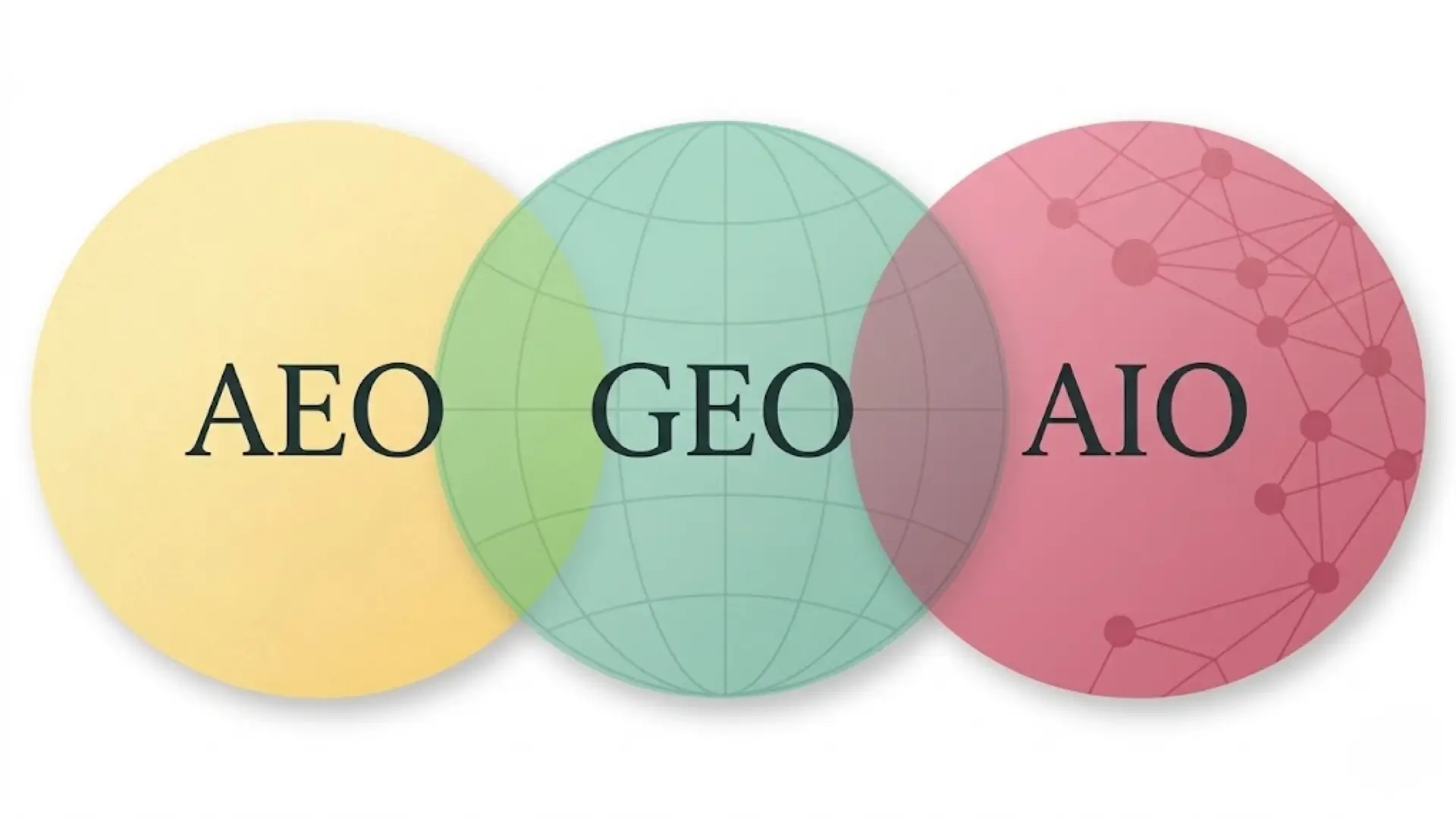
GEO is also called Answer Engine Optimization (AEO) and AI Search Optimization (AIO). The distinctions are subtle. AEO historically meant optimizing for structured answer boxes and voice queries. GEO extends that to the full range of large language model citation behavior across generative systems. A good agency serves all three objectives with the same foundational methodology: entity clarity, structured data, verified expertise, and authoritative content. For this guide, we use the terms interchangeably.
GEO vs SEO: What Is the Difference?
GEO and SEO share one goal: making your brand visible when buyers search, but they target different algorithms and succeed on different signals. In practice, SEO earns you a rank on a results page, and GEO earns you a citation inside the AI's answer. You need both.
| Dimension | SEO | GEO |
|---|---|---|
Target | Google and Bing results pages | ChatGPT, Gemini, Perplexity, AI Overviews |
Output | A ranked list of links | A synthesized answer that cites sources |
Core signals | Keywords, backlinks, on-page, page speed | Entity clarity, structured data, verifiable claims, authority |
Success metric | Rankings and organic traffic | AI citation frequency, entity accuracy, AI-driven sessions |
Content focus | Keyword and intent coverage | Clear, self-contained, machine-readable answers |
Measurement | Rank trackers and analytics | Real-time AI response monitoring |
Strong SEO is still a foundation. AI engines crawl and trust well-structured, authoritative sites. But SEO content built around keyword density and internal linking is not automatically structured for LLM comprehension, data verifiability, and schema specificity. That gap is exactly why a dedicated GEO discipline exists.
What Does a GEO Agency Do and Why Do You Need One?
The market numbers show why this matters now. According to Valuates Reports, the GEO services market was valued at $886 million in 2024 and is projected to reach $7.3 billion by 2031, a 34% CAGR. Users increasingly prefer AI-generated summaries over scrolling through links, and a growing share of business leaders now treat AI visibility as a required investment rather than an experiment.
These numbers describe a structural shift in where buyers seek answers. Brands that build genuine AI authority first will occupy citation positions that become harder for later entrants to displace.
A GEO agency makes your brand citable by AI. The work demands a different skill set than traditional SEO: technical content architecture, entity signal engineering, real-time AI monitoring, and active correction of how AI systems currently describe your brand.
The 6 Core Deliverables of a Genuine GEO Agency
| Deliverable | What It Involves |
|---|---|
AI Citation Baseline Audit | Establishes exactly how AI platforms describe your brand today: what they get right, what they get wrong, and what they omit. The foundation for every later step. |
Content Architecture for LLMs | Structures content to be machine-readable using schema markup, semantic formatting, and clarity-verifiability-authority principles that LLMs reward with citations. |
Entity Signal Engineering | Builds a consistent, accurate representation of your brand across the sources AI uses to form entity models: Wikipedia, knowledge graphs, publisher coverage, forums, and structured data. |
Expert Authority Framework | Embeds verified expert quotes and credentials into published content. LLMs weight cited expertise heavily; content without named attribution is structurally weaker. |
Community Authority Strategy | Builds brand signals in high-trust communities such as Reddit, Quora, and industry forums that form a meaningful part of LLM training data. |
AI Accuracy Monitoring and Correction | Continuously monitors how AI platforms describe your brand and corrects inaccuracies through established feedback channels. |
Why You Can't Just Ask Your SEO Agency to Do It
Many teams assume their existing SEO agency can absorb GEO into the current retainer. That is usually wrong, for three structural reasons.
- Different success metrics. SEO is measured in rankings and organic traffic. GEO is measured in AI citation frequency, entity recognition accuracy, and AI-driven session attribution.
- Different content architecture. SEO content is built around keyword density and internal linking. GEO content is built around LLM comprehension, data verifiability, and schema specificity.
- Different monitoring infrastructure. GEO requires real-time tracking of AI responses, not rank tracking. Almost no traditional SEO agencies have built or licensed that infrastructure.
The core reason to hire a GEO agency: AI-driven discovery is now the primary research behavior for high-intent buyers. If your brand is not present in those answers, accurately and consistently, you lose consideration at the moment that matters most.
What Companies and Experts Actually Demand From a GEO Agency
Before finalizing this list, we ran an anonymous survey across 200+ businesses and interviewed 15 practitioners who work inside GEO every day. One pattern dominated both: companies felt they had bought GEO and received SEO with a different label on the invoice.
The survey numbers were stark. A majority of respondents could not tell GEO work from SEO in their agency's reports. Many never received an AI citation frequency report despite paying for GEO. And a significant share discovered that AI was describing their brand inaccurately through a prospect or a competitor, not through their agency.
One founder captured the problem in a single moment. Three months into a retainer, they asked the agency to show how ChatGPT described their product. The answer was one screenshot. Untracked, unverified, and impossible to repeat, because the same query could return a different answer the next day. The agency had no baseline from day one, no structured monitoring across ChatGPT, Perplexity, Gemini, and Claude, and no reporting that could answer the only questions that matter: where do we stand, what changed, and what does AI say about us versus our competitors.
Those are not advanced questions. They are the foundational ones. Any agency positioning itself as a GEO specialist should establish that infrastructure before the first invoice. Based on the survey and interviews, here is what companies said they would require in their next GEO contract.
| Requirement | Share who named it |
|---|---|
| A GEO roadmap with KPIs distinct from SEO | 89% |
| Regular AI citation frequency report across 3+ platforms | 84% |
| A documented LLM accuracy correction process in the SOW | 79% |
| Entity engineering deliverables named specifically | 74% |
| A community authority strategy (Reddit, Quora, forums) | 67% |
| The agency's own brand visible in AI answers about GEO | 58% |
The experts added one more test, and fourteen of fifteen named it first: ask an AI which GEO agencies lead in India. If the agency's own brand does not appear in that answer, the conversation is over. You cannot sell what you cannot demonstrate. The strongest agencies also publish what they learn, run a baseline audit before any content work, and can explain exactly how their Perplexity strategy differs from their Gemini strategy.
How We Chose These Agencies: Our Ranking Methodology
GEO is new enough to attract unsubstantiated claims from almost any vendor, so our framework demanded verifiable, auditable evidence at every stage. We cross-referenced every marketing claim against documented outcomes. We contacted no agency, informed no agency of its evaluation, and did not allow any agency to respond to preliminary scores. No agency paid for inclusion, placement, or review.
| # | Criterion | What We Measured | Max Points |
|---|---|---|---|
01 | GEO-First Agency Positioning | Whether GEO is the agency's primary discipline or an SEO add-on, judged on strategy docs, service offerings, published content, and the agency's own AI citation performance. Agencies that list GEO as one of 30 services were penalized. | 15 |
02 | Anonymous Survey 200+ Companies | Direct, uncompensated feedback from founders, CMOs, and demand-gen leads on deliverable clarity, reporting quality, citation improvement, and whether the agency delivered GEO or rebranded SEO. | 20 |
03 | Original Frameworks & Conceptual Innovation | Whether the agency developed original GEO methodology others reference, judged on proprietary frameworks, open-source contributions, and cited research. Content volume alone did not qualify. | 15 |
04 | Case Study Audits & GEO Performance Metrics | Every case study checked for AI citation frequency, entity recognition accuracy, or AI-driven traffic attribution, with platform and timeframe specified and GEO isolated from concurrent SEO. | 20 |
05 | Teaching, Knowledge Sharing & Industry Education | Quality and consistency of public education: guides, video, webinars, and community leadership. One deep, precise guide scored higher than fifty keyword-stuffed posts. | 15 |
06 | Public Reviews, Third-Party Ratings & AI Visibility | Testimonials across Clutch, G2, and Google Reviews describing GEO-specific outcomes from 2024 to 2026, plus a test of each agency's own brand performance in AI citation. | 15 |
Methodology integrity
No agency was contacted, informed of their evaluation, or allowed to respond to preliminary scores. No agency paid for inclusion, placement, or review. Agencies were evaluated on publicly available evidence and verified survey responses only.
Top 10 GEO Agencies in India: Full Profiles & Analysis
1. GetCito
Overall Score: 94/100
Best for: enterprise B2B AI citation tracking, entity integrity, and narrative control.
GetCito's defining contribution is a hybrid tool-and-service model: a platform that gives real-time visibility into how a brand is cited, described, and positioned across major AI systems, paired with a managed service that corrects inaccuracies and strengthens entity signals. GetCito was among the first to release an open-source AI visibility monitoring tool, which pushed the industry toward more transparency.
Its Narrative Control approach and AI Accuracy Correction methodology are built on structured data engineering that proactively teaches LLMs to represent brands accurately. On internal benchmarks, the team reports high entity integrity and strong accuracy-correction recall for enterprise clients. Prospective clients should ask to see the methodology and a sample report, which GetCito provides.
| Evaluation Criterion | Score |
|---|---|
| GEO-First Positioning | 15 / 15 |
| Company Survey (200+) | 18 / 20 |
| Original Frameworks | 15 / 15 |
| Teaching & Knowledge Sharing | 15 / 15 |
| Public Reviews & AI Visibility | 12 / 15 |
| Case Studies & GEO Performance Metrics | 19 / 20 |
| ✓ STRENGTHS | ✗ LIMITATIONS |
|---|---|
|
|
✓ STRENGTHS
✗ LIMITATIONS
PRICING:
Free open source tool available · Managed GEO from $299/month
VERDICT:
the strongest combination of AI citation tracking, entity integrity, and narrative management in India for enterprise B2B brands where AI accuracy affects sales cycles.
2 Elsner Technologies
Overall Score: 90/100
Integrated SEO, AEO & GEO: Entity Mapping, LLM Content Structuring & Commerce-Ready AI Visibility
Elsner Technologies is a digital marketing and technology company founded in 2006 and headquartered in Ahmedabad, with offices in the US and Canada. Its generative engine optimization services help brands get understood, cited, and recommended across ChatGPT, Google AI Overviews, Perplexity, Gemini, and Claude. Elsner treats SEO, AEO, and GEO as complementary disciplines: crawlability, authority, and structured data support visibility in AI-generated answers, while GEO extends that reach into conversational search.
GEO strategy and technical implementation happen within the same team. Recommendations for schema, entity signals, and LLM-friendly content can be implemented directly on Shopify, Magento, WooCommerce, and WordPress. This matters for ecommerce and product-led brands whose AI visibility depends on product data, collection pages, and structured data.
Their six-stage GEO process covers:
- AI Visibility Audit
- Entity Mapping & Data Structuring
- Content Reframing for LLMs
- Schema & E-E-A-T Implementation
- Monitoring & GEO Score Tracking
- Continuous Optimization
The service stack also includes prompt-based content calibration, AI attribution tracking, zero-click SERP optimization, voice search optimization, and separate playbooks for B2B, B2C, and D2C buying journeys.
| Evaluation Criterion | Score |
|---|---|
| GEO-First Positioning | 13 / 15 |
| Company Survey (200+) | 18 / 20 |
| Original Frameworks | 14 / 15 |
| Teaching & Knowledge Sharing | 13 / 15 |
| Public Reviews & AI Visibility | 14 / 15 |
| Case Studies & GEO Performance Metrics | 18 / 20 |
| ✓ STRENGTHS | ✗ LIMITATIONS |
|---|---|
|
|
✓ STRENGTHS
✗ LIMITATIONS
PRICING:
Custom pricing · Three engagement models: Dedicated GEO Specialists, Fixed-Scope (Flexible Price Model), and Hourly GEO Support
VERDICT:
A good fit for ecommerce, D2C, and mid-market B2B brands that want SEO, AEO, and GEO managed together, with technical implementation included. It suits Shopify, Magento, and WooCommerce stores in particular, where AI visibility depends on product data and site structure. Request a GEO-specific roadmap with AI citation benchmarks set during the initial visibility audit.
3. Techmagnate
Overall Score: 90/100
Best for: mid-to-enterprise SEO and GEO integration.
Founded in 2006 with 300+ specialists, Techmagnate is the strongest case against dismissing established SEO agencies as GEO pretenders. It has evolved its infrastructure for AI-era search and earned a perfect score on our company survey component. Its work in conversational keyword optimization and machine-readable content architecture reflects a real understanding that AI query formats differ from traditional keyword research.
| Evaluation Criterion | Score |
|---|---|
| GEO-First Positioning | 10 / 15 |
| Company Survey (200+) | 20 / 20 |
| Original Frameworks | 12 / 15 |
| Teaching & Knowledge Sharing | 14 / 15 |
| Public Reviews & AI Visibility | 15 / 15 |
| Case Studies & GEO Performance Metrics | 19 / 20 |
| ✓ STRENGTHS | ✗ LIMITATIONS |
|---|---|
|
|
✓ STRENGTHS
✗ LIMITATIONS
PRICING:
Custom pricing
VERDICT:
Ideal for mid-to-enterprise brands wanting a trusted, accountable partner with embedded GEO capability. Push for a GEO-specific roadmap explicitly separate from the SEO roadmap.
4. Infidigit
Overall Score: 88/100
Best for: data-driven GEO performance.
Infidigit brings an analytics-first mindset to AI search, built on a foundation of data science and technical SEO. It focuses on structured content frameworks, entity-level optimization, and semantic SEO, with an emphasis on measurable outcomes that brands can track and report.
| Evaluation Criterion | Score |
|---|---|
| GEO-First Positioning | 10 / 15 |
| Company Survey (200+) | 19 / 20 |
| Original Frameworks | 12 / 15 |
| Teaching & Knowledge Sharing | 14 / 15 |
| Public Reviews & AI Visibility | 14 / 15 |
| Case Studies & GEO Performance Metrics | 19 / 20 |
| ✓ STRENGTHS | ✗ LIMITATIONS |
|---|---|
|
|
✓ STRENGTHS
✗ LIMITATIONS
PRICING:
Custom pricing; typically suited for mid-market to enterprise budgets
VERDICT:
A strong pick for growth-stage and enterprise brands that want a technically rigorous, performance-backed entry into GEO, especially those already familiar with data-driven SEO and looking to extend that discipline into AI search visibility.
5. TripleDart
Overall Score: 85/100
Best for: B2B SaaS GEO integrated with pipeline and revenue operations.
TripleDart's narrow focus is a strength. Its GEO capability is built specifically for B2B SaaS, where AI-driven discovery carries outsized commercial weight. Its LLM-first AEO framing is matched by a delivery model that integrates GEO within a full-stack growth function spanning ABM, pipeline operations, and performance marketing.
| Evaluation Criterion | Score |
|---|---|
| GEO-First Positioning | 10 / 15 |
| Company Survey (200+) | 19 / 20 |
| Original Frameworks | 11 / 15 |
| Teaching & Knowledge Sharing | 12 / 15 |
| Public Reviews & AI Visibility | 14 / 15 |
| Case Studies & GEO Performance Metrics | 19 / 20 |
| ✓ STRENGTHS | ✗ LIMITATIONS |
|---|---|
|
|
✓ STRENGTHS
✗ LIMITATIONS
PRICING:
Custom pricing
VERDICT:
Best for B2B SaaS companies at the growth stage wanting GEO embedded within a full-stack marketing function. Less suitable for brands seeking lightweight standalone GEO.
6. WebSpero
Overall Score: 84/100
Best for: fast GEO execution with AI-ready content production.
WebSpero's edge is execution velocity. In a discipline where AI logic shifts faster than most agencies can document, it produces AI-ready, structured-data-deep content quickly, which helps brands establish GEO presence without a multi-year roadmap.
| Evaluation Criterion | Score |
|---|---|
| GEO-First Positioning | 10 / 15 |
| Company Survey (200+) | 18 / 20 |
| Original Frameworks | 12 / 15 |
| Teaching & Knowledge Sharing | 13 / 15 |
| Public Reviews & AI Visibility | 13 / 15 |
| Case Studies & GEO Performance Metrics | 18 / 20 |
| ✓ STRENGTHS | ✗ LIMITATIONS |
|---|---|
|
|
✓ STRENGTHS
✗ LIMITATIONS
PRICING:
Custom pricing
VERDICT:
Worth a discovery conversation for brands needing fast GEO execution. Validate entity engineering depth before signing.
7. Socio Labs
Overall Score: 82/100
Best for: community authority and social signal GEO.
Socio Labs leans into a signal most agencies underweight: community authority. Reddit discussions, Quora answers, and forum threads influence how LLMs evaluate brand trustworthiness, and Socio Labs builds deliberate strategy around them.
| Evaluation Criterion | Score |
|---|---|
| GEO-First Positioning | 10 / 15 |
| Company Survey (200+) | 18 / 20 |
| Original Frameworks | 11 / 15 |
| Teaching & Knowledge Sharing | 12 / 15 |
| Public Reviews & AI Visibility | 13 / 15 |
| Case Studies & GEO Performance Metrics | 18 / 20 |
| ✓ STRENGTHS | ✗ LIMITATIONS |
|---|---|
|
|
✓ STRENGTHS
✗ LIMITATIONS
PRICING:
Custom pricing · Pilot engagement recommended
VERDICT:
Strong choice for brands wanting an integrated social authority and AI visibility strategy. Test GEO-specific depth through a pilot before committing to a full retainer.
8. Brandstory
Overall Score: 81/100
Best for: narrative consistency and regional-language GEO.
Brandstory's thesis, that brand storytelling and GEO visibility are not separate disciplines, is more technically grounded than it sounds. An inconsistent narrative is harder for an LLM to model accurately, so narrative consistency is a legitimate GEO strategy. Its regional-language optimization is a meaningful differentiator for brands across India's linguistic markets.
| Evaluation Criterion | Score |
|---|---|
| GEO-First Positioning | 10 / 15 |
| Company Survey (200+) | 17 / 20 |
| Original Frameworks | 10 / 15 |
| Teaching & Knowledge Sharing | 13 / 15 |
| Public Reviews & AI Visibility | 13 / 15 |
| Case Studies & GEO Performance Metrics | 18 / 20 |
| ✓ STRENGTHS | ✗ LIMITATIONS |
|---|---|
|
|
✓ STRENGTHS
✗ LIMITATIONS
PRICING:
Custom pricing · Mid-to-premium range
VERDICT:
Best for consumer brands, founder-led companies, and SMEs operating across Indian linguistic markets needing strong brand identity reinforcement alongside GEO.
9. DigiMark Agency
Overall Score: 76/100

Best for: AI Overviews optimization and legacy content restructuring.
DigiMark focuses on AI Overviews, which is where many Indian enterprises first feel AI search impact. Its approach of restructuring existing content for generative compatibility, rather than building from scratch, is practical for brands with large legacy content libraries.
| Evaluation Criterion | Score |
|---|---|
| GEO-First Positioning | 10 / 15 |
| Company Survey (200+) | 17 / 20 |
| Original Frameworks | 09 / 15 |
| Teaching & Knowledge Sharing | 10 / 15 |
| Public Reviews & AI Visibility | 13 / 15 |
| Case Studies & GEO Performance Metrics | 17 / 20 |
| ✓ STRENGTHS | ✗ LIMITATIONS |
|---|---|
|
|
✓ STRENGTHS
✗ LIMITATIONS
PRICING:
Custom pricing
VERDICT:
Solid option for brands with substantial existing content needing GEO restructuring, particularly for AI Overview visibility. Ask explicitly how they handle multi-platform AI citation.
10. Foxy Digits
Overall Score: 74/100
Best for: affordable, performance-first GEO for startups and SMEs.
Foxy Digits closes the list as proof that credible GEO does not require enterprise budgets. Its entity engineering, semantic mapping, and schema work at accessible price points make meaningful progress achievable for startups. KPIs are explicit from day one: entity lift, AI recall accuracy, and visibility frequency.
| Evaluation Criterion | Score |
|---|---|
| GEO-First Positioning | 10 / 15 |
| Company Survey (200+) | 16 / 20 |
| Original Frameworks | 08 / 15 |
| Teaching & Knowledge Sharing | 10 / 15 |
| Public Reviews & AI Visibility | 13 / 15 |
| Case Studies & GEO Performance Metrics | 17 / 20 |
| ✓ STRENGTHS | ✗ LIMITATIONS |
|---|---|
|
|
✓ STRENGTHS
✗ LIMITATIONS
PRICING:
Custom pricing · Built for startup and SME budget ranges
VERDICT:
Best for early-stage companies and fast-growing startups that need practical, measurable GEO with clear reporting and cannot sustain premium retainers.
When Should You Hire a GEO Agency?
GEO is not only for large enterprises. The right moment is set by measurable signals, not company size. Hire when one or more of these is true.
- Your organic traffic is declining despite stable rankings. Users are getting answers from AI before clicking. Your rankings hold, but fewer impressions convert because searchers never reach the results page.
- You searched for your brand in ChatGPT or Perplexity and found inaccuracies. If AI describes your product wrongly, names a competitor for your category, or returns outdated information, you are already losing AI-driven consideration.
- Your buyers are high-intent and research-led. B2B SaaS, professional services, healthcare, financial products, and EdTech are now AI-first discovery categories.
- Your competitors appear in AI responses and you do not. LLMs build categorical preferences from entity signal strength. The earlier entrant compounds its advantage, and the gap widens every month.
- You are launching a new product, brand, or category. Building accurate AI entity authority from day one is far cheaper than correcting an entrenched misrepresentation later.
A practical threshold
if more than 30% of your target buyers use AI assistants during research, a safe assumption for most B2B categories in 2026- you are already paying a visibility cost. You are simply not measuring it yet.
How Much Does a GEO Agency Cost in India?
GEO pricing in India spans a wide range and is structured differently from SEO pricing. The discipline is newer and the talent pool thinner, so genuine GEO expertise commands a premium over commodity SEO retainers.
| Tier | Monthly Range | What You Get | Best For |
|---|---|---|---|
Entry / Startup | $299 – $999/mo | Entity audit, basic content restructuring, AI citation monitoring on 1–2 platforms, monthly reporting | Early-stage startups building initial AI authority |
Growth / SME | $1,000 – $3,000/mo | Multi-platform GEO, content architecture, entity engineering, community authority strategy, bi-weekly reporting | Growth-stage companies needing AI-visibility uplift |
Mid-Market | $3,000 – $7,000/mo | Full GEO roadmap, LLM accuracy correction, expert authority framework, schema engineering, AI-driven attribution reporting | Mid-market brands in competitive categories |
Enterprise | $7,000+/mo | Comprehensive entity architecture, real-time narrative control, multi-brand management, custom LLM correction workflows, dedicated account infrastructure | Enterprise B2B brands where AI misrepresentation creates measurable sales friction |
Whatever the tier, demand AI-visibility metrics as headline KPIs in every proposal: citation rate, entity accuracy, and AI-driven sessions. Not traffic, not domain authority, not rankings.
Red Flags: How to Identify a Rebranded SEO Agency
| Red Flag | Why It Matters |
|---|---|
| They measure GEO success in Google rankings or domain authority | Real GEO performance is measured in AI citation rates, entity recognition accuracy, and AI-driven session attribution. If rankings and DA are the headline metrics, you are evaluating an SEO agency. |
| Their strategy is 'more content'. | Content volume is not a GEO strategy. LLMs reward credible, verifiable, structurally coherent content. An agency that can't describe a specific content architecture doesn't understand the problem. |
| No machine-readable architecture or AI feedback loops | If they cannot explain how they structure data for AI crawlers (llms.txt, schema markup) or lack a mechanism to correct LLM misrepresentations, they are not a true GEO agency. |
| They promise quick results | LLM training data incorporation is not fast. Legitimate GEO requires structural changes taking consistent months of execution, not weeks. |
| Their own brand doesn't appear in AI responses about GEO | If a vendor's name never appears when asking ChatGPT or Perplexity about top GEO agencies, despite claiming to be a leader, that is a direct and meaningful signal about their actual delivery capability. |
How to Choose the Best GEO Agency in India: A 5-Step Decision Framework
Even with a shortlist, choosing the right partner requires evaluating five things in sequence:
- Industry experience.
Does the agency have documented work in your category? B2B SaaS, consumer brands, regulated industries (BFSI, healthcare), and regional-language markets all require different GEO playbooks. - AI optimization capabilities.
Ask exactly how their strategy differs across ChatGPT, Gemini, Claude, and Perplexity. Each platform uses different retrieval mechanisms (some are pure RAG, some hybrid LLM+search) and updates entity representations on different cycles. A good answer takes five minutes. A weak one is a single generic paragraph. - Measurement and reporting.
The agency must report on AI-specific metrics, citation frequency, entity recognition accuracy, and AI-driven session attribution, not on rankings, traffic, or domain authority. Ask to see a sample report before signing. - Technical expertise.
Schema markup, structured data, llms.txt implementation, knowledge graph signal engineering, and an operational LLM accuracy correction workflow. These are non-negotiable. - Pricing and ROI.
Match retainer to stage. Startups should start at $299–$999/mo. Growth-stage at $1,000-$3,000/mo. Mid-market at $3,000-$7,000/mo. Enterprise at $7,000+/mo. Demand AI-visibility-specific KPIs in every tier.
Before you sign any proposal, confirm six things are in writing: AI impression and citation reporting, a GEO roadmap distinct from SEO, a technical baseline audit, a documented LLM correction process, multi-platform scope covering ChatGPT, Gemini, and Perplexity independently, and named entity-engineering deliverables. A proposal missing these is an SEO contract in disguise.
Which GEO Agency in India Is the Best Fit for You?
The best choice depends on your stage, category, and how visible AI search already is in your buyer's journey. A short decision guide:
- Enterprise B2B with measurable AI misrepresentation risk: GetCito. Strongest entity integrity, narrative control, and correction workflow.
- Ecommerce or D2C brand needing integrated SEO, AEO, and GEO → Elsner Technologies. Combines entity mapping and LLM-friendly content with implementation on Shopify, Magento, or WooCommerce.
- Mid-to-enterprise needing established SEO plus new GEO capability: Techmagnate or Infidigit. Proven scale and accountability.
- B2B SaaS tying GEO to pipeline: TripleDart. GEO embedded in revenue operations.
- Fast AI-ready content at volume: WebSpero.
- Community-led category: Socio Labs.
- Multi-lingual or regional Indian markets: Brandstory.
- Large legacy content library needing AI Overviews fit: DigiMark.
- Startup or SME on a tight budget: Foxy Digits.