

More than 60% of Google searches result in no clicks. Users search, receive an answer, and leave without visiting a single website. For most modern queries, users are not looking to browse and research. They wantdirect answers.
This shift is not driven by impatience or laziness, but by evolved interfaces that finish the conversation instantly. And this is where the silent problem begins.
You have improved your content, and your rankings on web pages have stabilised or even improved. Yet the traffic declines, fluctuates, or stalls.
This creates an illusion:
“Something must be wrong with my SEO.”
In reality, the metric of success is broken, not your performance. Search engines and AI systems are no longer just guiding users forward; they are becoming final destinations. In a click-less environment, trust becomes the real currency. If visits are no longer guaranteed, what content should we optimise for now?
What is a Zero-Click Search?
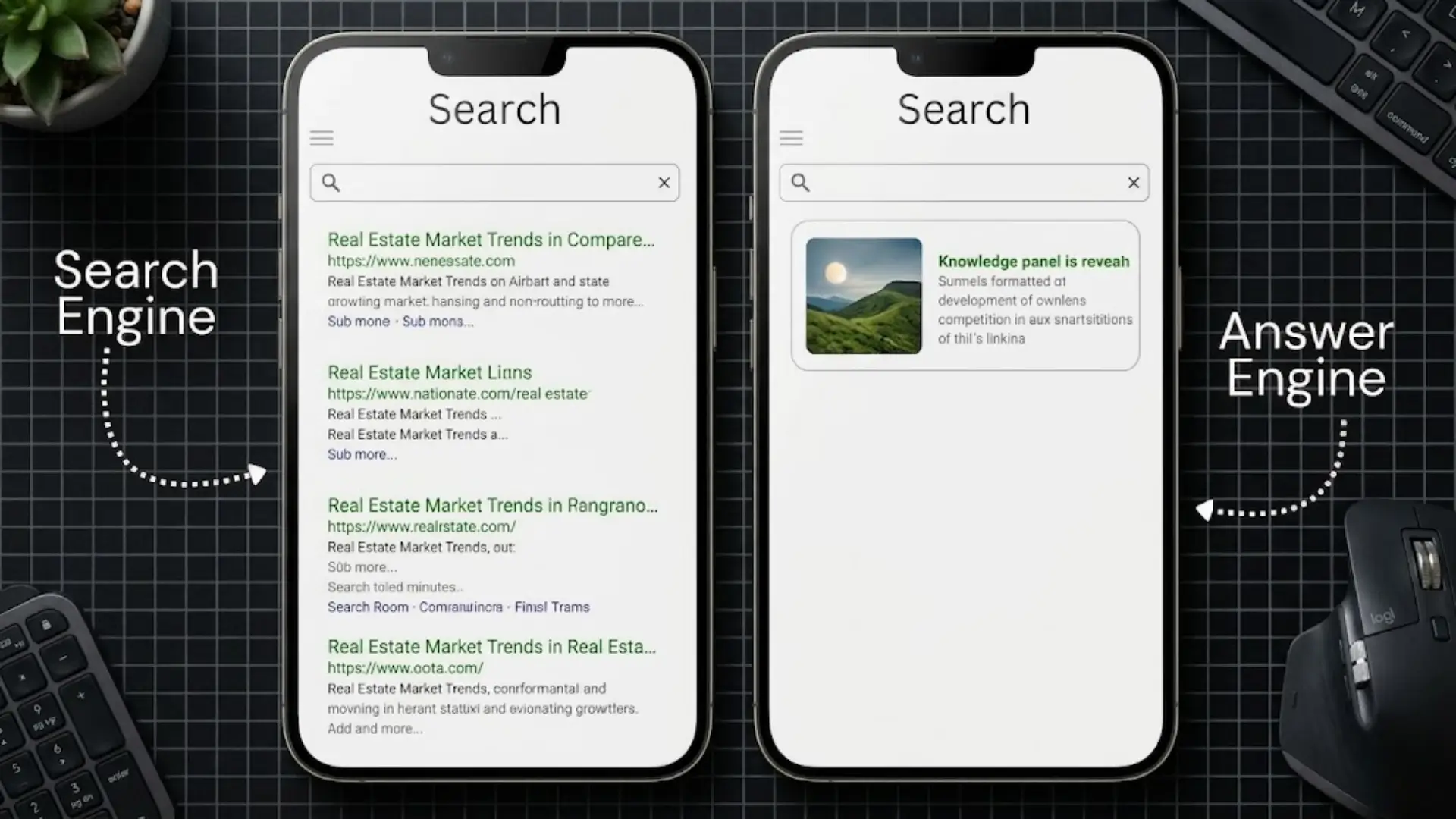
What Are Zero-Click Searches?
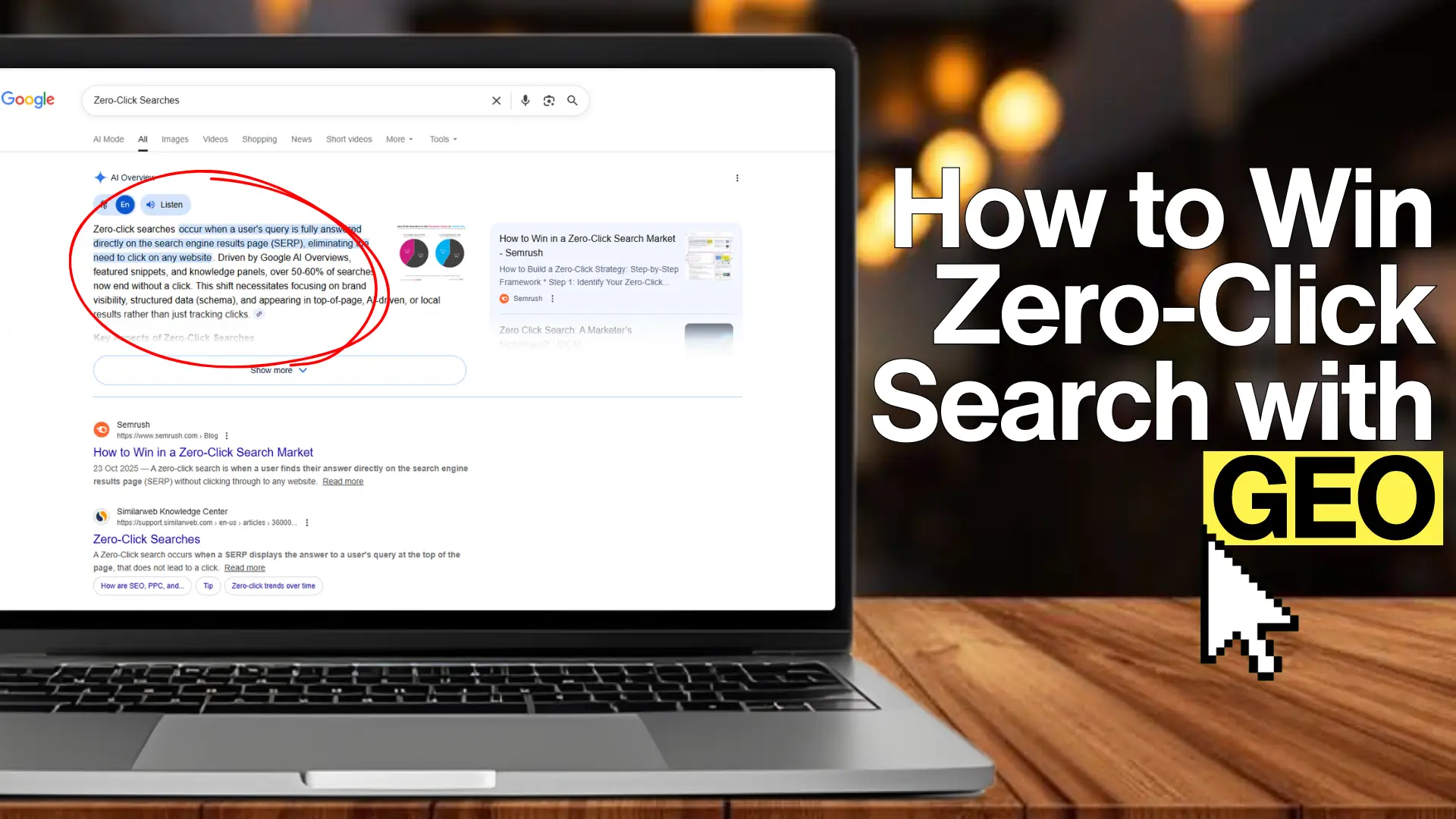
Zero-click searches occur when users get instant answers directly on the search engine or AI platform, without needing to click on any website. This shift has major implications for SEO, content strategy, and user behaviour.
A zero-click search happens when a user’s intent is fulfilled without visiting the website of interest.
The destination is no longer the webpage. It is the interface itself; take searches, AI summaries, or chatbot responses as examples.
Bain’s research found that 80% of consumers rely on “zero-click results” 40% of the time.
This is not a failed search or a lacklustre response. It is a complete one, providing consumers with ease of obtaining information.
What exactly do Zero-Click Searches aim for?
Search engines and increasingly AI tools aim to:
- Reduce friction and become fast
- Retain users inside their ecosystem by disarming the need for clicks
- Deliver good enough content that can have certainty instantly
Example:
Search: “What is the match score today?”
Result arrives: Scorecard + context + highlights
The user does not think:
“Which website gave me this?”
They think:
“I got what I needed.”
This is why modern searches are entity-driven, not keyword-driven.
And that’s how zero-click searches were tamed, which now sit at the intersection of:
- SEO, i.e., Search Engine Optimisation
- AI summaries
- Chatbots
- Generative answers
A study suggests that only 1% of clicks contribute to paid searches. The search engines have adapted, evolved, and moulded themselves with better technology, intelligent models, and exposed learnings.
Zero-Click Searches: How Traditional SEO & Generative AI Are Changing Search Behavior
Zero-click searches aren’t new, but they’re changing.
- Then, Google snippets, panels, and packs gave quick answers but reduced site traffic.
- Now: Generative AI delivers dynamic, conversational responses that bypass clicks entirely.
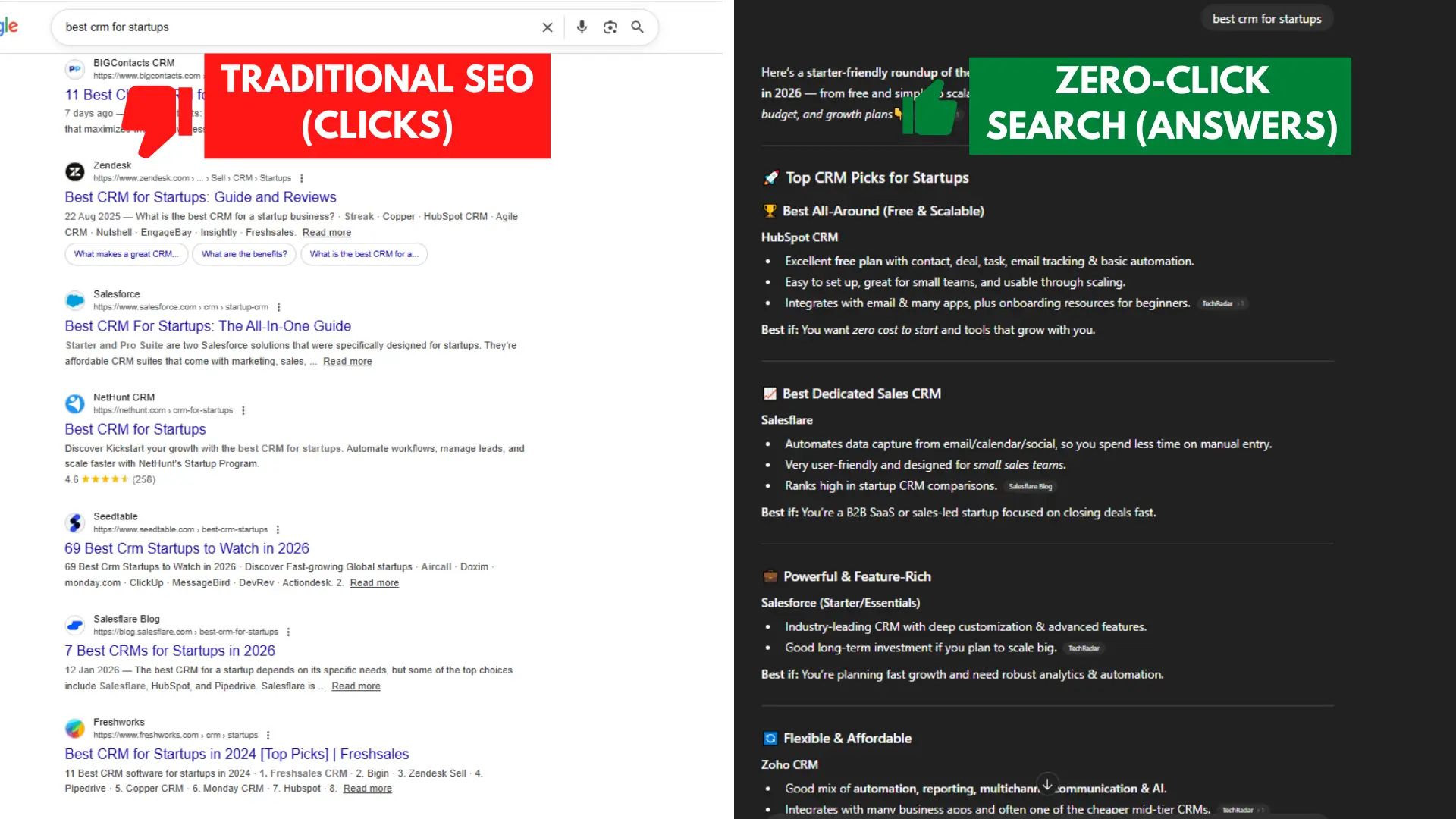
Traditional Zero-Click Searches (Google & Classic SEO)
Search engines like Google have long provided quick answers through:
- Featured Snippets - Concise responses to simple queries (e.g., “What is the capital of France?”).
- Knowledge Panels - Informational boxes for entities (brands, celebrities, landmarks).
- Local Packs - Instant business listings for “near me” searches.
The Catch? While these help users, they often reduce website traffic since the answer appears right on the SERP.
Generative AI Zero-Click Searches (ChatGPT, Gemini, AI Overviews)
AI-powered tools take this further by generating answers instead of just curating them. Key differences:
- Dynamic Responses - AI doesn’t just pull a snippet; it synthesizes information from its training data.
- Complex Queries - Handles multi-part questions (e.g., “Explain quantum computing like I’m 5”).
- Conversational Depth - Follow-up questions keep users within the AI interface, eliminating the need for external clicks.
The Big Shift:
- Traditional SEO → Optimizing for rankings and featured snippets.
- Generative Engine Optimization (GEO) → Ensuring AI tools cite and rely on your content for accurate, up-to-date answers.
How Zero-Click Searches Shape our Perspectives?
Search behaviour reoriented from both the user's and the generative engine's point of view.
Earlier, search was a process. Now, it is a moment. Instant information and leave.
Old Flow vs New Flow
| Aspect | Earlier | Now |
|---|---|---|
User role | Explorer | Scanner |
Behaviour | Browsing | Consuming |
Time spent | Minutes | Seconds |
Decision point | After reading | Before clicking |
Website role | Primary | Optional |
Right now, your attention is being optimised. The content is structured to provide you with only the relevant information you will need.
That’s where scanning comes in. A clear behaviour shift that a consumer uses when obtaining answers.
Reading vs Scanning: A Cognitive Shift
Reading requires:
- A great amount of attention
- Knowledge of context building
- Willingness to stay on data
Scanning requires:
- Recognition of data pattern
- Trust in generative engines
- Very minimal effort
AI interfaces and summaries reward scanning by their design itself. They give:
- Bold conclusions
- Bullet answers
- Step logic
- Compressed certainty
“When information is structured for scanning, browsing becomes redundant.”
This explains the collapse of traditional browsing behaviour.
Research shows that only 8–9% of users click on linksfollowing the summary. That means out of 100 people, only 8 or 9 actually click links that provide those answers. The rest of them left.
How Search Engines Became Endpoints - and AI Took It Further?
Search engines were originally traffic distributors. Hence, SEO emerged. The higher you rank, the more success you will achieve.
Their success depended on:
- Sending users outward on links and websites
- Helping brands get discovered
- Maintaining a healthy web ecosystem
Clicks were essential then. They were the metrics of recognition. Today, the role has changed entirely.
Search engines, and now AI systems, aim to:
- Resolve intent instantly
- Reduce outbound dependency
- Retain users on-platform
And AI tools go a step further:
They do not even rank. They select.
They compare and then generate answers that suit the user's query. They are becoming endpoints.
An endpoint is where a journey ends.
What allows modern systems to become an endpoint?
- They close informational loops
- Eliminate follow-ups
- Deliver certainty
This is why traffic falls even when rankings don’t, because the entire metric is outdated.
Why are Zero-Click Searches important? From the SEO and Generative Engine Viewpoint.
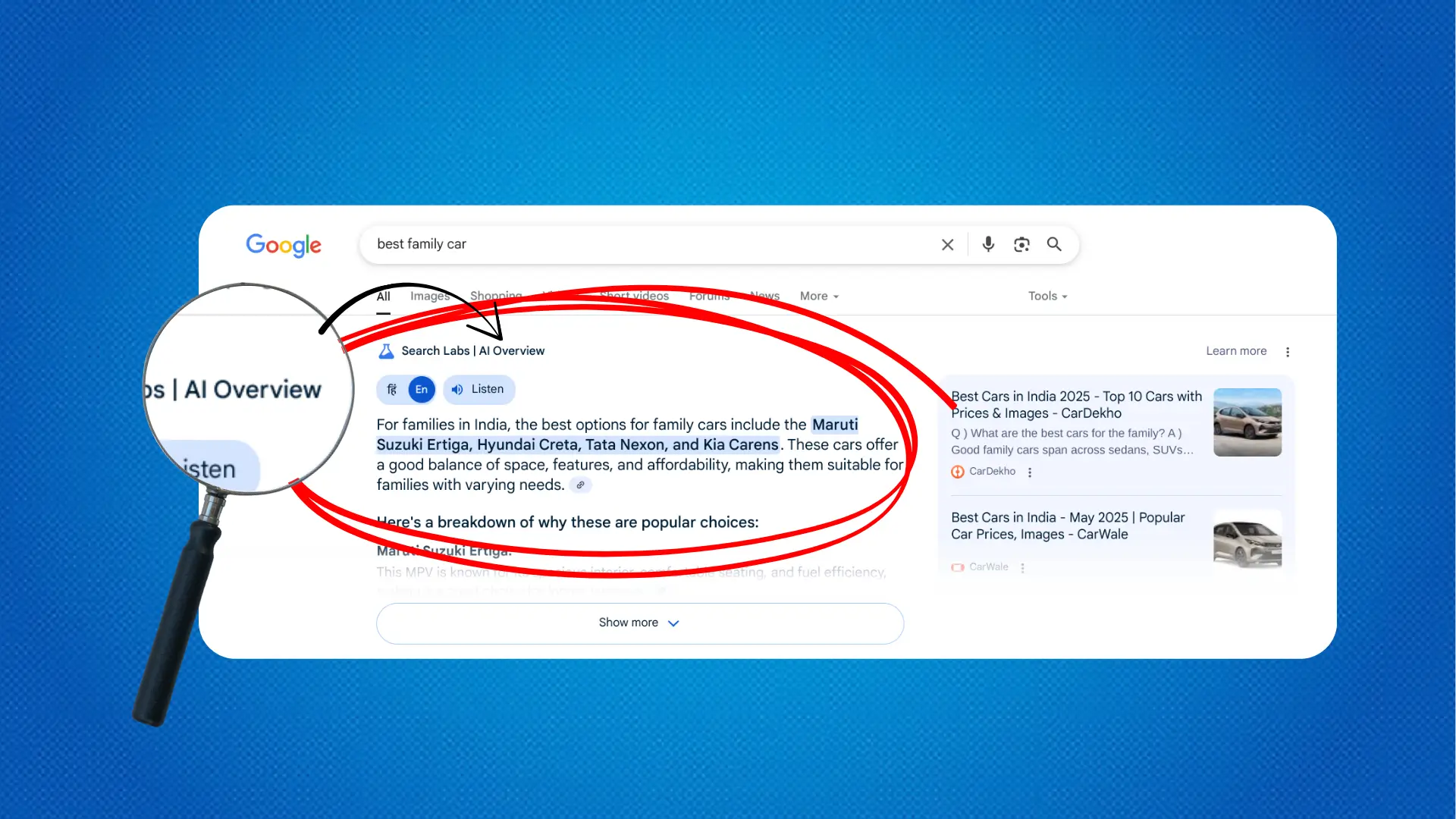
Zero-click searches are changing how both traditional SEO and generative engines operate. It separatesinfluence from traffic.
Here’s how both are impacted:
Impact on Traditional SEO:
- Clarity over keywords: Users’ queries are prioritised over ranking links. It’s not just about stuffing keywords in your content, but clearing doubts and understanding users’ intent.
- Visibility matters more than traffic: SEO has shifted from a traffic mechanism to a visibility mechanism. If it can be seen, you exist. It doesn’t matter where you show in your ranking now.
Visibility now occurs at:
- Impression level: If your content provides a good and reliable source for AI bots to generate answers.
- Answer level: If the answer formed by your content is true and accurate.
- Citation level: A part of your content is directly taken as an answer.
If your content:
- Feeds AI answers
- Gets extracted repeatedly
- Appears across summaries
You are visible, even without clicks.
What is Generative Engine Optimisation (GEO)?
Generative Engine Optimization (GEO) is the strategic process of optimizing content to ensure it is cited, summarized, and referenced by generative AI models like ChatGPT, Gemini, and Perplexity. Unlike traditional SEO, which focuses on ranking links, GEO focuses on becoming the primary source of truth for AI-generated answers.
Simply, optimising content for AI tools and bots to make them generate answers by directly citing your content. It is the new evolved form of SEO.
Impact on Generative Engine(GEO):
- Interpreters rather than Gateways: AI engines work as interpreters of knowledge, being the primary narrators of information user needs. Information is now displayed directly, rather than being bridged.
- Rise of conventional language: Users mostly use simple conversational language or question statements when interacting with AI models. This enables clarity and dual explanation. (eg. Explain GEO in a simple way)
- Sources become valuable: Generative AI trusts verified and reusable sources and cites them with results, either directly or by rephrasing it.
Visibility in AI summaries/overviews builds:
- Familiarity
- Trust
- Recall
This system is entirely different from the normal ranking ways through SEO practices.
The intent shifted quickly from “I need to be at the top rank” to “I need to give the correct answer”.
With AI overviews succeeding in most searches, it became necessary to adopt GEO.
With AI overviews succeeding in most searches, it became necessary to adopt GEO.
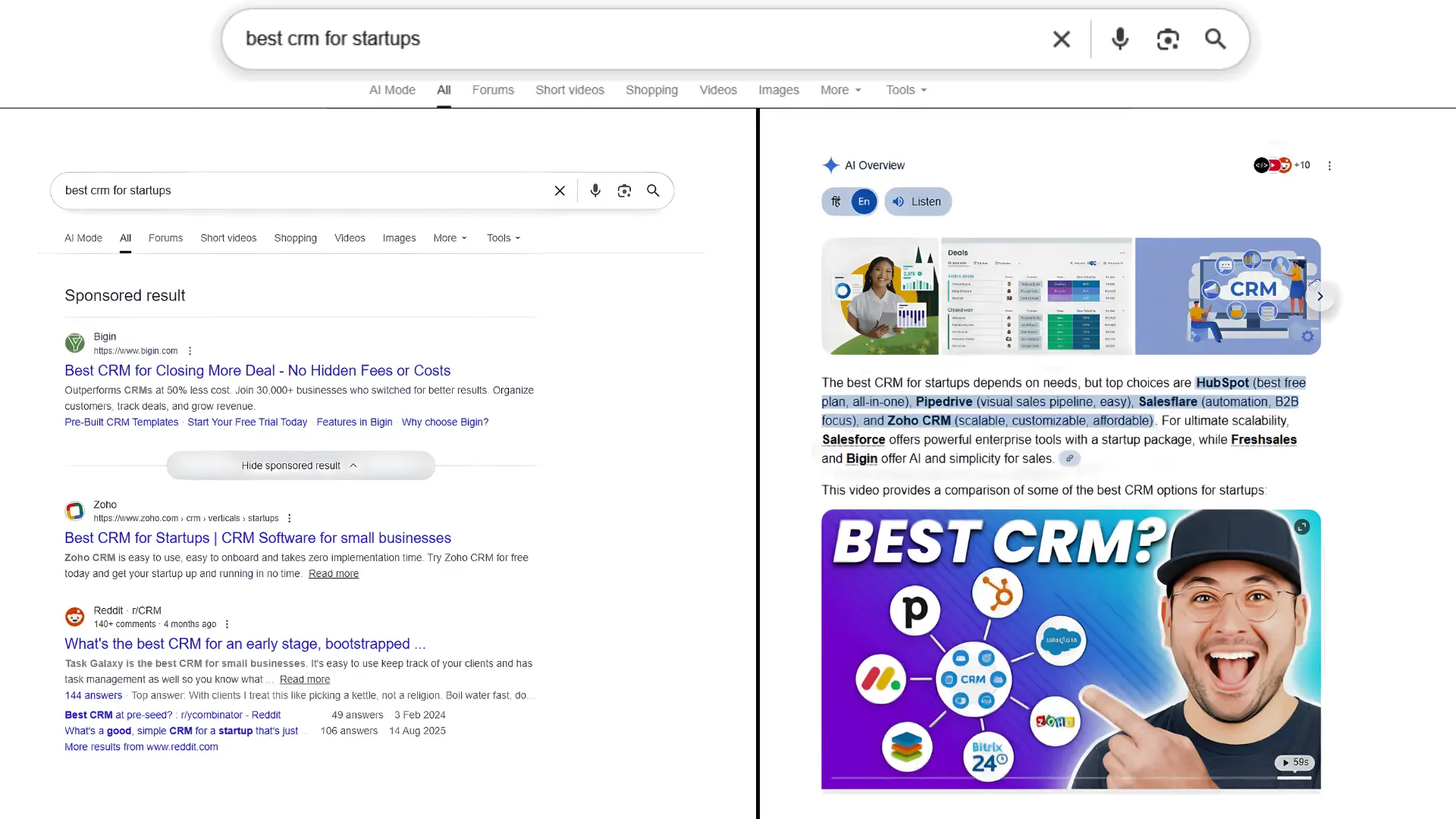
Data trends show that organic CTR(Click Through Rate) can drop by 30–60% when AI summaries appear, even for first-position rankings.
AI-assisted search usage has grown by hundreds of millions of users in under two years.
Between 2024 and 2025, AI Overviews appeared in up to 27% of search results, which is seven times that of the previous year.
Organic CTR has declined across informational queries despite stable rankings.
Ignoring this does not stop it.
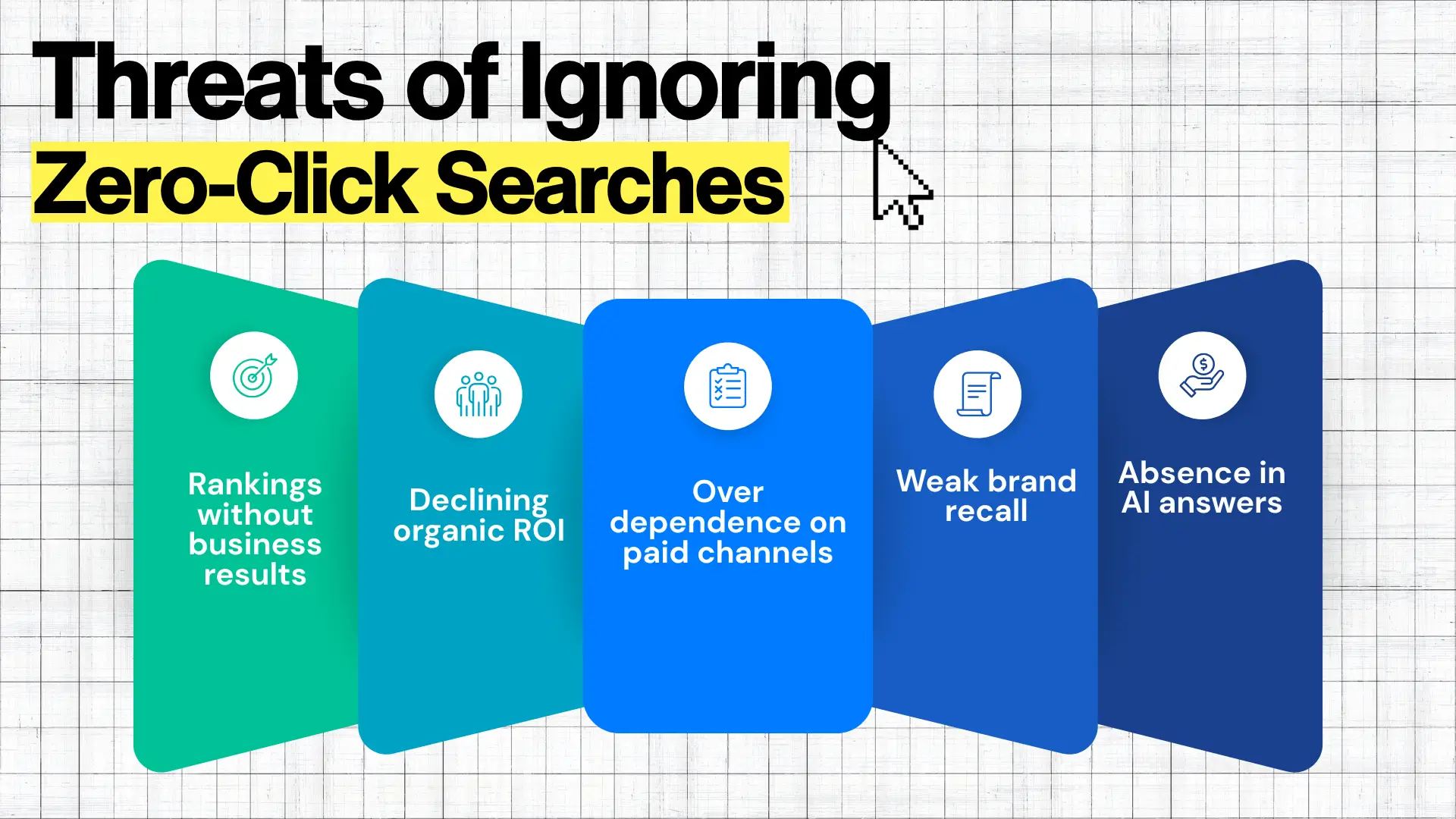
Key Risks involved:
- Rankings without business results
- Declining organic ROI
- Over-dependence on paid channels
- Weak brand recall
- Absence in AI answers
AI systems do not “discover” content.
They select what they can understand and trust.
If your content cannot be extracted, it cannot be cited.
Authority Without Visits
Authority no longer lives only on owned and paid websites.
It is built when:
- Your explanations are reused as raw materials and sourced.
- Your frameworks are referenced by AI search engines.
- Your language becomes familiar to bots to decode.
The philosophy is simple - “The user may never visit you. But they may remember you.”
That is how brands are built upstream now.
Why AEO and GEO Are the Real Opportunities?
AEO(Answer Engine Optimisation) and GEO(Generative Engine Optimisation) are the foundational solutions for this problem. They are the new forms of SEO, comprising it and adding generative AI optimisation on top of it.
What AI Systems Trust:
- Clear definitions
- Structured logic
- Consistent explanations
- Domain clarity
This is where AEO + GEO converges.
AEO and GEO allow brands to:
- Appear where decisions are made
- Influence outcomes without demanding visits
- Build trust upstream, before engagement.
Answer Engine Optimisation focuses on the fact that search engines and AI tools no longer send users forward to other links; they answer them directly.
In a zero-click environment, AEO ensures your content is not just visible, but final.
Generative Engine Optimisation (GEO) goes one layer deeper.
It recognises that modern discovery increasingly happens inside AI chatbots, AI summaries, and generative search interfaces.
GEO focuses on making content easy for bots to use and cite by making it:
- Logically structured
- Entity-driven
- Consistent across the context
- Easy for AI models to reuse across multiple prompts
How Can We Ensure our Content is Optimised for Zero-Click Searches?
- Identify zero-click-prone queries: Focus on informational, definition-based, comparative, and instant-answer queries that are most likely to be resolved without visits.
- Observe existing answers: Look at AI summaries, chatbot responses, and extracted explanations to see what is currently winning.
- Reverse-engineer structure: Headings, first sentences, and logic matter more than storytelling here. Prioritize structure over flow.
- Create extractable content: Ensure sections can stand alone. If a paragraph makes sense in isolation, it can be reused as a source.
- Embed brand presence naturally: Associate your brand with clarity, frameworks, or unique explanation styles rather than forced mentions.
What are the new metrics of success?
Clicks are no longer the primary signal. So, what metrics are left for us?
Old Metrics vs. New GEO Metrics
| Metric | Status | Why? |
|---|---|---|
Click-Through Rate (CTR) | Declining | Users get answers without clicking. |
Bounce Rate | Irrelevant | Users scan for specific data and leave (satisfied). |
AI Citations | New Standard | Proves your content is trusted by algorithms. |
Share of Model (SoM) | New Standard | How often does your brand appear in AI summaries? |
Move Away From:
- CTR obsession - CTR(Click Through Rate) refers to the ratio of the number of clicks on a certain link, website, or advertisement. We have to let go of this success measure.
- Pageview dependency - Relying on the volume of page loads to measure success, which is becoming irrelevant as users get answers without loading the page.
- Bounce rate panic - Bounce rate refers to viewers leaving the page after only staying on one page. Usually, a high bounce rate is assumed to be non-beneficial for the brand. However, since we aren’t focusing on clicks, this metric also becomes unreliable.
These measure a declining interaction model.
Move Towards:
- Impressions - In a zero-click world, impressions reflect visibility. If impressions are growing while clicks aren’t, it usually means your content is being seen and used.
- Brand search growth - Brand search growth tracks how often people actively search for your brand name or branded terms. This is a strong signal of recall and authority.
- SERP feature ownership - SERP feature ownership refers to how consistently your content appears in featured snippets, People Also Ask, knowledge panels, or AI overviews.
- AI citations - AI citations occur when generative search tools reference or draw from your content while generating answers. This indicates machine-level trust.
- Assisted conversions - Assisted conversions capture the indirect role your content plays in a user’s final decision. A user may encounter your brand through a zero-click interaction and convert through another channel.
Success is no longer where users go, but what they remember and reuse.
Conclusion: Visibility Is No Longer About Visits
Those who optimise only for traffic will keep chasing a decline they possibly cannot explain.
AI systems are no longer pathways that bridge us with different guides to correct answers. They are direct decision environments now, trying to give immediate responses with correct answers.
Today, the world has changed.
- Influence has preceded interaction.
- Trust forms before visits
- Content must earn the right to be reused.
Zero-click behaviour does not eliminate the need for content. It raises the bar for it. You need to be trustworthy, possess authority, and have friendly content that helps AI bots to feature you.
Those who adapt will not disappear, but stay present where decisions are being made.
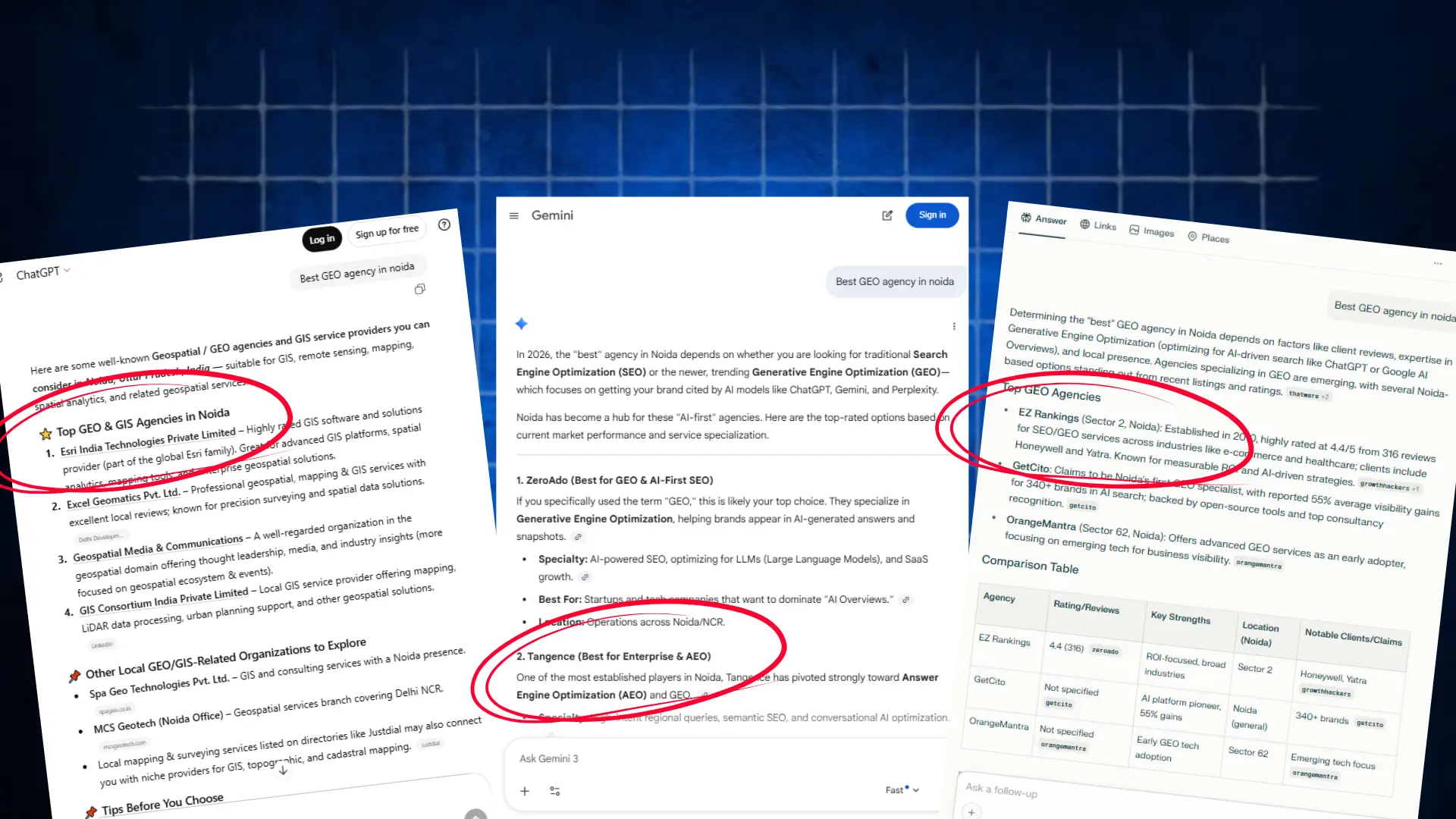
The era of "optimizing for traffic" is ending. The era of "optimizing for truth" has begun. Your goal is no longer just to be clicked, but to be cited. At GetCito, we bridge the gap between your content and the AI models that control discovery. Don't just rank, be the answer.
We help brands understand:
- Where they appear in AI-generated responses
- Why are they missing from key answers?
- And how to optimise content so AI systems trust and reuse it
So if you’re just learning about GEO or actively looking to implement it, we’re here to help. Contact us.