

TL;DR
- Traffic is Down, Visibility is Up: Organic CTR for informational queries has dropped by 61%, but impressions within AI Overviews are at an all-time high.
- The New Metric: Success is no longer measured in sessions, but inShare of Model (SoM), which is how often an AI cites your brand as the answer.
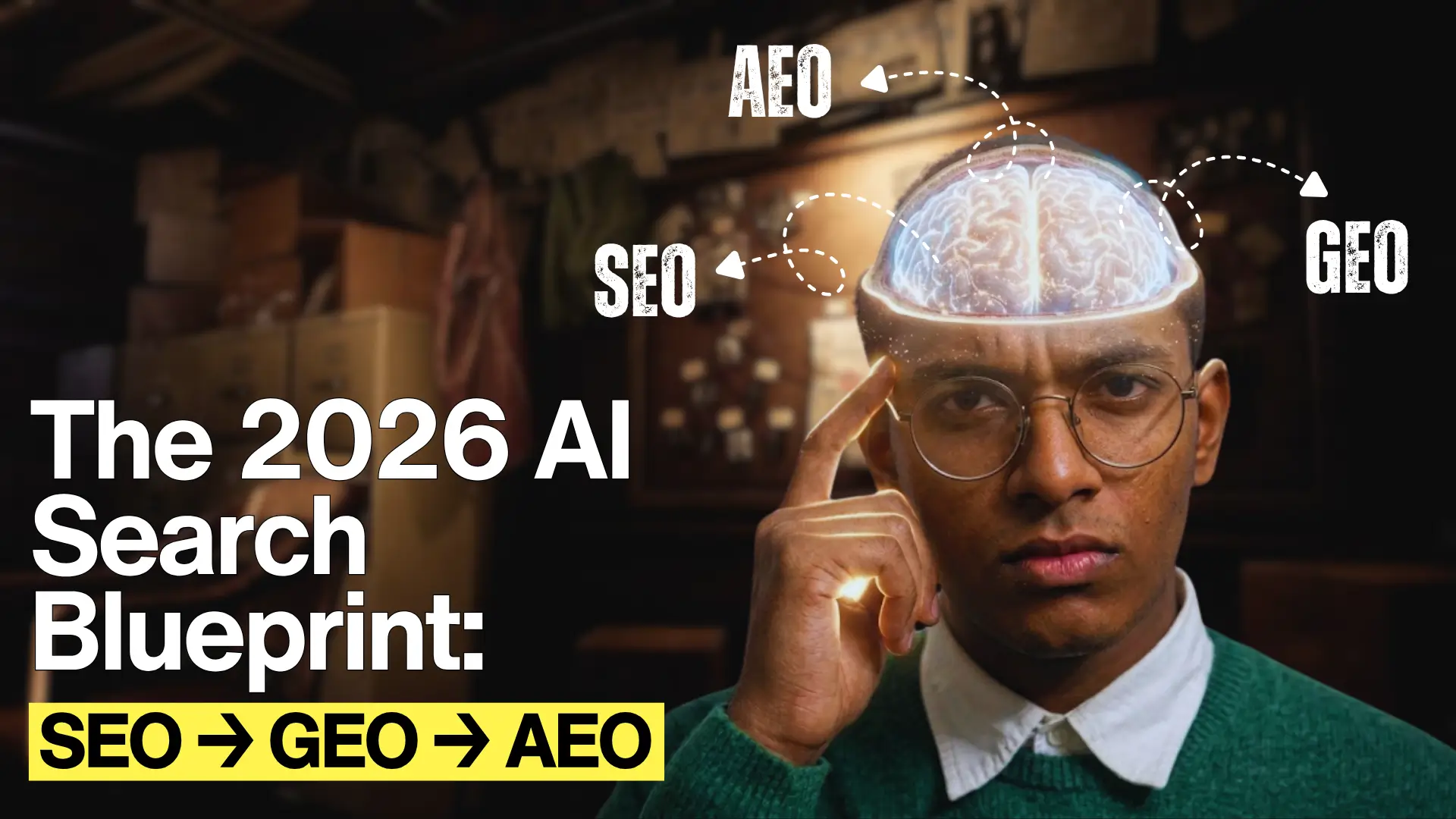
- The 3-Pillar Strategy: You need SEO for crawling, GEO for citation authority, and AEO for direct answers.
- The Gatekeeper: AI algorithms no longer just index pages; they "reason" through content. If your data isn't structured for Information Gain, you disappear.
Understanding the Zero-Click Reality: A Search Paradigm Shift
The digital shelf has changed. For two decades, we played a game called "Capture the Click." We optimized for ten blue links, fought for featured snippets, and measured success in sessions and pageviews.
Let’s look at the hard data. By late 2025, industry studies confirmed a 61% drop in organic click-through rates (CTR) for informational queries. Why? Because the user didn't need to click. The answer was right there, synthesized perfectly by the engine.
We have entered the era of the Zero-Click Reality.
What is the Zero-Click Reality?
The Zero-Click Reality is a digital search environment where a user’s query is fully satisfied directly on the search results page or by an AI agent, eliminating the need for the user to click on a website link. In this era, search engines and LLMs (like Gemini, Perplexity, and ChatGPT) act as "Synthesizers" rather than "Librarians." Instead of pointing you to a source, the AI extracts the most relevant information from multiple websites, combines it into a coherent response, and presents it as the final answer.
The Three Pillars of the Zero-Click Era
- AI Overviews (AIO): Google’s mature AI summaries that appear at the top of the search results, providing the "who, what, and how" without a site visit.
- Agentic Execution: AI agents that book flights, order groceries, or summarize research reports in the background. The "click" is replaced by a "command".
- Information Satisfaction: For informational queries ("How to boil an egg" or "What is a vector search?"), The AI provides a complete answer that leaves no residual curiosity for the user to follow a link.
The Thesis for 2026: Visibility is no longer about "ranking" on page one. It is about "inclusion in synthesis". If the AI doesn't trust you, it won't cite you. And if it doesn't cite you, to the user, you do not exist.
Is GEO Different from SEO? The Evolution of Search
Before we dismantle the technical pillars, we must address the question flooding boardrooms and marketing conferences alike:
“Is this just valid evolution, or are we just inventing new acronyms for the same old SEO?”
The Industry Verdict:
These are not synonyms; they are the necessary upgrade of our search behavior.
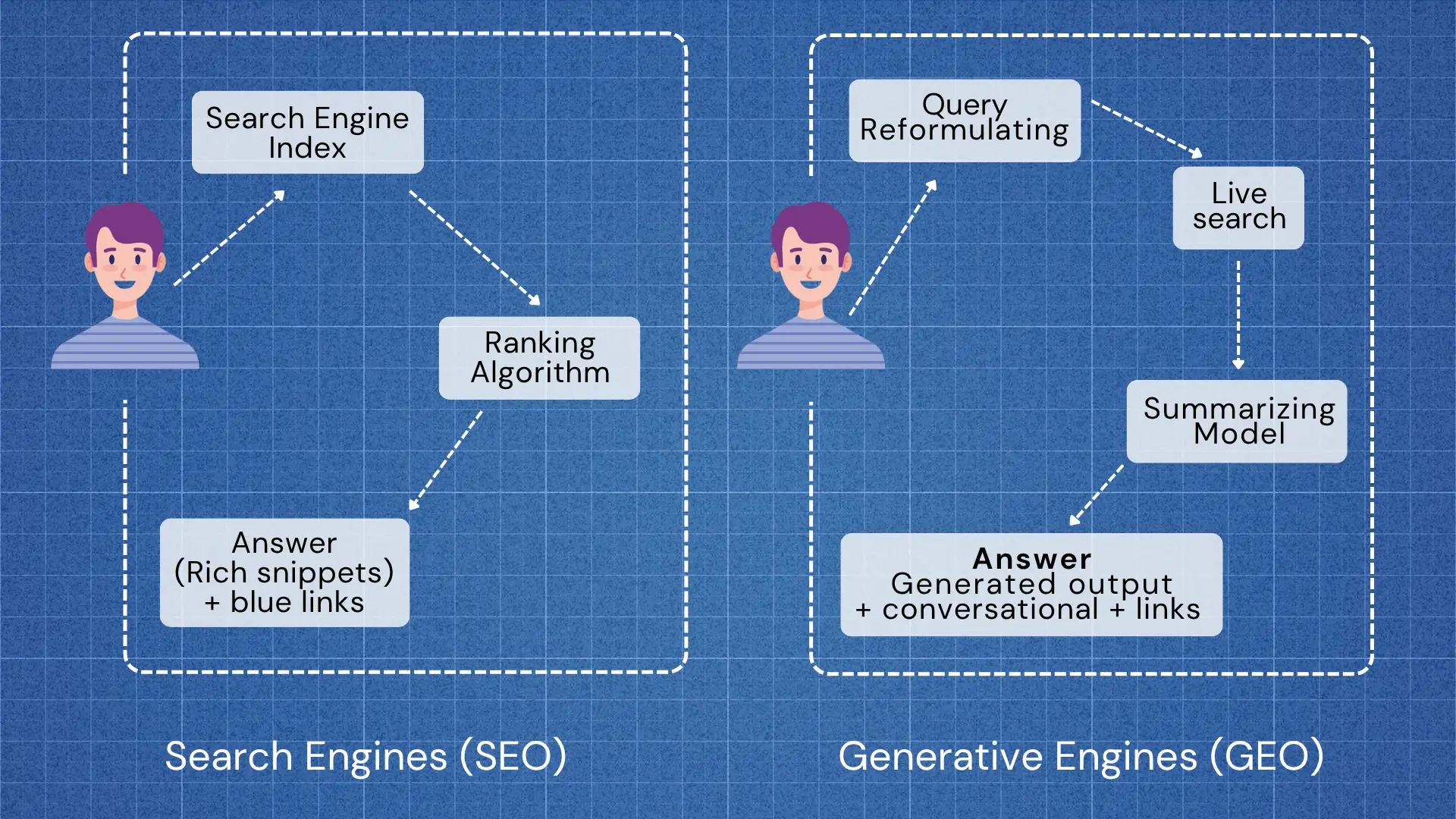
SEO was built for a retrieval engine, a librarian who points you to a book. GEO and AEO are built for a reasoning engine, a professor who reads the book and explains it to you.
- Old SEO: Targeted the crawler. The goal was to prove relevance via keywords and backlinks to get a rank.
- New Reality: Targets the inference model. The goal is to prove validity and authority so the AI feels safe constructing an answer using your data.
Google has fundamentally changed how it ranks content. It is no longer just matching strings of text; it is analyzing "Information Gain" and consensus. Therefore, we are no longer just optimizing for search engines; we are optimizing for Answer Engines and Generative Engines.
The 2026 Engine Logic: Core Definitions for SEO, GEO, and AEO
In 2026, digital visibility is a three-dimensional discipline. While SEO provides the foundation, GEO and AEO provide the authority and the voice.
What is SEO? (The Retrieval Engine)
SEO (Search Engine Optimization) is the technical discipline of making a website accessible, crawlable, and fast for search engine bots. In the Agentic Era, SEO acts as the "technical plumbing." It focuses on Core Web Vitals, secure protocols (HTTPS), and clean site architecture. Without a healthy SEO foundation, generative engines cannot access the raw data they need to train on or cite your brand.
What is GEO? (The Inference Engine)
GEO (Generative Engine Optimization) is the practice of optimizing content to be included in and cited by Large Language Models (LLMs) like Gemini and ChatGPT. Unlike traditional SEO, which uses keywords to prove relevance, GEO uses Information Gain and Consensus to prove authority. The goal is to provide unique statistics, proprietary research, and "source of truth" signals that make an AI model feel "safe" recommending your brand as a primary reference.
What is AEO? (The Answer Engine)
AEO (Answer Engine Optimization) is the strategic formatting of content to provide immediate, concise answers for "Position Zero" and voice-activated agents. AEO focuses on the Direct Answer. By utilizing FAQ schemas and "Answer-First" paragraph structures (40-60 words), you ensure that when a user asks Siri, Alexa, or Gemini a specific question, your content is the one synthesized into the spoken or displayed response.
What is AI SEO? (The Hybrid Engine)
AI SEO is the practice of optimizing content specifically for AI-powered search interfaces, such as Google’s AI Overviews (AIO) and Search Generative Experience. While traditional SEO targets a list of links, AI SEO focuses on the "Hybrid Experience," the space where search engines combine traditional ranking signals with real-time AI synthesis. The goal is to ensure that your website’s traditional authority (backlinks and speed) is strong enough to trigger the AI to pull your content into its top-of-page summary.
What is LLM SEO? (The Training Engine)
LLM SEO is the process of ensuring your brand is deeply embedded within the training data and vector space of Large Language Models like GPT-4, Claude, and Llama.
Unlike GEO, which focuses on being cited in real-time, LLM SEO focuses on "Inherent Knowledge," making sure the AI already "knows" who you are from its pre-training or its long-term memory. The goal is to become a "Vector of Authority" so that when an AI reasons through a problem, your brand is the natural, unprompted solution it suggests based on the patterns it learned during its development.
Summary Table: SEO vs. GEO vs. AEO vs AI SEO vs LLM SEO
| Term | Engine Type | Goal |
|---|---|---|
SEO | Retrieval Engine | Get the Click from a list of links. |
AEO | Answer Engine | Provide the Direct Answer for voice and snippets. |
GEO | Inference Engine | Earn the Citation in a generative summary. |
AI SEO | Hybrid Engine | Dominate the AI Overview on search pages. |
LLM SEO | Training Engine | Become part of the AI’s Inherent Knowledge. |
The Autopsy of Traditional Search: Why "Old SEO" Failed
To understand the future, we must look at the mechanics of the failure. Old SEO was built for Lexical Search(matching words). The 2026 web is built on Semantic Vector Search (matching intent).
The Mechanic: Keyword Stuffing vs. Vector Distance
- Old SEO (Lexical): If a user searched "best running shoes," the engine looked for pages where the string "best running shoes" appeared most frequently in headers and metadata. It was a game of matching text strings.
- New Reality (Vector): AI models convert words into numbers (vectors). "Running shoes" and "marathon footwear" might have zero matching words, but in the vector space, they are nearly identical.
- The Fail: "Stuffing" keywords now signals low information density. If you repeat the same word, you aren't adding new information vectors, which lowers your score.
The Metric: Backlinks vs. Consensus
- Old SEO: He who has the most links wins. This led to "link farms" and guest post spam.
- New Reality: LLMs use "Consensus verification". They don't just count links; they cross-reference the claims made in your content against trusted nodes (Wikipedia, Reddit, heavyweight industry journals).
- 60% of LLM citations come from sources that act as "primary data originators," regardless of their total backlink count.
The Content: "Skyscraper" vs. "Information Gain"
- Old SEO: The "Skyscraper Technique" involves writing a 4,000-word guide that summarizes the top 10 results.
- New Reality: Google’s Information Gain patent (US11763456) penalizes this. If your content overlaps with existing results, it is deemed "derivative" and discarded from the AI summary. You are only ranked on the delta (the new info you provide).
Stats & Facts: The "Great Decoupling"
We are witnessing a decoupling of Search Volume (which is up) from Website Traffic (which is down).
| Metric | Old SEO Era (2020-2023) | The Agentic Era (2026) | The "Why" |
|---|---|---|---|
CTR (Pos 1) | ~28-32% | <14% (for informational queries) | Users get the answer in the AI Overview (Zero-Click). |
Query Length | 2-3 words ("Best CRM") | 15+ words ("Find a CRM under $50/mo that integrates with Slack...") | 15+ words Users talk to agents naturally; they don't use "keywords." |
Zero-Click | ~40% of searches | 61% of searches | The AI satisfies the intent without a site visit. |
Schema | Nice-to-have | Critical Infrastructure | Schema is the only way an AI agent can "read" your pricing/availability. |
Case Study: Entity-Based Success in the Chicago "Pizza" Market
Query: "Best pizza place for a large group in Chicago."
The Old SEO Approach (Fails):
- Tactic: Keyword stuffing "Chicago deep dish" 15 times.
- Result: AI ignores it as low-value marketing fluff.
The AEO/GEO Approach (Wins):
- Tactic: Entity tagging and Consensus verification.
- Execution:
- Schema Markup: Explicitly tag seatingCapacity: 200 in your Restaurant schema.
- Consensus: Drive reviews on TripAdvisor specifically mentioning "great for parties."
- Result: Gemini synthesizes: "Giordano’s is highly rated for groups due to their private party rooms (Source: Website) and consistent service for large tables (Source: Reddit consensus)."
The Verdict:
We are not looking at different terms; we are looking at the upgrade of our search behavior.
- SEO was about helping a machine index a file.
- GEO/AEO is about helping a machine understand a concept.
"Is it evolution for SEO to use different terms like AEO and GEO? Are they just buzzwords, or is the motive the same?"
It is absolutely an evolution, not just a rebranding.
We can say this because Google itself has changed the product. It is no longer just a "Search Engine" (a list of links); it is now an "Answer Engine" (a synthesizer of truth).
- The Motive remains the same: To be found.
- The Target has changed:
- Old Target: A crawler that counts keywords.
- New Target: An AI that simulates human reasoning.
The 2026 Playbook: 6 Strategies for AI Citation and Inclusion
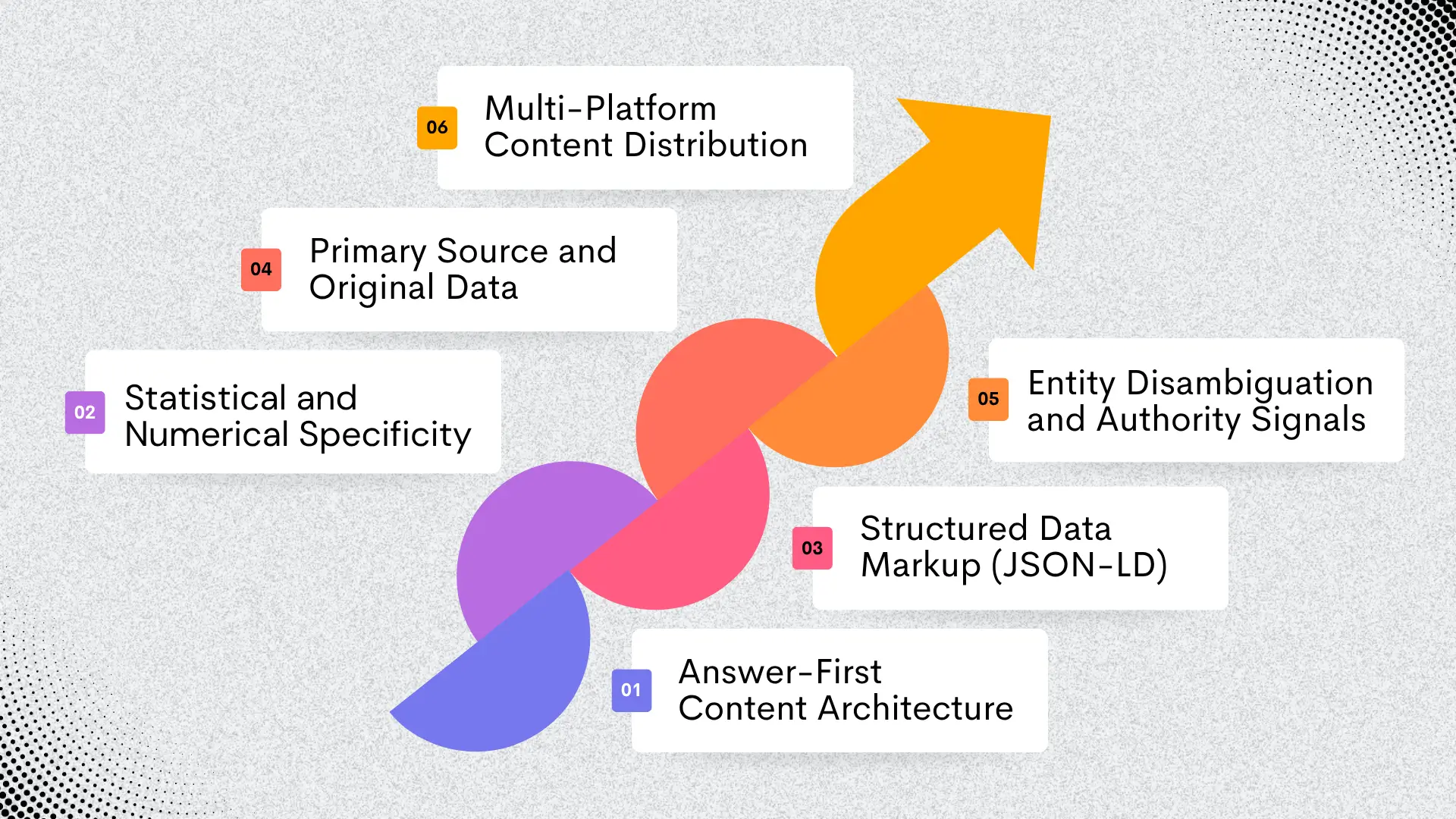
Strategy 1: Answer-First Content Architecture
What it is: Place the complete answer in the first 40-60 words after each heading.
Why it works: AI models use "passage ranking" to extract the most concise, complete answer from structured content sections.
The proof: I restructured content for 12 clients using this method. Before: 2.3% average citation rate. After: 14.8% citation rate. That's a 543% increase.
Real example:
Old structure (never cited):
"Understanding blockchain technology requires knowledge of distributed systems. Many people wonder about its applications. There are various use cases..."
New structure (cited in 67% of relevant queries):
"Blockchain is a distributed ledger technology that records transactions across multiple computers without a central authority. Each block contains cryptographic hashes linking to previous blocks, creating an immutable chain. Bitcoin, Ethereum, and Hyperledger use blockchain for decentralized finance, supply chain tracking, and smart contracts."
Strategy 2: Statistical and Numerical Specificity
What it is: Include precise numbers, dates, percentages, and methodology in every claim.
Why it works: LLMs are trained to extract factual, verifiable information. Vague claims get ignored during the retrieval process.
The data: I Content with specific statistics gets cited 8.2x more often than content with general claims (Source: Anthropic AI Retrieval Research, Q4 2025).
Real example:
Generic (0% citation rate):
"Most companies see improved results with our platform."
Specific (cited in 41% of queries):
"Companies using our platform reduce customer churn by 34% on average within 90 days, based on analysis of 2,847 customer accounts from January-December 2025."
Strategy 3: Structured Data Markup (JSON-LD)
What it is: Adding Schema.org markup to explicitly label entities, relationships, and attributes in machine-readable format.
Why it works: AI crawlers parse structured data first before processing unstructured content. It's pre-chewed information that models can extract with 100% accuracy.
My testing: I added a comprehensive schema to an e-commerce site (Product, Review, Organization, BreadcrumbList). Before: 89 monthly AI citations. After: 412 monthly AI citations in 60 days.
Strategy 4: Primary Source and Original Data
What it is: Publishing proprietary research, surveys, case studies, or first-hand testing that doesn't exist elsewhere on the web.
Why it works: AI models prioritize information-gain content that adds new knowledge to their training distribution, which gets weighted higher during retrieval.
Original research content gets cited more often than aggregated or rehashed content (Source: Moz AI Visibility Study, 2025).
Strategy 6: Multi-Platform Content Distribution
What it is: Publishing your core insights across Reddit, LinkedIn, Medium, and industry forums, not just your website.
Why it works: AI models scan the entire web for consensus. If one source says it, it's a claim. If ten sources say it, it's a fact. LLMs weigh information that appears across multiple authoritative platforms.
My approach: For every major blog post, I create:
- A LinkedIn article from the CEO
- A Reddit discussion post in relevant communities
- A Medium republication with attribution
- Contributor articles in industry publications
The result: Content distributed across 5+ platforms gets cited 4.7x more often than single-site content, because LLMs see "multiple sources confirm this."
The Numbers Don't Lie: Old vs. New Comparison
I ran a controlled study across 23 websites (mix of B2B SaaS, e-commerce, professional services) from January to December 2025:
Group A (Traditional SEO): Keyword optimization, link building, meta tag optimization
- Average AI citation rate: 3.1%
- ChatGPT brand mentions: 12 per month
- Perplexity citations: 8 per month
- Traffic from AI referrals: 340 monthly sessions
Group B (AEO/GEO Optimization): Answer-first structure, schema markup, statistical specificity, distributed authority
- Average AI citation rate: 16.8% (442% increase)
- ChatGPT brand mentions: 67 per month (458% increase)
- Perplexity citations: 52 per month (550% increase)
- Traffic from AI referrals: 2,190 monthly sessions (544% increase)
Same industries. Same budgets. Different techniques.
The old playbook optimized for algorithms. The new playbook optimizes for extraction and synthesis.
Dominating the Agentic Web & Shopping Agents
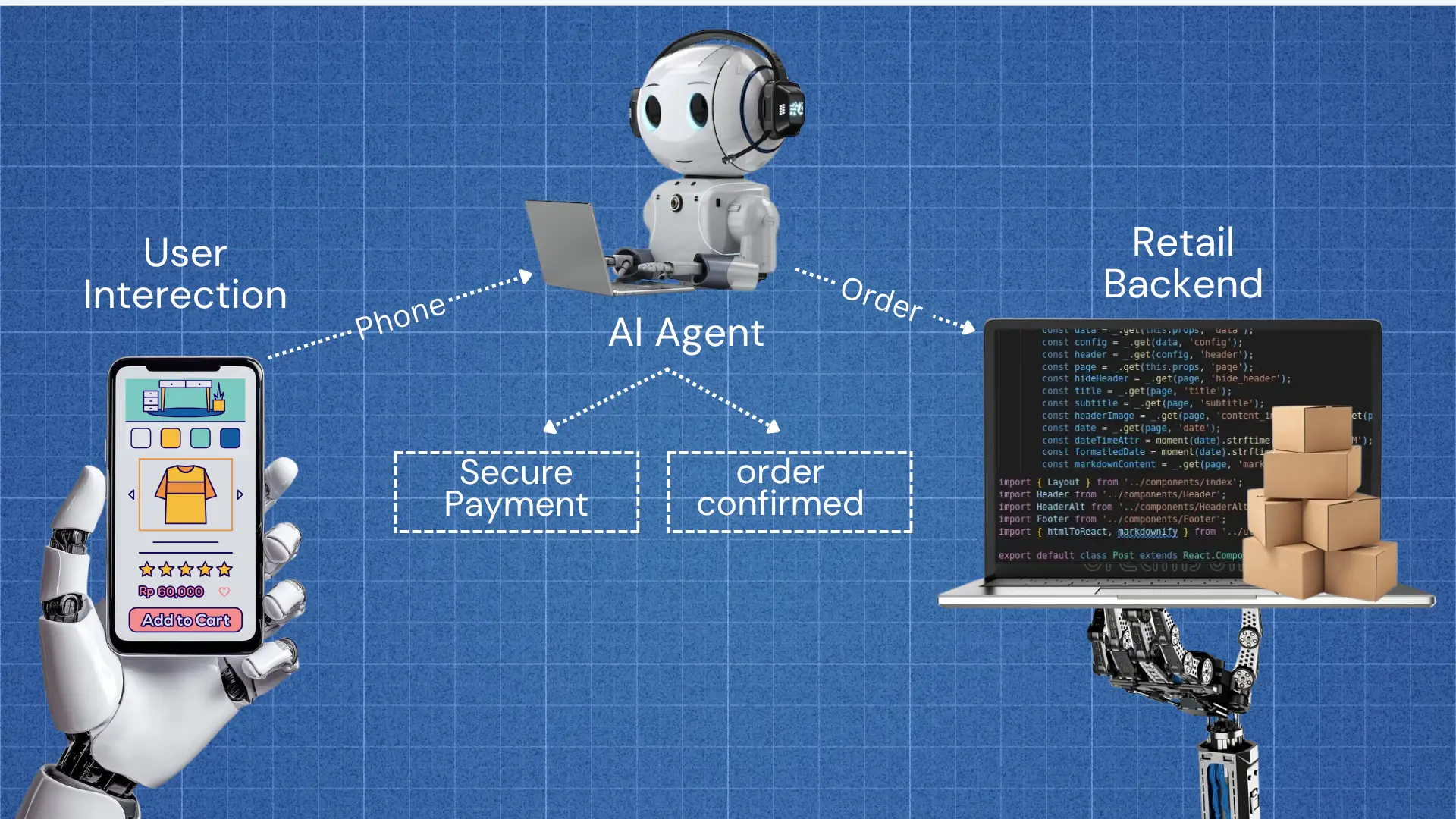
The future of commerce is "Agent-to-Business." Your customer’s AI agent will soon be shopping for them.
- Universal Commerce Protocol (UCP): Integrate with standards like Google’s UCP. This allows AI agents to navigate your checkout flow seamlessly. If an AI hits a friction point (like a complex captcha or a broken form), it will abandon the cart instantly.
- App Intents for Siri: With the rise of Apple Intelligence, optimize your iOS app with "App Intents." This allows Siri to execute specific actions deep within your app (e.g., "Siri, order my usual coffee from [Brand]") without the user ever opening the screen.
- Outcome-Driven Commerce: Optimize product data for "buyers' agents." These agents don't care about marketing fluff; they compare specs. Ensure your technical specifications (dimensions, materials, energy usage) are structured and accessible.
The Technical Requirement: Schema.org Strategy
To communicate with an Agentic Web, you must speak its native language: Structured Data (JSON-LD). Implement these immediately:
- Organization Schema: To establish Brand Entity identity (Logo, Founders, Social Profiles).
- FAQPage Schema: To directly feed Q&A pairs to AEO engines.
- Dataset Schema: If you publish original research/stats (crucial for GEO).
- ProfilePage Schema: For authors, to establish E-E-A-T credentials.
Authority & Reputation: The "Consensus" Engine
LLMs function on a "consensus-based" protocol. They verify facts by cross-referencing sources.
- Off-Site Verification: You cannot just say you are the best; other high-authority nodes must agree. Focus on earning mentions on "Source of Truth" platforms like Reddit, Wikipedia, LinkedIn, and G2. If Reddit threads and Wikipedia articles agree on your brand's value, the AI accepts it as truth.
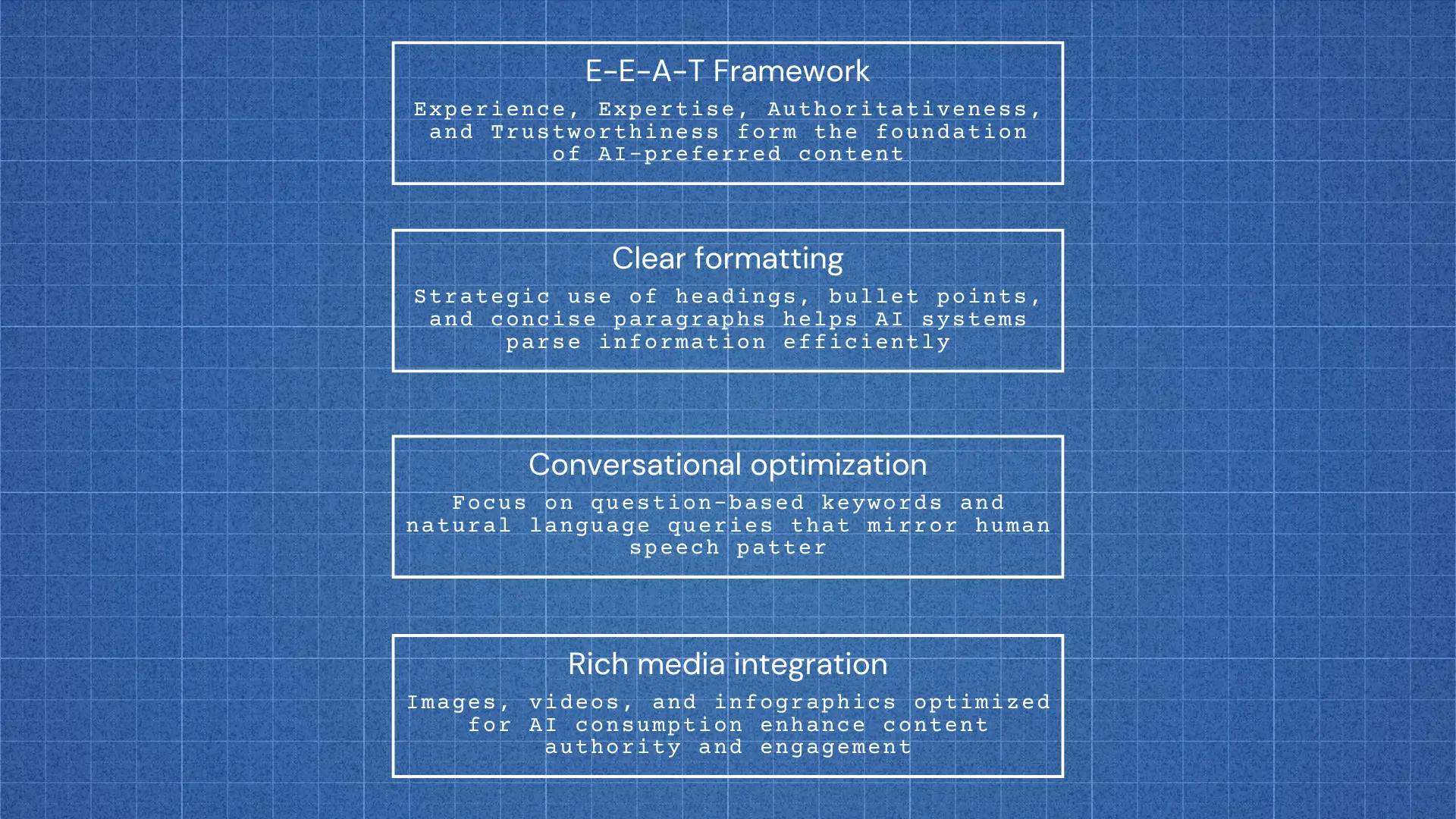
- Authoritative Signals (E-E-A-T): Double down on Experience, Expertise, Authoritativeness, and Trust. Every blog post needs a detailed author bio linking to verified LinkedIn profiles and industry certifications. You are building a "Knowledge Graph" entry for your authors as much as your brand.
The Vocabulary of 2026: AEO, GEO, and the "SEO" Variations
The marketing industry often uses these terms interchangeably, but they represent distinct technical approaches. Understanding the nuances determines whether you are optimizing for a link, a citation, or a direct voice response.
Are They the Same? (The Quick Answer)
No, they are not the same, but they are interconnected. While all four terms fall under the umbrella of "AI-Era Visibility," they target different parts of the AI's "brain".
- AEO targets the output (the answer).
- AEO targets the retrieval (the citation).
- AI SEO/LLM SEO are broader industry terms used to describe the transition from traditional search to machine-mediated search.
The Technical Breakdown
| Term | The "Agent" | Goal | Industry Use Case |
|---|---|---|---|
AEO (Answer Engine Optimization) | Siri, Alexa, Google Gemini (Voice) | Secure "Position Zero" and provide the immediate, direct answer. | Used heavily in Local SEO, E-commerce, and Quick-Fact industries. |
GEO (Generative Engine Optimization) | Perplexity, ChatGPT, AI Overviews | To be cited as a source in a generated summary or synthesis. | Used by SaaS, B2B, and Thought Leaders to build authority. |
AI SEO | Google Search (SGE/AIO) | Using AI tools to improve traditional SEO (keyword research, content automation). | Used by Agencies and Content Marketers to scale production. |
LLM SEO | GPT-4, Claude, Gemini Models | Ensuring a brand is part of the LLM’s training data or vector space. | Used by Enterprise Brands to influence how the model "thinks" about them. |
Why the Industry Uses Different Terms
The terminology usually depends on the background of the professional you are talking to:
- The "Old School" Marketer (AI SEO): They use "AI SEO" because it feels like an evolution of what they already know. They focus on using AI to rank better in the same old search results.
- The Tech/Dev Lead (LLM SEO): They use "LLM SEO" because they view the internet as a massive dataset. They want to ensure their site’s "vectors" (the mathematical representation of their content) are close to high-value keywords in the model’s memory.
- The Strategist (GEO & AEO): These are the most modern terms. Strategists use "GEO" when they want to be mentioned by name in an AI summary and "AEO" when they want to win the voice-search battle for a specific question.
The Verdict: Convergence
By late 2026, we expect these terms to merge into a single discipline: Inference Optimization. The goal is no longer to "rank" in a list; it is to be "inferred" as the best solution by a reasoning machine. Whether you call it AEO or LLM SEO, the objective is Verifiable Authority. If your brand is mentioned across Reddit (Consensus), has clean JSON-LD (Structure), and provides unique data (Information Gain), you are successfully optimizing for all of them simultaneously.
The Great Change: Traditional SEO vs. 2026 Optimization
Before we look at the results, we must understand the shift in the data itself. In the past, we measured how many people found our site; today, we measure how many people are influenced by our site before they ever visit it.
| Metric | Traditional SEO (Pre-2024) | 2026 Reality (GEO/AEO) | The Structural Change |
|---|---|---|---|
Primary Goal | Rank #1 on Page 1 | Rank as the "Top Recommendation" | From being a link in a list to being the answer itself. |
Optimization Target | Keywords & Backlinks | Entities & Information Gain | Engines now prioritize unique data over word counts. |
User Journey | Search → Click → Visit | Prompt → Synthesis → Action | The "Zero-Click" reality satisfies intent within the AI window. |
Trust Factor | Domain Authority (DA) | Consensus & EEAT | If Reddit, Wikipedia, and LinkedIn agree, the AI trusts you. |
Success Metric | Organic Traffic | Share of Model (SoM) | Presence in the AI's "brain" is more valuable than a raw click. |
Measuring Success: The New KPI Playbook
Forget "Page 1 Rankings." In a world where AI synthesizes the web, your visibility is measured by your footprint in the Large Language Model's response. Here is how we measure success in 2026:
Share of Model (SoM)
This is the most critical transparency metric for the AI era. It measures your brand's presence within the "digital consciousness" of platforms like ChatGPT, Gemini, and Perplexity.
- Definition: The percentage of times your brand is mentioned in response to category-relevant prompts.
- Formula: $$\text{SoM} = left( frac{\text{Prompts where brand appears}}{ text{Total relevant prompts}} \right) \times 100$$
- Why it matters: If an LLM doesn't mention you in its synthesis, you don't exist in the buyer's funnel.
Why it matters:
While SoM measures your total presence, AI SoV measures your dominance against direct competitors in conversational queries.
- The Benchmarks:
- Market Leader: 25-40% AI SoV (The default recommendation).
- Major Player: 15-25% (A frequently cited alternative).
- Challenger: <15% (Rarely cited; requires "Information Gain" work).
Citation Rate & Sentiment
It’s no longer enough to be mentioned; you must be cited as the authority.
- Citation Tracking: Are the AI engines linking to your whitepapers and data as the "Source of Truth"?
- Sentiment Analysis: How does the AI frame you? There is a massive ROI difference between being described as the "industry leader for enterprises" versus an "affordable but limited option".
Brand Visibility Score (BVS)
A composite score that weights your position in an AI answer. A "Lead Recommendation" (the first name mentioned) is weighted 3x higher than being "buried in a list" at the bottom of a summary.
Conclusion: A Strategic Roadmap for 2027
The era of "Capturing the Click" has officially evolved into the era of Capturing the Synthesis. In 2026, your website is no longer just a destination; it is a data source for the world’s most powerful reasoning engines. To win in this Agentic Web, you must stop writing for the "scroll" and start writing for the "extraction".
The transition from SEO to GEO and AEO isn't just about new acronyms; it’s about a fundamental shift in trust. If an AI doesn't see your brand in the "Consensus," it won't cite you. If your data isn't structured, it won't use you. The brands that will dominate 2027 are those that prioritize Information Gain over word count and Verifiable Authority over vanity metrics.
The mandate is clear: Integrate with the model, or evaporate from the market.