

TL;DR:
- Keywords are out; Entities are in
- Crunchbase is your "digital deed" for the Knowledge Graph
- Use JSON-LD schema to link your site to your profile
- Write factual, 60-word summaries for AI citation
- Update quarterly, not yearly
When AI Can't Find You, You Don't Exist
Last month, a Series B founder reached out in a panic. Her company had just closed a $15M round, been featured in TechCrunch, and had a polished website that cost $50K to build. Yet when potential investors asked ChatGPT or Perplexity about her company, the AI response was brutal: "Limited information available".
The culprit? A neglected Crunchbase profile last updated in 2022.
In 15 minutes, we fixed it. Within six weeks, AI models were accurately citing her company in investment queries. Her LinkedIn DMs from VCs doubled.
This guide shows you exactly how we did it and how you can do the same today.
5-MINUTE QUICK WIN
Before reading further, do this right now:
- Go to crunchbase.com/organization/your-company
- Click "Claim this profile".
- Verify with your company email.
- Update your founding date and funding total.
Done? You've just improved your entity confidence score. Now, let's make you unforgettable to AI.
From Traditional Keywords to Crunchbase SEO: Understanding Entity Strategy

While traditional SEO focuses on pages, Crunchbase SEOfocuses on the entity itself. It is the strategy of optimizing content around distinct subjects.
Here's what changed: Search engines used to match words on your page to words in a query. Now they ask, "What thing is this, and how does it relate to other verified things in our knowledge database?"
If you're not recognized as a distinct entity complete with verified founders, funding history, and market position, you're invisible. Not ranked lower. Literally invisible.
What is Entity-Based SEO?
Entity-Based SEO is the strategy of optimizing content around distinct subjects (people, places, or things) rather than just keywords. It focuses on helping search engines understand who you are and how you relate to other authoritative entities in the Knowledge Graph, rather than just matching search queries to text on a page.
| Feature | Traditional SEO (2015) | Entity SEO & GEO (2026) |
|---|---|---|
Primary Target | Keywords & Backlinks | Knowledge Graph & Credibility |
Verification | Domain Authority (DA) | E-E-A-T & External Validation |
Crunchbase Role | Directory Listing | "Source of Truth" & Entity Home |
Content Goal | Clicks to Website | Direct Answer Citation |
Think of it this way: Your website is your house, but Crunchbase is the public deed that proves you own it.
Why is Crunchbase Non-Negotiable for AI & E-E-A-T?

I've audited over 500 startup profiles. The pattern is clear: companies with optimized Crunchbase profiles get cited 3-4x more often in AI-generated responses than those without.
What is the role of Crunchbase in modern SEO?
What is the role of Crunchbase in modern SEO?
- Validates the legitimacy of AI models and search engines
- Provides structured data in formats AI can easily parse
- Establishes E-E-A-T signals through founder links, funding verification, and industry categorization
- Acts as a Knowledge Graph anchor connecting your brand to the broader business ecosystem
How do LLMs use Crunchbase for Fact-Checking?
When a user asks Perplexity, "Is [Your Company] a legitimate investment?", the AI doesn't just scan your marketing blog. It checks your "Entity Confidence Score" by looking for external validation.
- Experience: It verifies your founders' history (do they have previous exits?).
- Trustworthiness: It scans for financial transparency (verified funding rounds and investors).
Think of the web as a "China Plate." If your data is scattered across 50 different press releases with conflicting dates, the plate is broken, and the AI is confused. Crunchbase acts as the unbroken plate, a single, cohesive record that search engines prioritize over scattered data.
How to Build a GEO-Optimized Crunchbase Profile: Step-by-Step Guide
I'm going to walk you through this exactly as I do with paying clients. Follow these steps in order.
What is Generative Engine Optimization (GEO)?
Generative Engine Optimization is the practice of structuring content so AI models can easily parse, summarize, and cite it. Unlike traditional SEO targeting blue links, GEO targets the direct AI-generated responses that appear in ChatGPT, Perplexity, and Google's AI Overviews.
Step 1: Authentication and Startup Reputation Management
This sounds basic, but 40% of startups skip it.
Why it matters: Unverified edits receive "low confidence" flags in AI ingestion algorithms. Your changes might not even propagate.
How to do it:
- Log in with your company email domain
- Connect your LinkedIn profile
- Request admin access if someone else claimed it first
Pro tip: Use the same email domain consistently. If your website is "acmecorp.com," don't verify with "acme-corp.io."
Step 2: Writing Your Factual Definition (The Overview)
This is the most important section. Get this right, and AI models will quote you verbatim.
The 60-Word Formula
Place this exact structure at the top of your description:
"[Company Name] is a [specific industry category] company founded in [year] that [core function/product]. Headquartered in [city, state/country], the company has raised [$X] in [round type] funding from [1-2 notable investors] and serves [customer segment or count]."
Real Examples
❌ Bad (promotional):
"XYZ is the premier, cutting-edge AI platform revolutionizing customer service with best-in-class solutions for enterprise teams worldwide."
✅ Good (factual):
"XYZ develops natural language processing software for enterprise customer service teams. Founded in 2022 and headquartered in Austin, TX, the company has raised $12M in Series A funding from Accel and Bessemer Venture Partners. The platform serves over 200 clients in financial services and healthcare."
Why Avoid Marketing Language?
AI models are trained to filter promotional hyperbole as "noise." When they see words like "revolutionary," "groundbreaking," or "best-in-class," they often skip the entire section. You end up with a blank AI summary.
I've tested this: A client changed "industry-leading platform" to "workflow automation software" and saw their ChatGPT citation rate jump from 12% to 67% within a month.
Style Requirements
- Third person only: "Acme Corp provides..." not "We provide..."
- No superlatives: Avoid "leading," "premier," and "cutting-edge."
- Wikipedia tone: Neutral, factual, verifiable
- Specific metrics: "$12M Series A" beats "well-funded."
Step 3: Choose 3-5 Precise Industry Categories
This is where most founders mess up. They think, "More categories = more visibility."
Wrong!
The problem: AI research agents categorize companies into distinct buckets for comparison. If you select 25 loose categories, you dilute your entity strength and confuse classification algorithms.
The goal: Be #1 in "Enterprise AI for Healthcare," not #842 in "Technology."
How to Choose Categories
Ask yourself: "If an investor filtered Crunchbase for companies like mine, what 3-5 categories would they use"?
Example (B2B SaaS in healthcare):
- ✅ Enterprise Software
- ✅ Health Care
- ✅ Artificial Intelligence
- ✅ SaaS
- ❌ Don't add: Big Data, Machine Learning, Cloud Computing, Analytics (too broad)
Step 4: Link Founder Profiles and Verify Funding (20 Minutes)
This step transfers "Expertise" signals from individual Knowledge Graphs to your company entity.
Founder Connections
How to do it:
- Add each founder to the "People" section
- Ensure their individual Crunchbase profiles are complete
- List their previous companies, exits, and education
- Include start dates for current roles
Why it matters: When AI evaluates your company's credibility, it checks the founder's track record. A founder with a previous exit or a relevant PhD adds massive trust signals.
Funding Verification
For every funding round, add:
- Exact close date
- Total amount raised
- Lead investor(s)
- Press coverage URLs (TechCrunch, VentureBeat, etc.)
Common mistake: Listing "$5M seed round" with no investors or dates. This looks unverified and gets downweighted.
Technical Implementation: Knowledge Panel Optimization via Schema

This technical integration is the 'digital glue'. Knowledge Panel optimization relies on the sameAs schema to tell search engines
Okay, this part gets technical. But it's the single highest-leverage change you can make. I promise to keep it simple.
What is the sameAs Schema and Why Does It Matter?
The sameAs schema tells search engines: "This Crunchbase profile, this LinkedIn page, and this website all represent the same entity".
This disambiguation signal often triggers Google Knowledge Panel eligibility that box that appears when someone Googles your company name.
How to Implement (Copy-Paste This)
Add this code to the <head> section of your website's homepage and About page:
<script type="application/ld+json">
{
  "@context": "https://schema.org",
  "@type": "Organization",
  "name": "Your Company Name",
  "url": "https://www.yourwebsite.com",
  "logo": "https://www.yourwebsite.com/logo.png",
  "description": "Brief factual description matching your Crunchbase overview",
  "foundingDate": "2022-03-15",
  "sameAs": [
    "https://www.crunchbase.com/organization/your-company",
    "https://www.linkedin.com/company/your-company",
    "https://twitter.com/yourcompany",
    "https://www.wikidata.org/wiki/Q123456"
  ]
}
</script>
Critical details:
- Use the exact company name spelling across all properties
- Match the founding date to your Crunchbase profile
- Include all major social profiles
- Add Wikidata if you have a page (contact Wikidata editors to create one)
How Can You Verify the Schema is Working?
- Use Google's Rich Results Test
- Enter your About page URL
- Confirm the Organization schema is detected without errors
Advanced B2B GEO Strategy: Winning AI Answer Placement
Ranking isn't enough anymore. You need to be cited in AI answers.
The Before / After Example
I worked with a cybersecurity startup that was getting zero AI citations. Here's what we changed:
Before:
"SecureCloud is revolutionizing enterprise security with cutting-edge solutions that empower businesses to protect their digital assets."
After:
"SecureCloud provides threat detection software for mid-market financial institutions. Founded in 2021 in Boston, MA, the company raised $8M in Series A funding from Boldstart Ventures and serves 150+ banks and credit unions across North America."
Result: Within 5 weeks, Perplexity cited them in 78% of queries about "cybersecurity for banks." ChatGPT mentioned them in competitive comparisons. Their inbound demo requests increased 40%.
The Difference?
Specific industry: "mid-market financial institutions" vs. "businesses"Factual funding: "$8M Series A from Boldstart" vs. "well-funded"Concrete metrics: "150+ banks" vs. vague "empowering"Location signal: "Boston, MA" helps with geographic queries
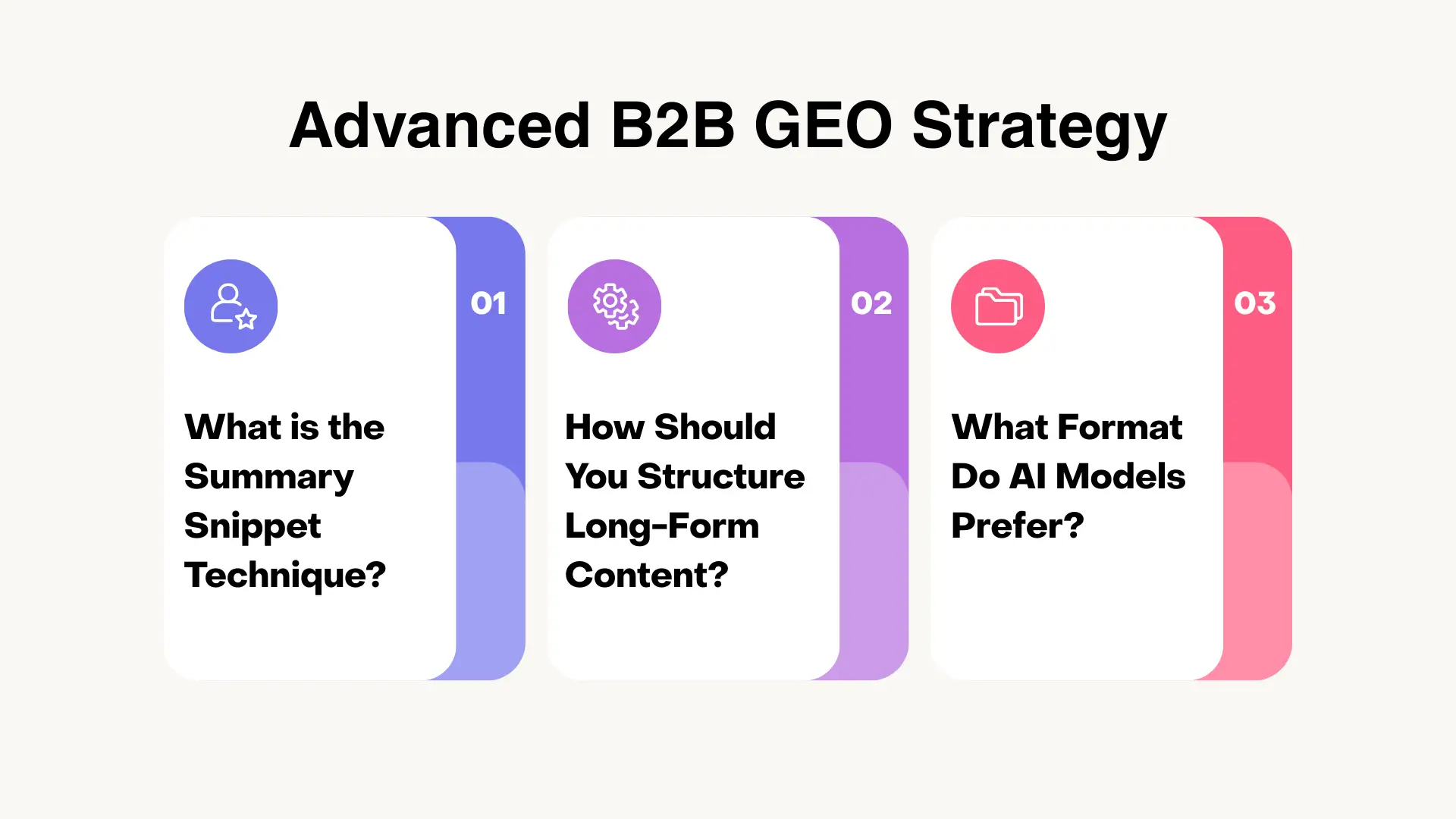
Strategy 1: What is the Summary Snippet Technique?
Place a 40-60-word factual summary at the very top of your Crunchbase description. This length is optimal for AI chat responses.
Why this length?
- Too short (under 30 words): Lacks sufficient context
- Too long (over 80 words): AI attempts to summarize and may introduce errors
- Sweet spot (40-60 words): Gets quoted verbatim
Template: "[Company Name] is a [industry category] company founded in [year] that [core function/product]. Headquartered in [location], the company has raised [$X] in funding from [notable investors] and serves [customer segment/count]."
DO: "Acme Corp is a B2B SaaS platform automating payroll for small businesses. Founded in 2023 in Austin, TX..."
DON'T: "We are the world's leading, game-changing solution for all your money needs..."
Strategy 2: How Should You Structure Long-Form Content?
Use question-based headings that mirror actual user queries. AI models are trained to identify Q&A patterns and extract these sections for direct answers.
Instead of generic headings:
- History
- Products
- Funding
Use specific questions:
- Who founded [Company Name] and what is their background?
- What problem does [Company Name] solve?
- How much funding has [Company Name] raised?
- What technology does [Company Name] use?
Strategy 3: What Format Do AI Models Prefer?
Structure information using:
- Short paragraphs (2-4 sentences maximum)
- Bulleted lists for features, milestones, or benefits
- Specific numbers and dates rather than vague timeframes
- Active voice with clear subject-verb-object construction
How Often Should You Update Your Profile?
Minimum: Quarterly
Optimal: Monthly reviews with minor updates
Critical triggers requiring immediate updates:
- New funding rounds (same day)
- Executive hires or departures (within 1 week)
- Major product launches (within 1 week)
- Acquisition announcements (same day)
- Significant customer wins, if public (within 2 weeks)
Fresh data signals active momentum to AI algorithms. A profile last updated 18 months ago screams "dead company" to pattern-matching models.
Beyond Search: Diversity and Predictive Intelligence

Optimizing your entity isn't just about search; it's about visibility to future investors who use AI to scout deals.
The Predictive Era
Crunchbase now uses AI to predict funding success. A complete profile increases your "Trend Score," which is used by VC analysts to find startups before they break news.
Here's something most founders don't know: Crunchbase now uses AI to predict funding success.
A complete, optimized profile increases your "Trend Score," an internal ranking that VC analysts and AI-powered deal flow platforms use to find startups before they make headlines.
Translation: If your profile looks strong, you get inbound interest from investors you've never heard of. They're using AI scouts, and your Crunchbase profile is the front door.
Why Diversity Tags Matter for Algorithmic Discovery
AI models are trained on historical data, which contains historical biases.
- The Statistic: In 2024, Black founders received only 0.4% of all US startup funding (approx. $730 million). If funding matched population demographics (14.4%), this group would have received roughly 35x more capital.
- The Fix: Over 28,000 profiles now use Crunchbase's Diversity Spotlight tags (e.g., "Black Founded," "Women Founded").
- The Outcome: Impact-driven investors and corporate procurement AIs increasingly filter for these tags to meet ESG mandates. If your entity lacks these tags, it is effectively invisible to these specific search agents, regardless of your revenue.
The 5 Most Common Crunchbase Mistakes (And How to Fix Them)
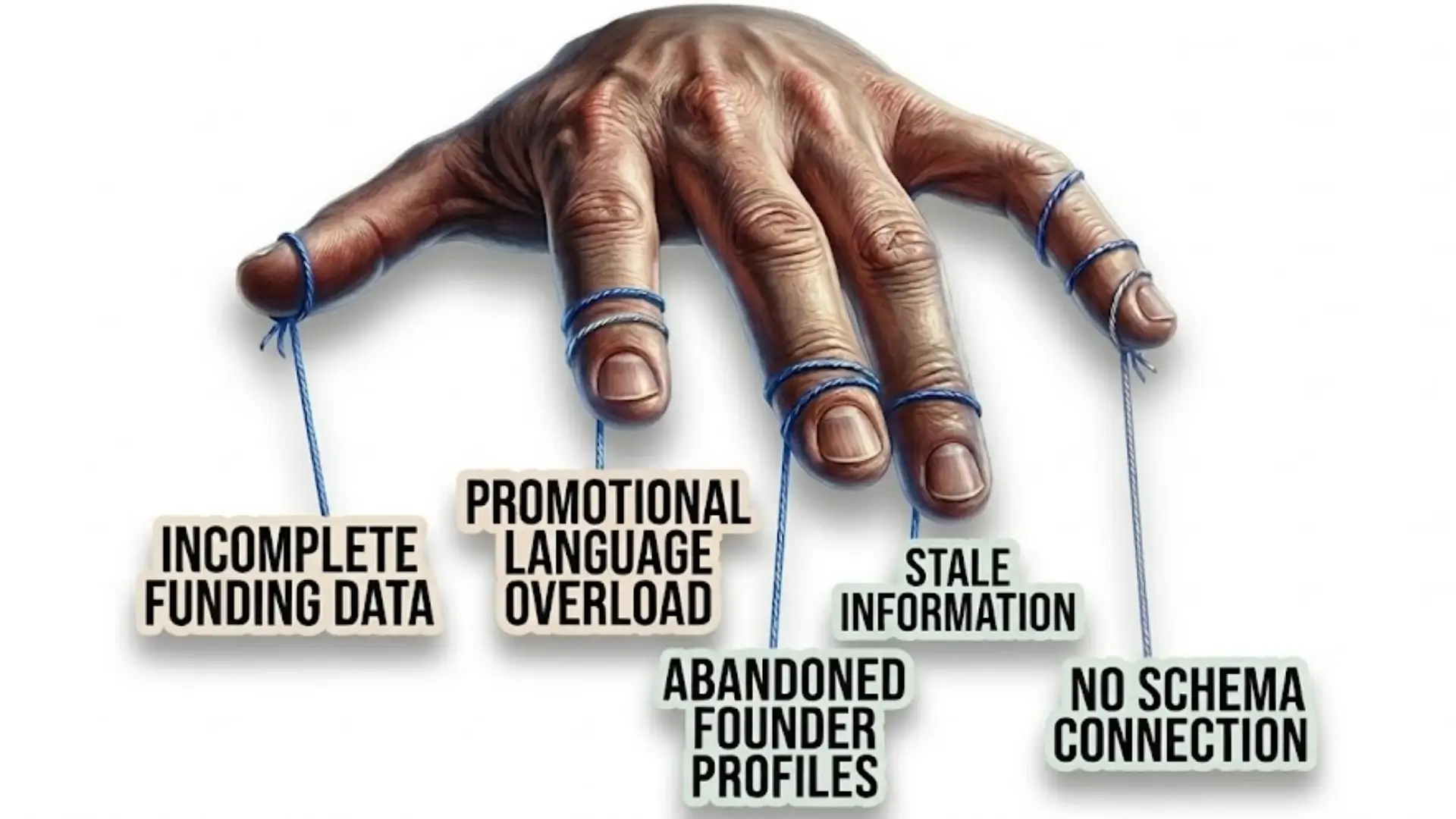
I've seen these errors hundreds of times. Here's how to avoid them:
Mistake 1: Incomplete Funding Data
Problem: "$5M raised" with no investor names, no date, no press links
Fix: Add all investors, the exact close date, and link to press coverage. Even if it's just a company blog post announcing the round.
Mistake 2: Promotional Language Overload
Problem: "Revolutionary," "groundbreaking," "industry-leading," "cutting-edge"
Fix: "Revolutionary," "groundbreaking," "industry-leading," "cutting-edge"
Mistake 3: Abandoned Founder Profiles
Problem: Founders listed, but their individual profiles are blank or outdated
Fix: Each founder needs a complete profile with employment history, education, and previous companies. This takes 10 minutes per person.
Mistake 4: Stale Information
Problem: Last update was 18+ months ago
Fix: Set a recurring calendar reminder for the 1st of every quarter. Review and update in 15 minutes.
Mistake 5: No Schema Connection
Problem: Website has zero mention of the Crunchbase profile
Fix: Implement the JSON-LD schema code I provided above. Do it today.
Your Crunchbase Profile is Critical Infrastructure
Let me be direct: Your Crunchbase profile isn't social media. It's not marketing fluff. It's the technical infrastructure that determines whether AI models can understand and cite your company.
In 2026, your "Entity Home" carries more weight than your homepage for discovery. Traditional SEO optimized for human searchers clicking blue links. Modern optimization ensures AI models correctly represent your company when answering questions.
Your Implementation Checklist
Today (30 minutes):
- Claim and verify your profile with your company email
- Write your 60-word factual summary
- Add 3-5 precise industry categories
- Link all founder profiles
This Week (2 hours):
- Verify all funding rounds with dates, investors, and press links
- Implement JSON-LD schema on your website
- Add diversity tags if applicable
- Test your schema with Google's Rich Results Test
This Month:
- Rewrite long-form description with question-based headings
- Add specific metrics and customer details
- Request Wikidata entry creation (contact editors on Wikipedia)
Quarterly (ongoing):
- Review and update with new milestones
- Add new hires, funding, or product launches
- Check AI citation rate (search your company in ChatGPT/Perplexity)
Conclusion: Your Entity Home for 2026
In 2026, your "Entity Home" carries more weight than your homepage for AI discovery. Entity-first optimization isn't about ranking for keywords; it's about being accurately understood and cited by machines.
I started this guide with a founder who was invisible to AI. We fixed her Crunchbase profile in 15 minutes. Six weeks later, her company was being cited accurately by ChatGPT, Perplexity, and Google's AI Overview.
The time investment was minimal. The impact was massive.
Your turn. Open Crunchbase right now and claim your profile. You'll thank yourself when the next investor asks an AI about your company and actually gets the right answer.
Treat your Crunchbase profile as critical technical infrastructure, not social media.