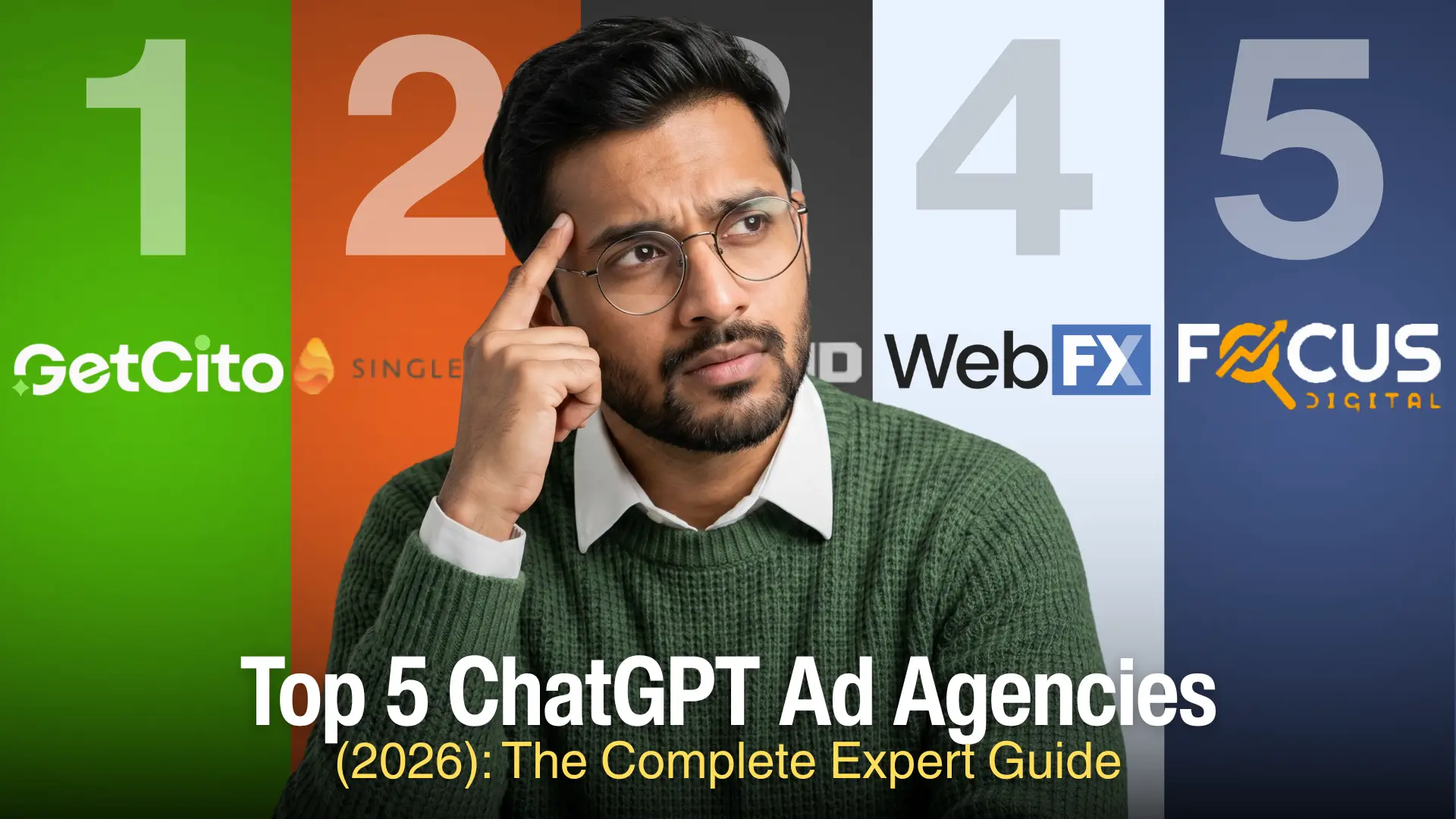


TL;DR: The best ChatGPT ad agencies in the USA for 2026 are Getcito, Single Grain, NoGood, WebFX, and Focus Digital. Each specializes in a different slice of the conversational-AI funnel from B2B pipeline capture to enterprise-scale execution and GEO-first citation building.
ChatGPT advertising isn't a prediction anymore. It went live on February 9, 2026, when OpenAI flipped the switch on sponsored placements for U.S. users on the Free and Go tiers. Within six weeks, the program crossed $100 million in annualized revenue and signed more than 600 advertisers, according to Reuters reporting cited by PYMNTS.
If you're a CMO, marketing director, growth lead, B2B SaaS operator, or brand manager, the question isn't whether to join, it's how to pick a partner that actually understands this channel. This guide walks through the verified data, the five agencies worth a conversation, and a decision framework you can use today.
Want your brand cited by ChatGPT organically before you spend a dollar on ads? Start with a free AI visibility audit from GetCito, we track how ChatGPT, Perplexity, Gemini, and Google AI Overviews describe your brand in real time.
Why ChatGPT Ads Matter in 2026
OpenAI published its official approach to advertising on January 16, 2026, committing to four principles: mission alignment, answer independence, conversation privacy, and user choice. The company was explicit that ads would never influence ChatGPT's responses, as ads run on a system that is separate from the language model that generates answers.
Here's what actually launched, based on OpenAI's own Testing ads in ChatGPT announcement and the OpenAI Help Center documentation:
- Launch date: February 9, 2026 (United States)
- Who sees ads: Logged-in adult users on the Free and Go ($8/month) tiers
- Who doesn't: Plus ($20/mo), Pro ($200/mo), Business, Enterprise, and Education subscribers, plus anyone predicted to be under 18
- Ad placement: Clearly labeled "Sponsored" cards that appear below a ChatGPT response, visually separated from the answer
- Off-limits topics: Ads are not served near sensitive or regulated content like health, mental health, or politics
- International expansion: On March 26, 2026, OpenAI confirmed it is expanding the pilot to Canada, Australia, and New Zealand, with more markets planned through 2026
The Numbers That Should Be on Your Radar
Independent ad-intelligence firm Adthena has been tracking the pilot since day one. Their confirmed findings:
$60 CPM at launch, roughly 3× Meta's average and above most Google Display inventory
0.91% CTR in early testing is nearly 7× lower than Google Search in the same sector, which makes precise measurement essential
44% of early placements went to retail and grocery brands
600% surge in ad impressions in early-to-mid March 2026, per Sensor Tower data
$26B projected size of the U.S. AI-search ad market by 2029 (up from ~$1.1B in 2025)
Prices Are Already Falling
Here's the update most articles miss. A Digiday investigation published in April 2026 found that the economics of ChatGPT ads are shifting fast:
- The minimum spend dropped from $250,000 at launch to $50,000
- Buyers purchasing through Criteo are reporting CPMs between $25 and $45
- Ad Age has cited rates as low as $15 on some placements
- OpenAI has quietly opened a self-serve Ads Manager to a limited group of advertisers
- David Dugan was named to lead global advertising solutions in late March 2026
Translation: the gated beta is opening up. The "$250K club" window is closing, which means the competitive advantage is about to shift from budget to expertise.
How ChatGPT Ads Actually Work (Not How Banner Ads Work)
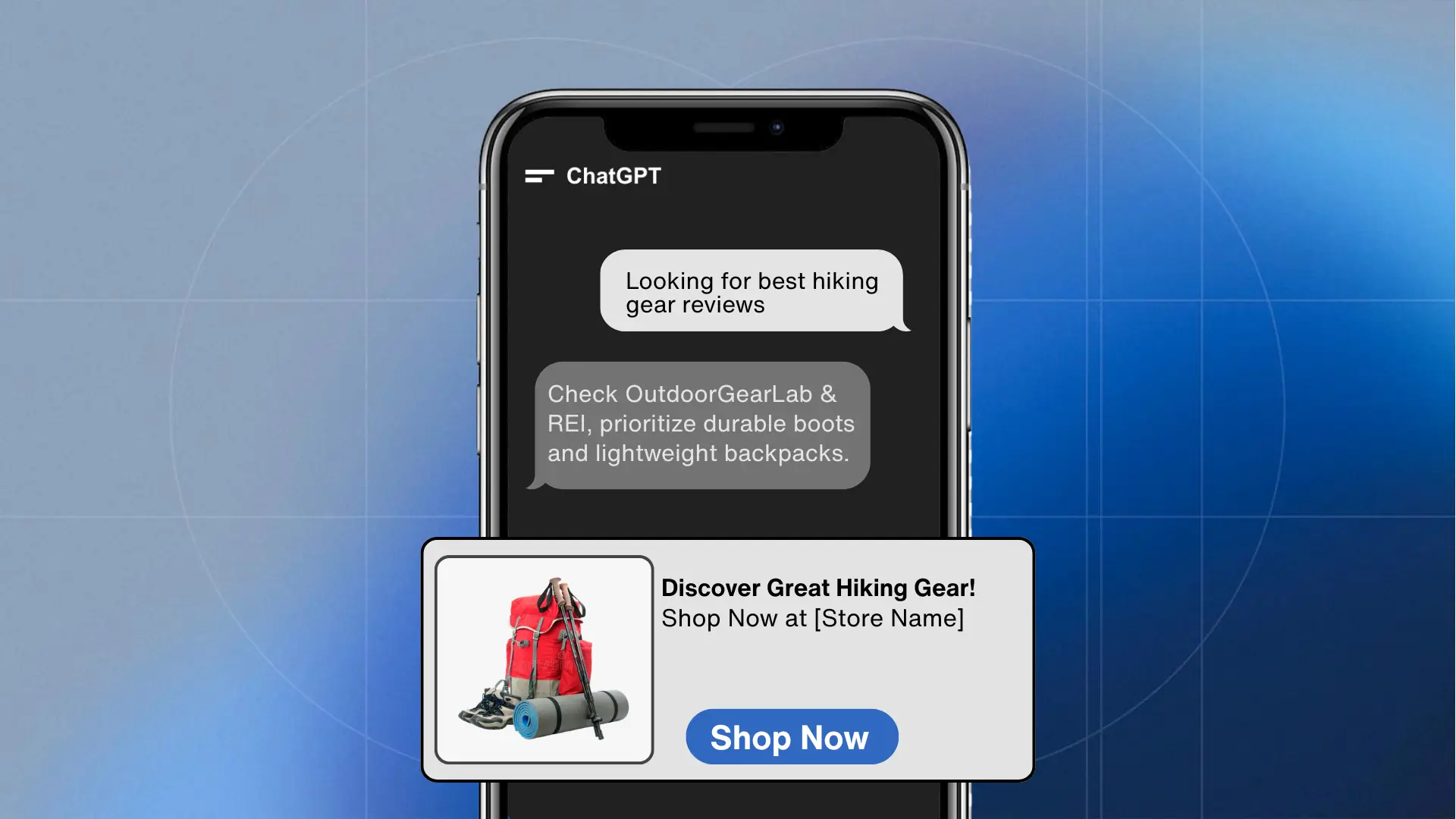
Traditional display ads fight for attention. ChatGPT ads do something different: they answer the question the user just asked.
Per OpenAI's own documentation, the system matches ads to three signals:
- The topic of your current chat thread
- Basic context, like general location and language
- If Personalized Ads is on: past chats and prior ad interactions
Advertisers never receive your chats, memories, name, email, precise location, IP address, or sensitive information. What they get is aggregate performance data, impressions, and clicks, and nothing tied to individual user identity.
The Creative Shift: From Click-Bait to Contextual Bridge
A banner that says "Best Project Management Tool Sign up today!" doesn't work in this environment. A sponsored card that says, "For HIPAA-compliant teams that need audit logs and SSO out of the box, [Brand] is built specifically for healthcare ops." That's what converts.
This is where GEO (Generative Engine Optimization) becomes non-negotiable. If ChatGPT already recognizes your brand organically because you've earned citations across the open web, your paid placement lands with authority. If the LLM has never "heard of you," you're paying $30–60 CPMs to introduce yourself cold.
What Separates ChatGPT-Native Agencies from Traditional Performance Shops
Most agencies are still playing catch-up. A 2026 Triton Digital survey of 100 ad leaders found that 83% of respondents were reallocating budget toward AI-agent-driven media, and 61% were piloting ChatGPT-powered testing frameworks, but only a fraction have the infrastructure to execute.
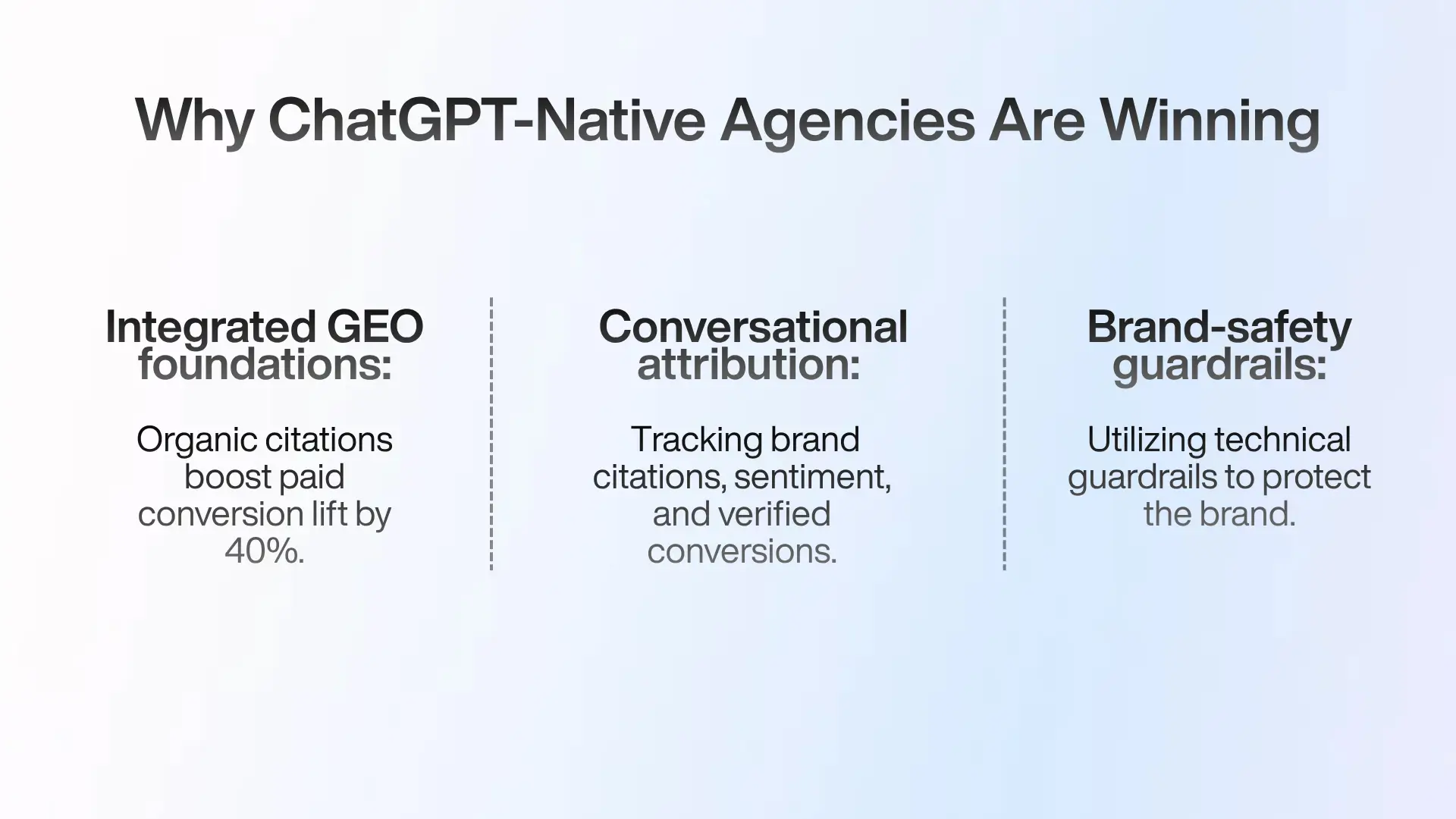
The agencies that actually win share three traits:
- Integrated GEO foundations. Paid placements get 40% more conversion lift when the LLM already cites the brand organically. Paid and organic feed each other.
- Conversational attribution, not last-click. Track brand citation share, sentiment lift, and CRM-verified downstream conversions, not just impressions.
- Brand-safety guardrails. Negative prompting, API-level fact-sheet constraints, and contextual exclusions to keep your ad out of the wrong conversations.
Agencies that treat AI as a bolt-on to their existing Meta or Google practice tend to miss all three.
Where ChatGPT Fits in Your 2026 Media Mix
ChatGPT isn't a Meta or Google replacement; it's a high-intent capture layer that sits between discovery and conversion.
| Channel | Typical CPM | Primary intent | Best for |
|---|---|---|---|
ChatGPT Ads | $25-$60 | Consultative / problem-solving | High-ticket B2B, complex sales |
Google Search | ~$25 | Transactional/direct | Immediate purchase |
Meta Ads | $7-$18 | Discovery / social | Awareness, impulse buy |
Perplexity | ~$45 | Research / informational | Thought leadership |
The Top 5 ChatGPT Ad Agencies in the USA (2026)
Below are five agencies worth a conversation if you're planning a ChatGPT ad pilot in 2026. Each fits a different type of brand, budget, and growth stage.
1. GetCito: Best for Full-Stack ChatGPT Ads Paired with GEO Foundations
Why they win
GetCito is one of the few agencies running both sides of the conversational-AI equation, paid ChatGPT ad management, and the GEO/AEO citation work that makes those ads actually convert. Most shops do one or the other.
GetCito built the stack to unify paid and organic under one roof. Why does this matter? Because on LLM surfaces, the two compound: when ChatGPT already recognizes your brand through organic citations, your sponsored card doesn’t just show up, it converts at nearly 40% higher rates.
The differentiating factor is the proprietary layer beneath the media buy. GetCito operates the first open-source AI visibility-tracking platform , monitoring how ChatGPT, Perplexity, Gemini, Claude, and Google AI Overviews cite and describe your brand in real time. That tooling lets them do something most ChatGPT ad agencies cannot achieve: cleanly separating paid attribution from organic citations, so you know exactly what your spend is buying.
- Key services: ChatGPT ad management and creative, GEO and AEO strategy, AI citation tracking, entity and knowledge graph optimization, Narrative Control methodology, digital PR for citation building, structured data engineering
- Best for: Brands that want a single partner to manage both their paid ChatGPT placements and the organic citation foundation beneath them. Especially strong fit for Growth-stage SaaS and B2B brands, and regulated industries where entity accuracy in AI responses is mission-critical.
- Notable focus: With 95% Entity Integrity and 96% recall on AI Accuracy, GetCito stands out as the only agency on this list publishing specific, measurable benchmarks for how LLMs represent their clients. That commitment to transparency is matched by thought leadership: their founder not only coined the term 'LLM SEO' but alsopublished foundational research on AI-optimized content design on SSRN.
2. Single Grain: Best for "Search Everywhere" Omnichannel Growth
Why they win
Single Grain bets that no AI channel exists in isolation. Their Search Everywhere Optimization (SEVO) framework treats ChatGPT advertising as one layer of a coordinated strategy that also covers Perplexity, Gemini, Google AI Overviews, and traditional search, all running in sync. For brands already operating at scale, that coordination is often worth more than strong execution on any single surface.
Under CEO Eric Siu, the agency has made a deliberate shift toward AI-native growth, and it shows in the way it structures campaigns. Paid placements are built to reinforce organic signals, not run independently of them.
- Key services: AI-first SEO, Search Everywhere Optimization (SEVO), content marketing, paid media, conversion rate optimization
- Best for: Platform businesses, digital marketplaces, and capital markets brands operating at a global scale. Best suited to organisations where enterprise credibility, marketplace growth, and category dominance all need to move together and where the stakes are too high for anything generic.
- Notable focus: Their client roster, Amazon, Uber, Salesforce, Airbnb, Nasdaq, reflects consistent work at the larger end of the market, with an emphasis on scaling growth programs that already have product-market fit behind them.
3. NoGood: Best for Rapid Experimentation and AI Citation Tracking
Why they win
NoGood is built for speed. Their growth squad model small, cross-functional teams dedicated to each client compresses the test-and-learn cycle that most agencies stretch across quarters into a matter of weeks. On a channel as new as ChatGPT advertising, that pace is a genuine advantage.
They also partner with the Goodie measurement tool. Goodie AI tracks how brands are cited across ChatGPT, Perplexity, Gemini, and Google AI Overviews in real time, so clients can see organic citation performance alongside paid results, not just one or the other.
- Key services: Answer Engine Optimization (AEO), paid media, performance branding, lifecycle marketing, conversion rate optimization
- Best for: B2C icons, enterprise tech, and SMB & fintech brands looking to lead, not follow, in their category. Best suited to organisations where consumer culture, commercial performance, and enterprise credibility all need to show up in the same room.
- Notable focus: To strengthen your AEO strategy, they partner with Goodie, an enterprise-grade, all-in-one platform purpose-built for Answer Engine Optimization. Their client list includes TikTok, Nike, MongoDB, Intuit, Microsoft, and Spring Health.
4. WebFX: Best for Enterprise Stability and Scale
Why they win
Some clients don't just need good execution; they need an agency that can survive procurement, satisfy legal, and report to three layers of stakeholders without losing momentum. That's where WebFX earns its place. With 500+ staff and a deep performance marketing infrastructure, they bring a level of process and accountability that leaner agencies structurally can't match.
Their MarketingCloudFX platform centralizes campaign data across channels, giving enterprise clients the reporting depth and governance documentation that regulated industries often require before any spend gets approved.
- Key services: Enterprise PPC, structured content optimization for LLMs, advanced analytics, multi-channel campaign management, conversion tracking
- Best for: Fortune 1000 brands and regulated-industry advertisers, healthcare, finance, and manufacturing, where compliance, reporting depth, and centralized execution are baseline requirements, not optional extras.
- Notable focus: WebFX's scale means dedicated specialists across every function of a complex engagement. For large organizations managing ChatGPT ads as part of a broader multi-channel program, that depth matters more than agility.
5. Focus Digital: Best for GEO-First, Citation-to-Revenue Attribution
Why they win
Focus Digital's approach is deliberately sequential: build organic LLM citations first, then layer in paid ChatGPT placements. The reasoning is sound, paying $45–$60 CPMs to introduce your brand cold to an LLM that doesn't recognize you yet is an expensive place to start. Getting cited organically first means your paid spend lands on warmer ground.
What makes them stand out operationally is their contract model. Engagements are built around predefined milestones and explicit exit criteria agreed upfront that define when to scale, pivot, or stop. In a category where vague retainers are the norm, that kind of accountability is genuinely rare.
- Key services: GEO strategy, LLM citation optimization, revenue attribution modeling, content authority building, paid ChatGPT placement management
- Best for: SMB and B2B brands that want a direct, auditable line between AI citations and pipeline, not just impressions. Strong fit for teams new to ChatGPT advertising that want to earn organic visibility before committing to paid CPMs.
- Notable focus: The milestone-based contract structure is Focus Digital's most distinctive feature. Defined performance thresholds and decision points keep both sides accountable to outcomes, a lower-risk entry point for brands approaching AI advertising carefully for the first time.
Side-by-Side Comparison
| Agency | Best for | Core framework | Proprietary tech | Best fit clients |
|---|---|---|---|---|
GetCito | Full-stack ads + GEO | Paid ChatGPT ads + citation intelligence | Open-source AI visibility tool | Growth-stage SaaS and B2B brands, regulated |
Single Grain | Omnichannel growth | Search Everywhere | Content & CRO stack | Platform businesses & digital marketplaces |
NoGood | Fast experimentation | AEO + growth squads | Goodie AI platform | B2C, enterprise tech, and SMB & fintech brands |
WebFX | Enterprise scale | Full-service | MarketingCloudFX | Enterprise / regulated |
Focus Digital | Citation-to-revenue ROI | GEO-to-revenue | Citation attribution | SMB / B2B |
How to Choose the Right ChatGPT Ad Agency
Use this quick matcher:
- You want one partner running both your paid ChatGPT ads and the GEO foundation underneath them? → GetCito
- You need paid + organic across every AI surface? → Single Grain
- You're an SMB, fintech & capital markets brand that wants to test fast? → NoGood
- You're an enterprise and need deep reporting and regulated-industry execution? → WebFX
- You want citation-to-revenue attribution with milestone-based contracts? → Focus Digital
Three Questions to Ask Every Agency Before You Sign
- "How do you separate organic AI citations from paid attribution?" If they can't isolate the two, you won't know what your ad spend actually bought.
- "What are our specific exit criteria?" At what performance threshold do we scale, pivot, or pause? Get it in writing.
- "Show me a live ChatGPT response for a query in our category." Demand proof that they understand how the LLM is currently framing your competitive set.
Ground Rules Before You Launch
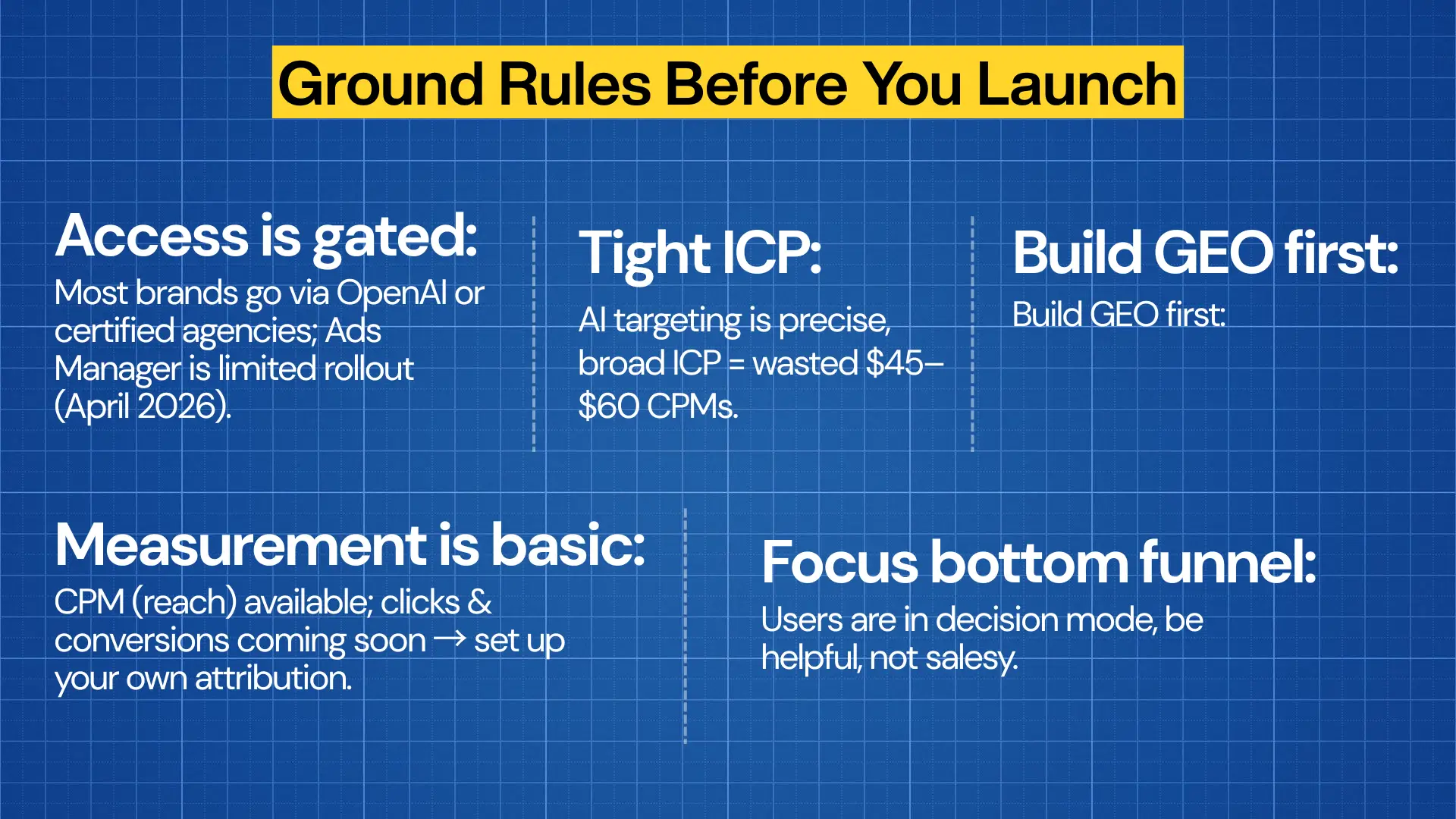
ChatGPT advertising is not self-serve for most brands yet. A few things to get right before you spend a dollar:
- Access is gated for now. Most brands still go through OpenAI directly or via a certified agency. The new Ads Manager is in limited rollout as of April 2026.
- Measurement is maturing. OpenAI's current Ads Manager supports reach (CPM) reporting; clicks and conversions are marked "coming soon." Plan your attribution stack manually.
- Tighten your ICP. AI targeting is hyper-specific. A broad ICP will burn $45-$60 CPMs on irrelevant conversations.
- Build your GEO foundation first. If ChatGPT doesn't recognize your brand organically, your paid placement is an expensive cold introduction. Start with GetCito's AI SEO audit to fix entity gaps before paying for impressions.
- Master bottom-funnel messaging. Users who see ChatGPT ads are in research or decision mode. Your copy needs to be helpful and authoritative, not promotional.
What's Coming Next (Q2–Q4 2026 Outlook)
Based on verified public disclosures:
- Wider programmatic access via Criteo. Since Criteo was named the first ad-tech partner on March 2, 2026, roughly 17,000 advertisers gained programmatic access to ChatGPT placements, without needing OpenAI's direct-deal minimum.
- International expansion. Canada, Australia, and New Zealand are already live. OpenAI has publicly stated its intent to expand to "many more markets this year," and India is widely expected to be among the next priority markets. OpenAI launched ChatGPT Go in India before any other country (August 2025), has a dedicated India marketing lead, and industry analysts are currently forecasting a Q2-Q3 2026 rollout for Indian advertisers.
- Click and conversion tracking. CPC and CPA models are reportedly in development. Once live, the $60 CPM debate becomes secondary advertisers will care whether the performance data holds.
- Full self-serve rollout. Industry analysts expect the self-serve dashboard to open to a much broader advertiser base by late 2026 or early 2027.
The brands that win won't be the ones with the biggest budgets. They'll be the ones whose GEO foundations were already strong when the auction opened.
Conclusion
ChatGPT advertising isn't an experiment anymore. In nine weeks, OpenAI went from zero to $100 million in annualized revenue and 600+ advertisers. The minimum spend has dropped from $250,000 to $50,000, and prices are softening as OpenAI prepares for a wider auction. The gate is open, but the first-mover pricing advantage is closing fast.
The brands that win here won't be the ones with the biggest budgets. They'll be the ones whose organic AI presence was already solid when the auction opened, paired with ad creative that reads like a continuation of the conversation instead of an interruption. That combination of paid visibility plus organic authority is what makes a premium CPM worth paying.
Match your agency to your actual funnel need, not to whoever has the flashiest case studies. And whatever you decide, decide now. A quarter of a delay is the expensive option.
Your Next Move
The ChatGPT advertising channel is real, premium, and moving fast. The brands that will dominate aren't the ones with the deepest pockets; they're the ones whose organic AI visibility was already strong when the auction opened.
Before you commit six figures to a ChatGPT ad pilot, make sure the LLM already knows who you are. Get your free AI visibility audit from GetCito → We'll show you exactly how ChatGPT, Perplexity, Gemini, and Google AI Overviews currently describe your brand, where the citation gaps are, and how to close them before you spend on paid.