

Organic traffic reports that once showed reliable growth are now showing something different: steady volume for branded terms, softening numbers for category-level queries, and an analytics gap that no one on the team can fully explain. If that sounds familiar, you are not dealing with a content quality problem or a technical SEO regression. You are dealing with a structural shift in how people find information.
AI-powered search engines, Google AI Overviews, ChatGPT, Perplexity AI, and Gemini now synthesize and deliver answers directly, without requiring a user to click through to a source. Study found that 65% of search queries now end without a single click. Ahrefs data shows a 58% drop in organic clicks for many established brands over the same period. These are not outliers. They reflect a new default behavior.
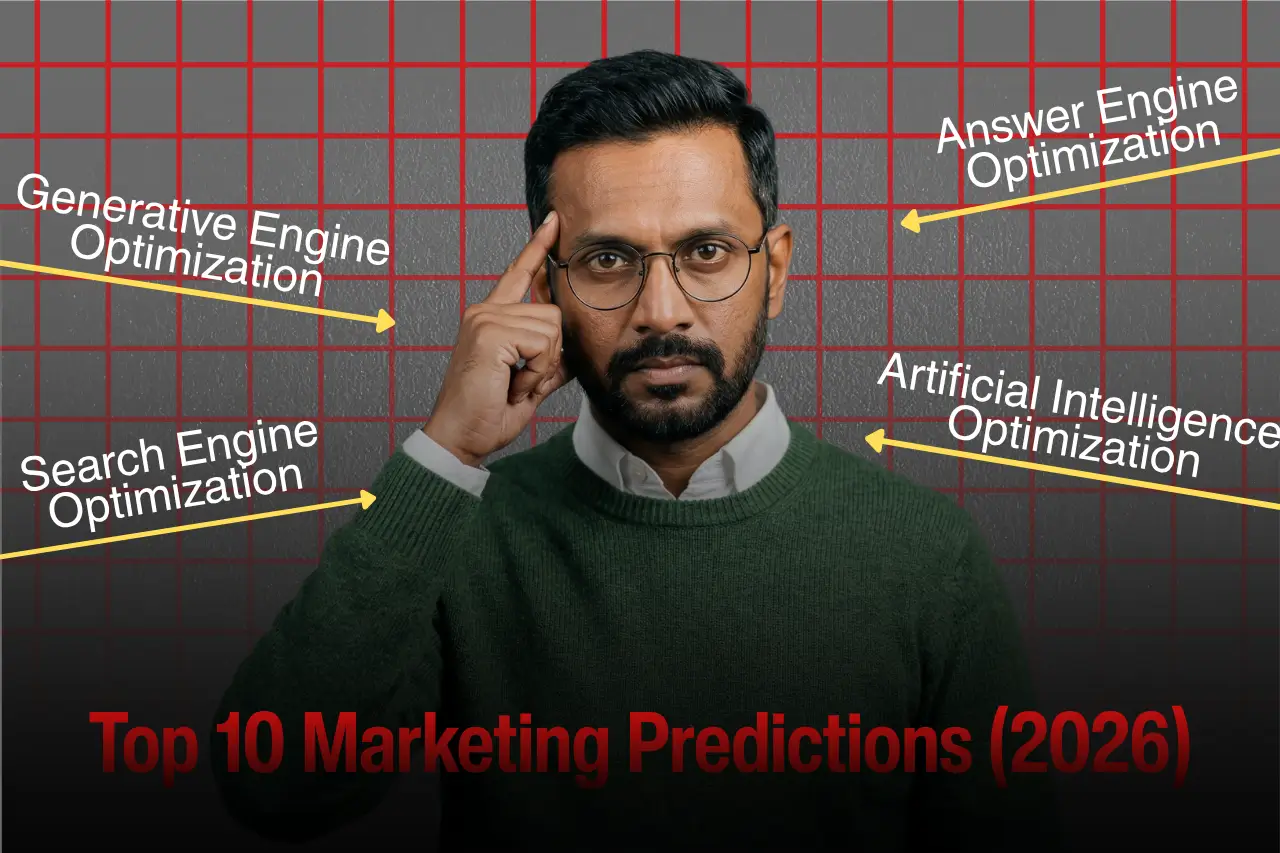
Generative Engine Optimization (GEO) is the discipline that has grown up in response to the practice of building content, entity signals, and citation authority so that AI engines reference your brand when generating answers. Choosing the right GEO agency to support that work is now a meaningful business decision, and most organizations have no framework for making it well.
This guide provides one.
What is the Difference Between SEO, GEO, and AEO?
Before evaluating any agency, it helps to understand the distinction between the three disciplines that converge in modern AI search optimization.
SEO (Search Engine Optimization) : The foundational practice of optimizing content and technical infrastructure (site speed, backlinks) so pages rank in traditional search engines.
Goal: Rank in the top ten blue links.
GEO (Generative Engine Optimization) : Extends SEO into AI-generated responses. It utilizes entity clarity, structured data, and demonstrable expertise so Large Language Models (LLMs) and RAG (Retrieval-Augmented Generation) systems use your brand as a source.
Goal: Be cited inside a synthesized AI answer.
AEO (Answer Engine Optimization) : Focuses specifically on content structure. It ensures the format, precision, and directness of your content are suitable for extraction by AI systems and voice search.
Goal: Provide the exact answer an AI needs to fulfill a user prompt.
In practice, the three reinforce each other. GEO without AEO produces authoritative content that AI engines trust but cannot easily extract. AEO without SEO produces well-structured content that nobody finds. A good GEO agency integrates all three.
Why AI Search Is Changing the Agency Selection Calculus
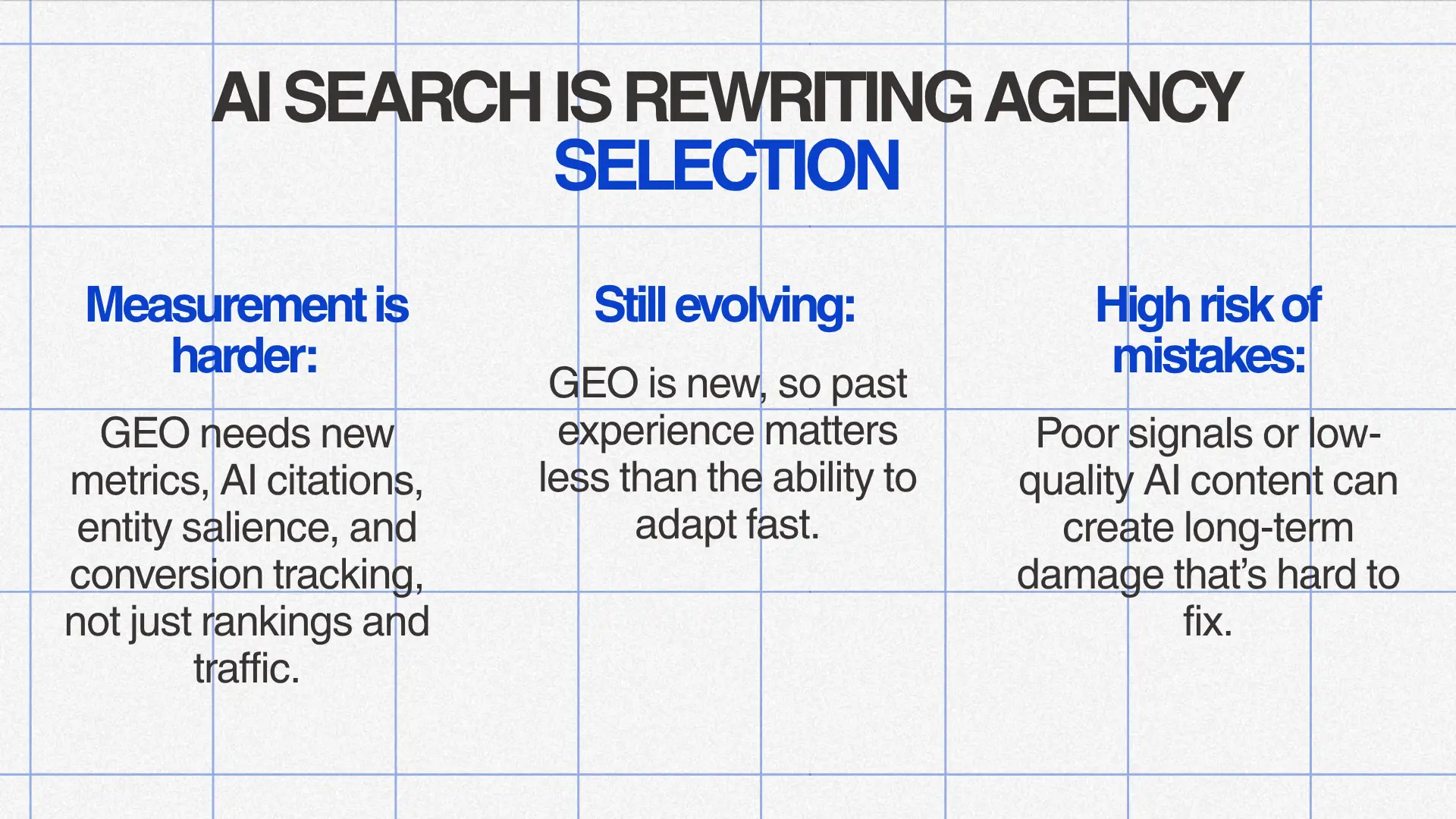
The question "which Digital Marketing Agency should we hire" has been answerable for years through a reasonably standard set of criteria: backlink track record, technical audit capabilities, content volume, and pricing. GEO changes the evaluation in three significant ways.
- Measurement is Harder: Traditional SEO progress is visible in ranking positions and organic traffic. AI citation growth requires different instrumentation tracking how often your brand appears in synthesized responses across multiple platforms, monitoring entity salience scores, and connecting AI referral traffic to downstream conversions. Many agencies are not yet equipped to do this well.
- The Discipline is New: GEO as a structured practice did not exist at a meaningful scale three years ago. That means agencies claiming deep expertise have limited track records to verify, and the skills that produced results twelve months ago are already being revised. The right agency is not necessarily the one that has been doing this longest; it is the one with the intellectual infrastructure to learn and adapt as the platforms evolve.
- High Stakes for Errors: Low-quality citation-building, entity signals that contradict each other across platforms, or AI-generated content published without adequate human review can produce outcomes that take considerably longer to reverse than they took to create. GEO errors compound in the same way that GEO wins do.
What Core Services Does a GEO Agency Provide?
Understanding what good GEO work looks like in practice is the prerequisite for evaluating any agency's proposal against it.
AI Visibility Strategy and Citation Research
Before any content is produced or schema is deployed, a capable agency maps the AI search landscape specific to your category. This means identifying the prompts and questions that AI engines are fielding in your space, analyzing which brands and publications are currently being cited in those responses, and establishing a baseline for where your brand stands or does not appear at all.
This research shapes everything downstream. Without it, GEO work is optimized for what the agency finds easiest to do rather than what will produce the most meaningful citation growth.
Technical Foundation: Schema, Entity Structuring, and Crawl Health
Schema markup, specifically JSON-LD for products, articles, FAQs, organizations, and events, translates content into structured data that AI parsers can consume efficiently and confidently. Entity structuring ensures your brand is described consistently across all digital touchpoints: your own site, third-party directories, Wikipedia-adjacent sources, and Wikidata. Crawl optimizationCrawl optimization ensures that AI bots can index your content without obstruction.
This technical layer is invisible to end users and frequently neglected by agencies that lead with content. It is also the layer that determines whether the content works.
AEO-Optimized Content Creation
Content designed for AI citation has a different profile than content designed for traditional SEO. It is fact-dense rather than volume-heavy. It answers specific questions directly before expanding into context. It uses the structural signals headers, defined terms, bulleted processes, and numbered steps that AI systems use to identify extractable answers.
FAQ sections, "how-to" frameworks, and definition-first writing are not stylistic choices in GEO content; they are functional requirements for AEO performance.
Digital PR and Authority Signal Building
AI engines do not treat all sources equally. Mentions in recognized trade publications, product listings on established review platforms, and citations in credible academic or research contexts, these carry weight that self-published content does not. A GEO agency that limits its work to on-site content is optimizing one signal while leaving the more powerful ones untouched.
Effective digital PR for GEO is not about volume of mentions. It is about the quality and domain authority of the sources that mention you, and the consistency of how your brand is described across them.
Integration With Traditional SEO
GEO does not function independently of technical SEO fundamentals. Page speed, mobile performance, crawl accessibility, and domain health all create the conditions in which AI citation becomes possible. An agency that cannot audit and address these foundations is building GEO authority on unstable ground.
10 Criteria for Evaluating and Hiring a GEO Agency
| Criterion | Key Focus / Question to Ask | The "Red Flag" (Watch Out) |
|---|---|---|
Operational Clarity | Ask: "How do entity signals connect to AI citations in real-time?" | Uses buzzwords like "AI-powered" without explaining technical mechanisms. |
Platform Tracking | Do they track ChatGPT, Perplexity, and Google AIO in separate views? | Showing one generic "Organic Traffic" dashboard for all AI platforms. |
Verifiable Metrics | Ask for baseline citation counts vs. growth over 6 months. | Vague claims like "Increased visibility" without raw data or screenshots. |
SEO/GEO Integration | Can they audit the technical schema and content structure simultaneously? | Treating GEO as a "separate product" from your foundational SEO. |
Sector Expertise | How do they handle your industry’s specific compliance or citation norms? | A "one-size-fits-all" approach is used across all verticals. |
Timeline Reality | What is the expected citation growth in the first 90 days? | Guarantees for specific placements in AI answers within weeks. |
Reporting Depth | Does reporting include "why" metrics moved and a forward action log? | Passive reporting that only shows "green" numbers without context. |
Defined Roles | Is there a clear split between brand strategy (you) and execution (them)? | Agencies want to "own" the strategy without your input. |
Contract Flexibility | Are there 30-day exit terms or milestone-based pilot periods? | 12-month lock-in contracts in a fast-moving AI landscape. |
Outcome Focus | Are they tracking AI-referred traffic all the way to conversion? | Optimizing for "citation count" alone rather than qualified leads/revenue. |
Pro-Tip for the Discovery Call
When you get to Criterion #1, use this Stress Test: > "Can you show me one specific entity gap on our current homepage right now, and tell me how that affects our citation probability in Perplexity?"
A legitimate GEO agency will immediately talk aboutSchema.org markup, entity salience, or knowledge graph consistency. A traditional SEO agency will likely revert to talking about "keywords" or "backlinks."
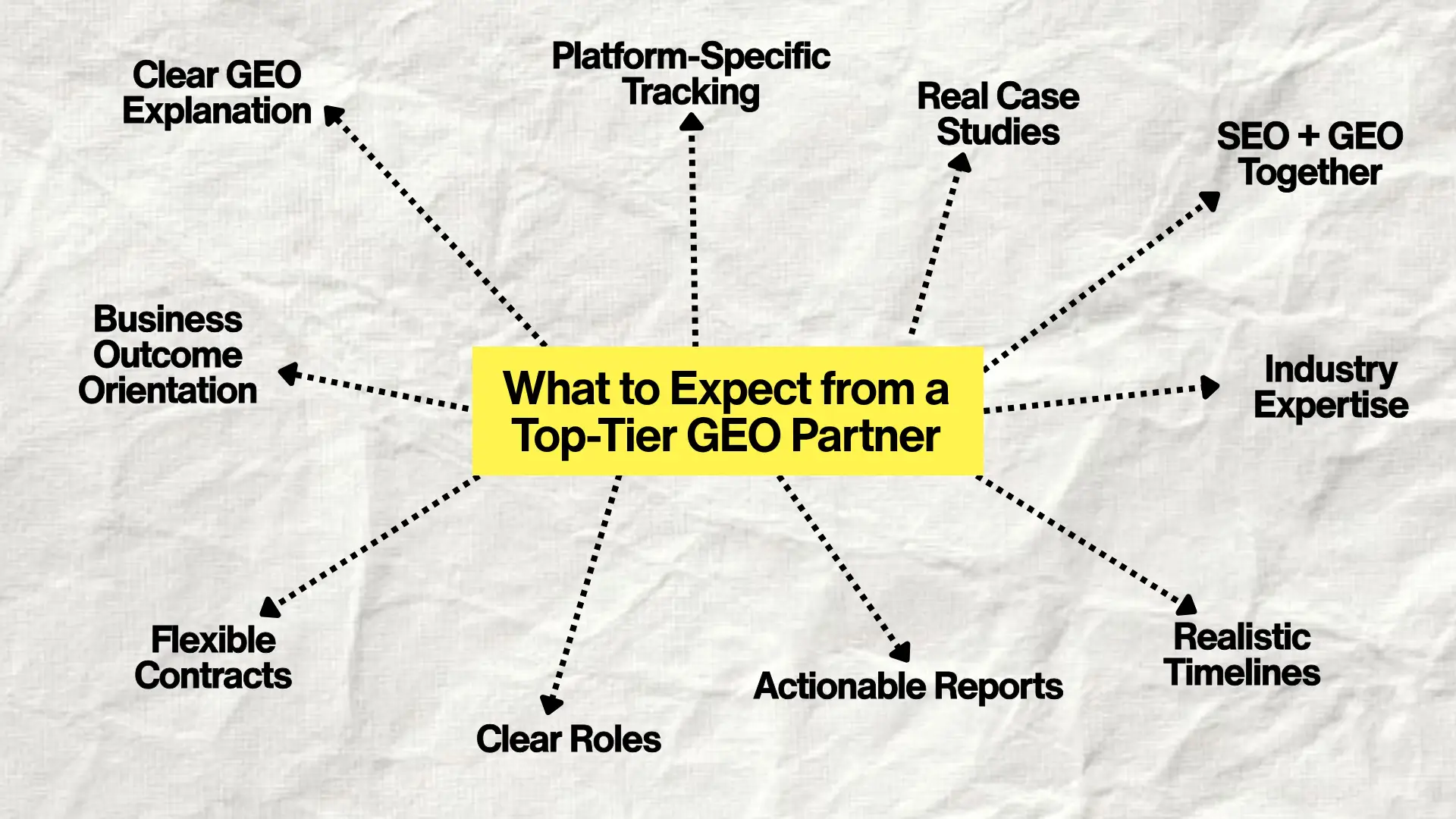
A Deep Dive: What to Expect from a Top-Tier GEO Partner
1. Clear, Operational Explanation of GEO
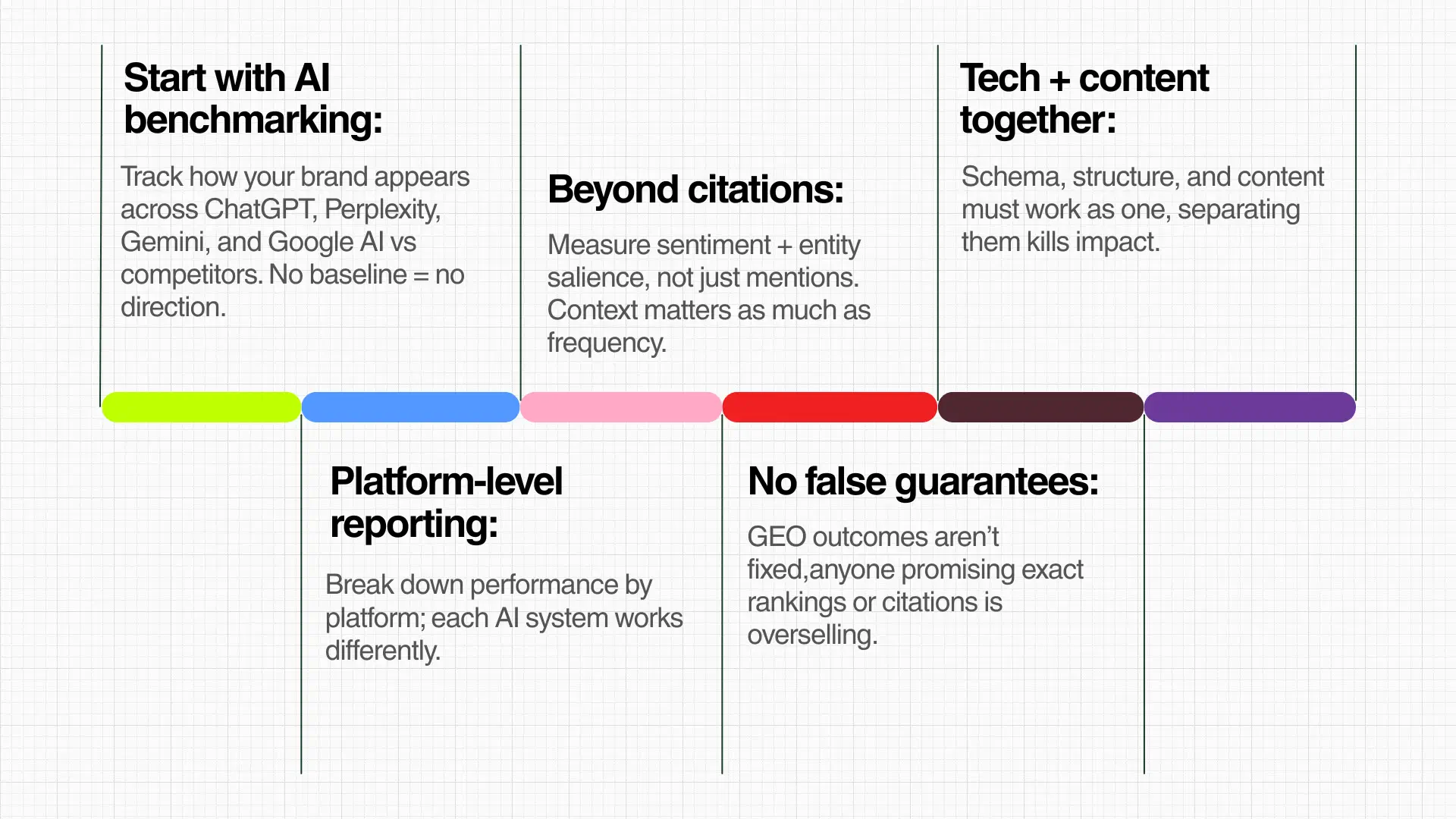
Ask any agency to explain, without slides, how entity signals build knowledge graph authority and how they connect to AI citations. The answer should be specific, grounded, and jargon-free. If it relies on vague phrases, the agency is describing outcomes they aspire to produce, not processes they know how to execute.
- The Test: Ask them to identify one specific entity gap on your homepage in real time.
2. Platform-Specific Citation Measurement
AI citation tracking requires different tools for different platforms. Perplexity surfaces links; ChatGPT draws from training data; Google AIO selects from indexed content.
- Expect to see: Citation frequency by platform, entity salience scoresentity salience scores, and share-of-voice across specific AI engines.
3. Verifiable Case Studies With Specific Metrics
"Improved AI visibility" is a claim, not a case study.
- The Proof: Look for baseline citation counts, methodology used, and measured outcomes with screenshots of reporting tools. Focus on citation growth percentage and AI-attributed referral traffic.
4. SEO and GEO Integration, Not Separation
GEO builds on SEO. An agency that positions GEO as an alternative to foundational search work oversimplifies the dependency.
- The Question: "Walk me through a technical audit that addresses both traditional SEO and GEO requirements simultaneously." It should cover crawl health, schema gaps, and entity consistency in one framework.
5. Sector-Specific Knowledge
Compliance and entity structures in healthcare differ wildly from e-commerce. An agency pitching a generic methodology is applying a template, not a strategy.
- The Question: Ask how they handle industry-specific regulatory or audience constraints.
6. Realistic Expectations About Timelines and Outcomes
GEO results accumulate through inputs, not shortcuts.
- Reasonable expectations: Measurable citation growth within 60 to 90 days; meaningful AI referral traffic at three to six months.
7. Transparent, Actionable Reporting
If a report doesn't tell you why a metric declined and what the response is, it’s useless.
- Minimum requirements: Citation velocity, entity coverage scores, and a forward-looking action log.
8. Defined Strategy and Execution Roles
The most functional engagements have a clear division: the client sets strategic goals/brand voice; the agency executes technical and content work.
- Best Practice: Require bi-weekly syncs and a shared document tracking deliverables and open questions.
9. Contract Terms That Reflect the Pace of Change
AI platforms update faster than annual contracts.
- The Structure: Pilot terms of one to three months with defined KPIs, followed by monthly rolling extensions and a 30-day exit notice.
10. Business Outcome Orientation
The ultimate test of GEO is not citation count it’s revenue. Agencies should prioritize whether AI-referred traffic converts and whether your brand recognition in the category is increasing.
How GetCito Approaches GEO: The Methodology Behind the Work
GetCito is a GEO and local search optimization agency that has built its practice around the measurement and growth of AI citation authority. What follows is a description of how their methodology works, not as a recommendation, but as a concrete illustration of what structured GEO work looks like in practice.
Competitive AI Benchmarking as the Starting Point
We begin every engagement by establishing where a brand stands in AI-generated responses relative to its direct competitors. This means querying AI platforms ChatGPT, Perplexity, Gemini, and Google AI Overviews with the specific prompts and questions that users in a given category are most likely to ask, and mapping which brands are cited, how frequently, and in what context.
This baseline is what makes everything measurable. Without it, GEO work is directionally sound but operationally blind.
Sentiment and Entity Analysis Alongside Citation Count
Citation frequency is the most visible GEO metric, but it is not the only one that matters. We track the sentiment and framing of citations, whether a brand is referenced positively, neutrally, or in a context that undermines credibility, and monitor entity salience scores that reflect how prominently a brand is represented in AI knowledge structures.
A brand that is cited frequently but consistently framed as a secondary option has a different problem than a brand that is absent from AI responses entirely. The measurement needs to distinguish between them.
Integrated Technical and Content Execution
Our work spans the technical layer (schema implementation, entity structuring, crawl optimization) and the content layer (AEO-formatted articles, FAQ architecture, structured guides) within the same engagement rather than as separate service tiers. The rationale is straightforward: technical infrastructure determines whether content work is recognized and indexed by AI systems. Separating them produces work that is complete in isolation but ineffective in combination.
Dashboard Reporting With Platform-Level Granularity
Rather than aggregating AI visibility into a single score, we report citation performance by platform, allowing clients to see where their brand is gaining ground, where gaps remain, and which platforms require different approaches. This granularity matters because the optimization levers for Perplexity are not identical to those for Google AI Overviews.
What GetCito Does Not Do
GetCito does not guarantee specific citation placements, ranking positions within AI responses, or knowledge panel acquisition on a defined timeline. These outcomes are probabilistic functions of the input authority signals, entity clarity, and content quality, not engineering deliverables. Agencies that guarantee them are selling certainty that does not exist in the underlying systems.
How Much Does a GEO Agency Cost? (2026 Pricing Tiers)
Pricing in GEO reflects the complexity of the work rather than a standard service package. Three general tiers describe the market:
Pilot engagements ($100–$5,00per month) cover the foundational layer: a baseline entity audit, initial schema implementation, a limited body of AEO-optimized content, and citation tracking across primary platforms. Appropriate for organizations validating GEO before committing to a full program.
Full retainers ($1000–$5,000 per month) support ongoing entity strategy, scaled content production, active digital PR for citation building, and integrated reporting. The appropriate tier for competitive categories where AI search is actively affecting qualified traffic.
Enterprise programs ($5,000–$50,000+ per month) address complex needs: programmatic schema across large content libraries, global PR infrastructure, multi-model influence strategy, and share-of-AI-voice analytics at category scale.
The more important question than tier is whether the pricing is tied to specific deliverables and measurable outcomes. A retainer with clear citation KPIs and conversion tracking creates accountability. A retainer framed as "ongoing GEO support" does not.
Contract Structure: Building in Accountability and Flexibility
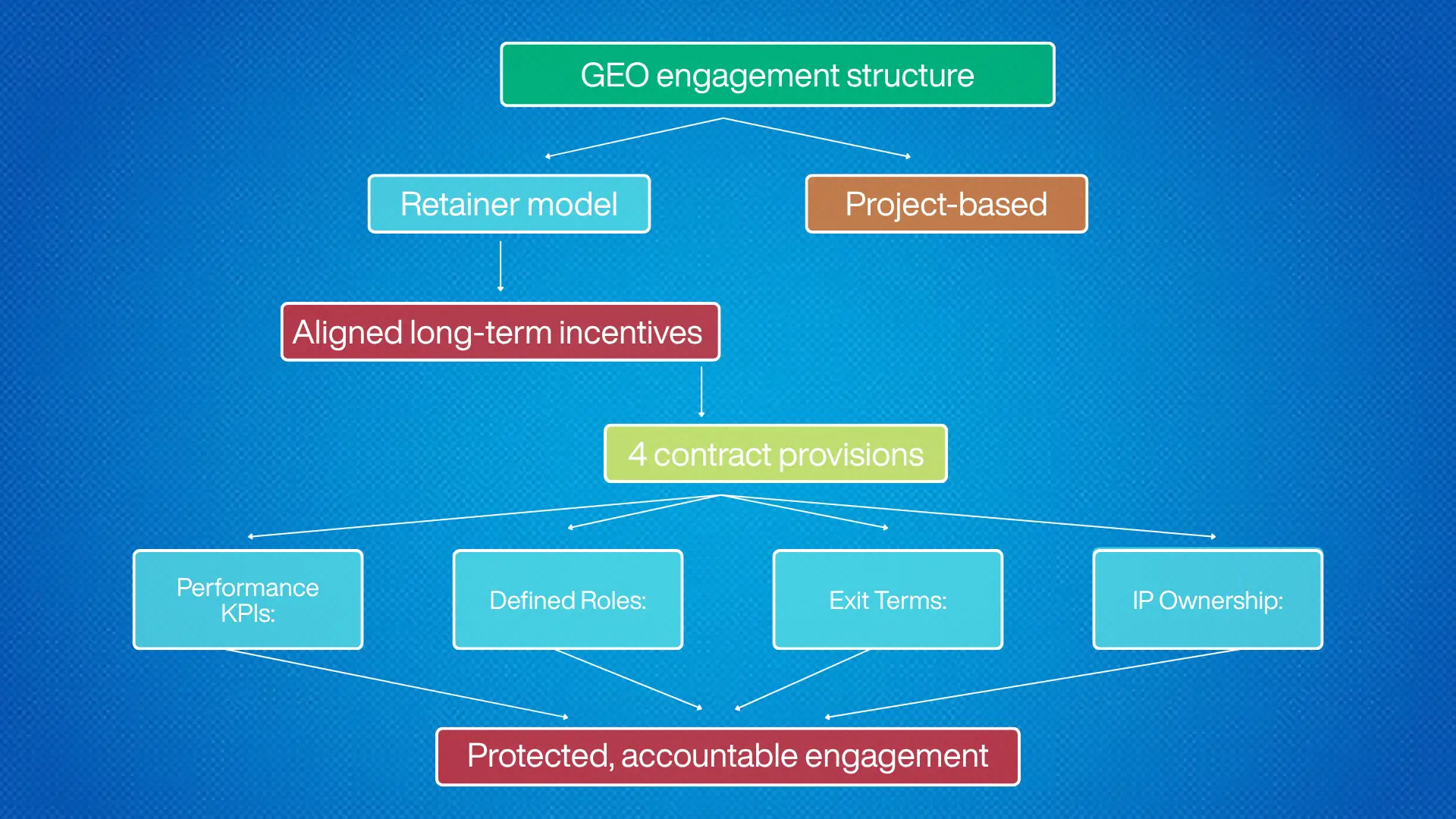
The right engagement structure acknowledges two realities: GEO is iterative and requires sustained effort to compound, and AI platforms change faster than any fixed-scope contract can anticipate.
Retainers outperform project-based engagements for ongoing GEO work because they create aligned long-term incentives. A project ends; a retainer agency stays invested as the landscape shifts and their work is tested continuously against performance. Project-based arrangements are appropriate for discrete diagnostics, an audit, a technical review, a content sprint, but not for the sustained entity and authority-building that drives meaningful AI citation growth.
Four contract provisions that protect the engagement on both sides:
Performance-linked KPIs tie at least a portion of the fee to measurable outcomes, citation growth percentages, AI referral traffic thresholds, conversion benchmarks, keeping accountability visible throughout the engagement.
Defined roles document which decisions belong to the client (strategic goals, brand positioning, approval authority) and which belong to the agency (content production, technical implementation, outreach execution). Undefined roles create scope disputes and diluted accountability.
Exit provisions, 30-day notice terms, milestone-based pilot exits, and no early-termination penalties after an initial pilot period are appropriate for a discipline where platforms update faster than annual contracts were designed to accommodate.
IP ownership clauses ensure that every content asset, strategic document, and tool configuration produced during the engagement reverts to the client upon exit. This is especially important for GEO work, where accumulated entity signals and content libraries represent ongoing value.
The Three-Phase Engagement Arc
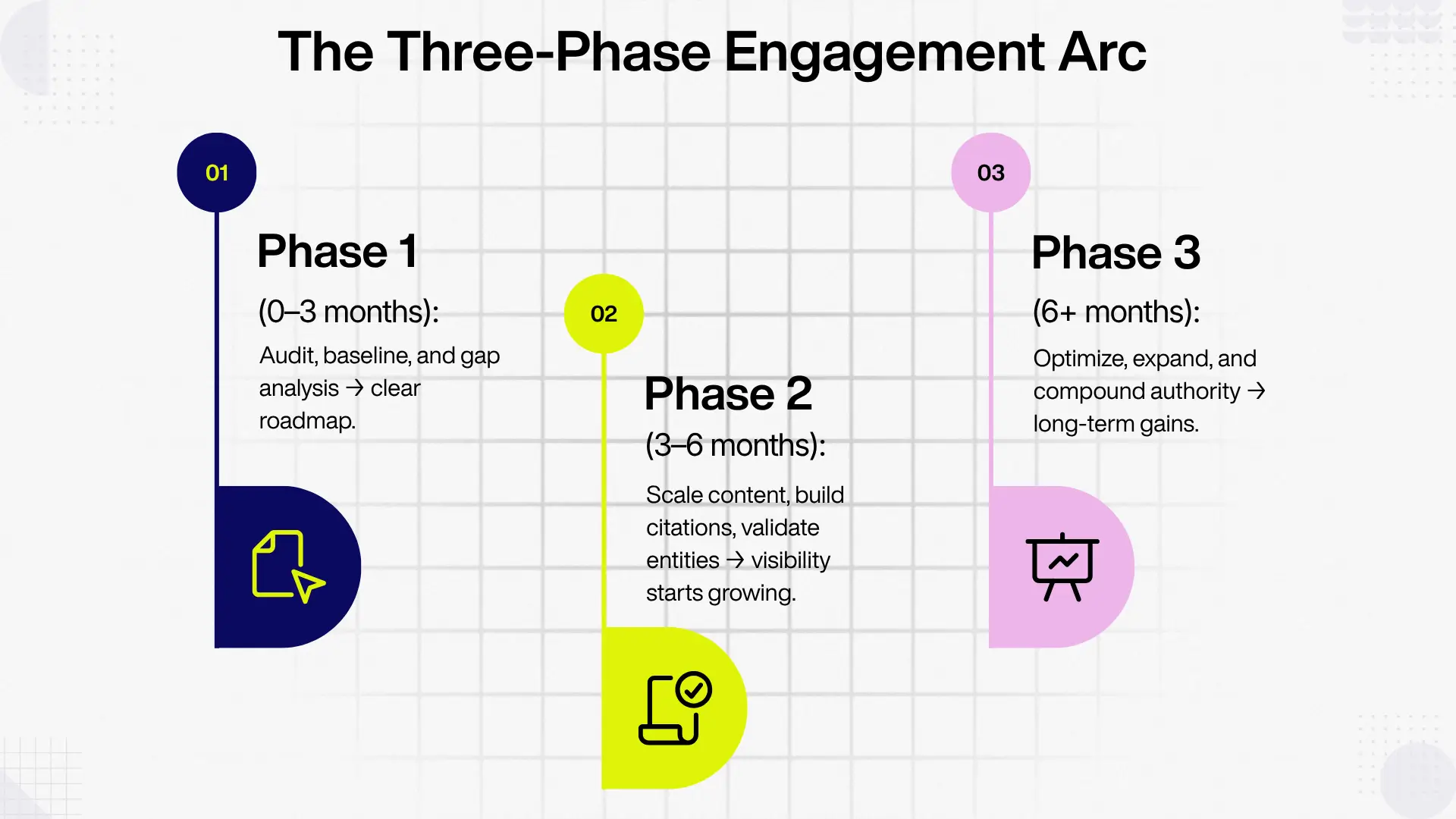
GEO authority does not accumulate linearly. Engagements that produce lasting results tend to move through three distinct phases.
Phase 1: Audit and Foundation (Months 1–3)
Technical schema review, competitive citation baseline, entity gap analysis, and identification of the highest-probability content opportunities. By the end of this phase, you should have a precise picture of where your brand stands in AI search and a prioritized roadmap for closing the most significant gaps.
Phase 2: Build and Scale (Months 3–6)
Scaled content production targeting specific AI prompts, active digital PR for citation acquisition, entity validation across platforms, and the first substantive shifts in citation share. This is where the quality of the agency's network becomes most visible. Citation authority depends on the caliber of sources that reference you.
Phase 3: Optimize and Expand (Month 6 Onward)
Monitoring share of model voice, refining content formats against observed AI response behavior, expanding into adjacent categories, and compounding the authority signals built in earlier phases. The work at this stage is more nuanced and more dependent on accumulated context, which is one reason the retainer structure that preserves that context consistently outperforms repeated project-based engagements.
How to Evaluate an Agency: A Practical Five-Step Process
Step 1: Define your goals in measurable terms before any agency conversation.
"Increase AI citation share in our primary category by 25% within 90 days" is a goal. "Improve our AI presence" is a direction. Agencies pitch to the specificity you bring; vague goals produce vague proposals.
Step 2: Shortlist three to five agencies from verifiable sources.
Clutch, G2, and direct referrals from operators who have run GEO programs are more reliable than agency aggregators that optimize for volume. Filter specifically for GEO track records, not general digital marketing credentials.
Step 3: Evaluate case studies as evidence, not testimony.
Require specific metrics, methodology, and measurement tools. Ask about one case study that did not go as planned and what the response was. How an agency discusses failure is more revealing than how they present success.
Step 4: Run a structured pilot before a full commitment.
Three months, defined KPIs, and clear exit terms. Discovery calls reveal positioning; pilots reveal capability.
Step 5: Review at 90 days against your original goals, not against adjusted benchmarks.
If an agency asks to revise the KPIs mid-pilot, understand precisely why before agreeing. Some revisions reflect genuine learning; others reflect an attempt to obscure underperformance.
A Final Note on What Makes This Work

GEO, done well, is not about gaming an algorithm. It is about building the kind of substantiated, clearly structured, independently verified expertise that AI systems and the humans who use them have good reasons to trust and reference.
The agencies that produce lasting results in this space are the ones that understand that distinction and build their work around it. They are not selling shortcuts. They are helping brands earn the kind of credibility that compounds in AI responses, in search results, and in the minds of the people who find them there.
Choosing the right partner to do that work is worth the time this guide requires. The alternative, moving quickly on a weak evaluation, produces results that are difficult to measure, harder to reverse, and expensive to fix.