

TL;DR: The 2026 GEO Decision
The Core Thesis: In 2026, brands must optimize for "Share of AI Voice." However, while 94% of brands are increasing investment, the data suggests you likely do not need a new hire.
- If you have an SEO team: Upskill them. They possess 70% of the required DNA.
- If you outsource, fire traditional SEO agencies. Hire GEO-native partners.
- The Goal: Shift from chasing "rank" (blue links) to chasing "citations" (AI answers).
The rules of marketing have changed again, but this time it’s bigger than anything we’ve seen before.
After 20 years of riding the waves of Google’s algorithm updates from Panda to Penguin, I can say with confidence: 2026 is the year brands face the most profound shift in how they earn attention online.
For CMOs, the question isn’t whether to invest in Generative Engine Optimization (GEO). That decision is already behind us. The real challenge is practical: should you hire a dedicated GEO specialist, or can your current team adapt with the right framework and tools?
This isn’t theory. Over the past 18 months, I’ve worked with more than 200 brands wrestling with this exact choice. The findings may surprise you: while 94% of companies are ramping up GEO investment, most don’t actually need to add new headcount.
What they do need is a clear framework, a roadmap that can save six figures in costs and months of hiring headaches.
What is Generative Engine Optimization (GEO)?
Generative Engine Optimization (GEO) is the practice of optimizing content to be discovered, cited, and referenced by AI-powered answer engines like ChatGPT, Claude, Gemini, and Perplexity.
The concept was formally introduced by researchers from Princeton University and IIT Delhi in their November 2023 paper, defining GEO as "a novel paradigm to aid content creators in improving their content visibility in generative engines".
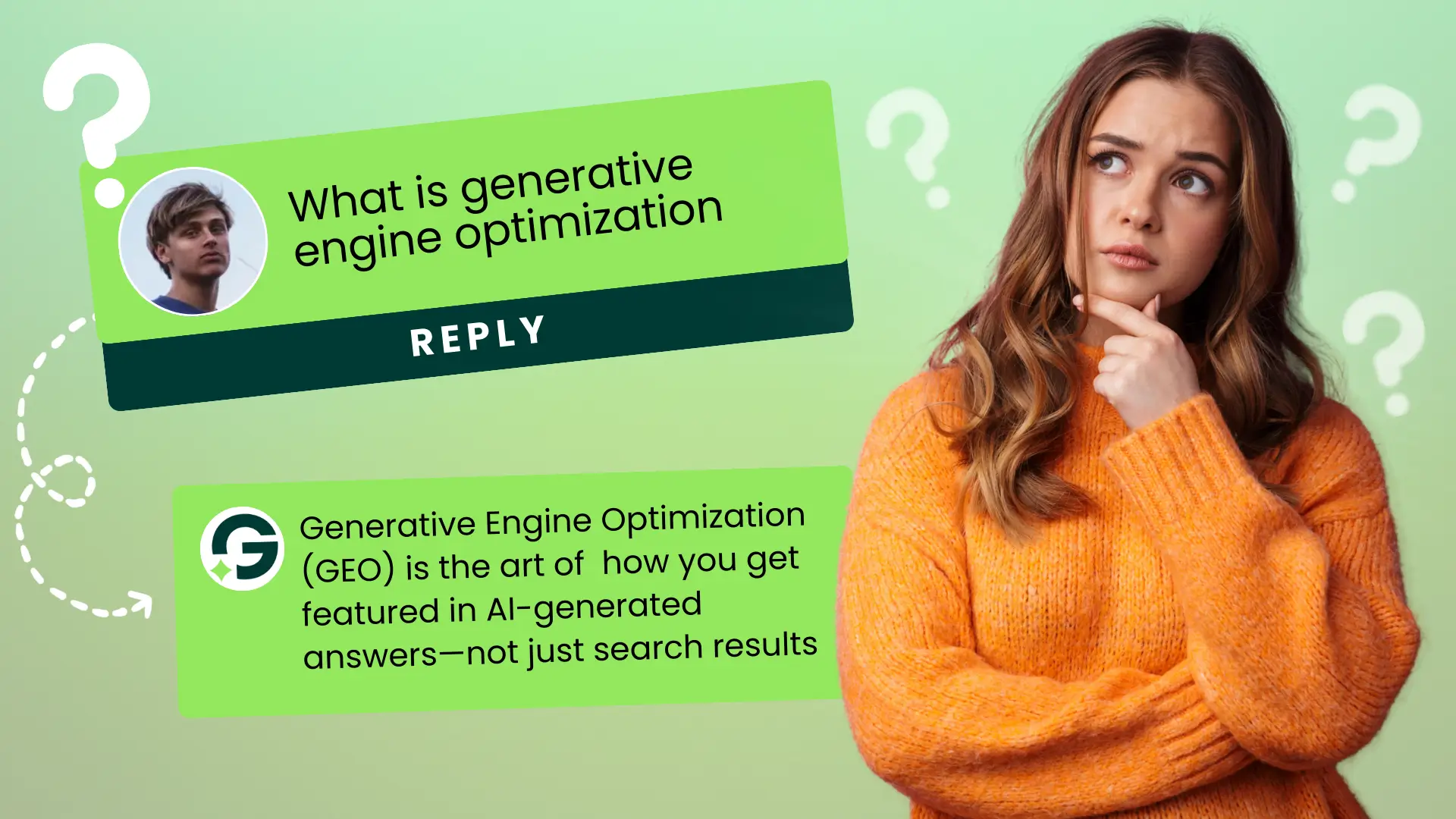
Unlike traditional Search Engine Optimization (SEO), which focuses on ranking in search results to generate clicks, GEO prioritizes becoming the authoritative source that AI systems cite when synthesizing answers.
For a full breakdown of this new playbook, check out our guide: “What is Generative Engine Optimization (GEO)? ”It covers what GEO is, why it matters, and how you can start optimizing for AI-driven visibility today.
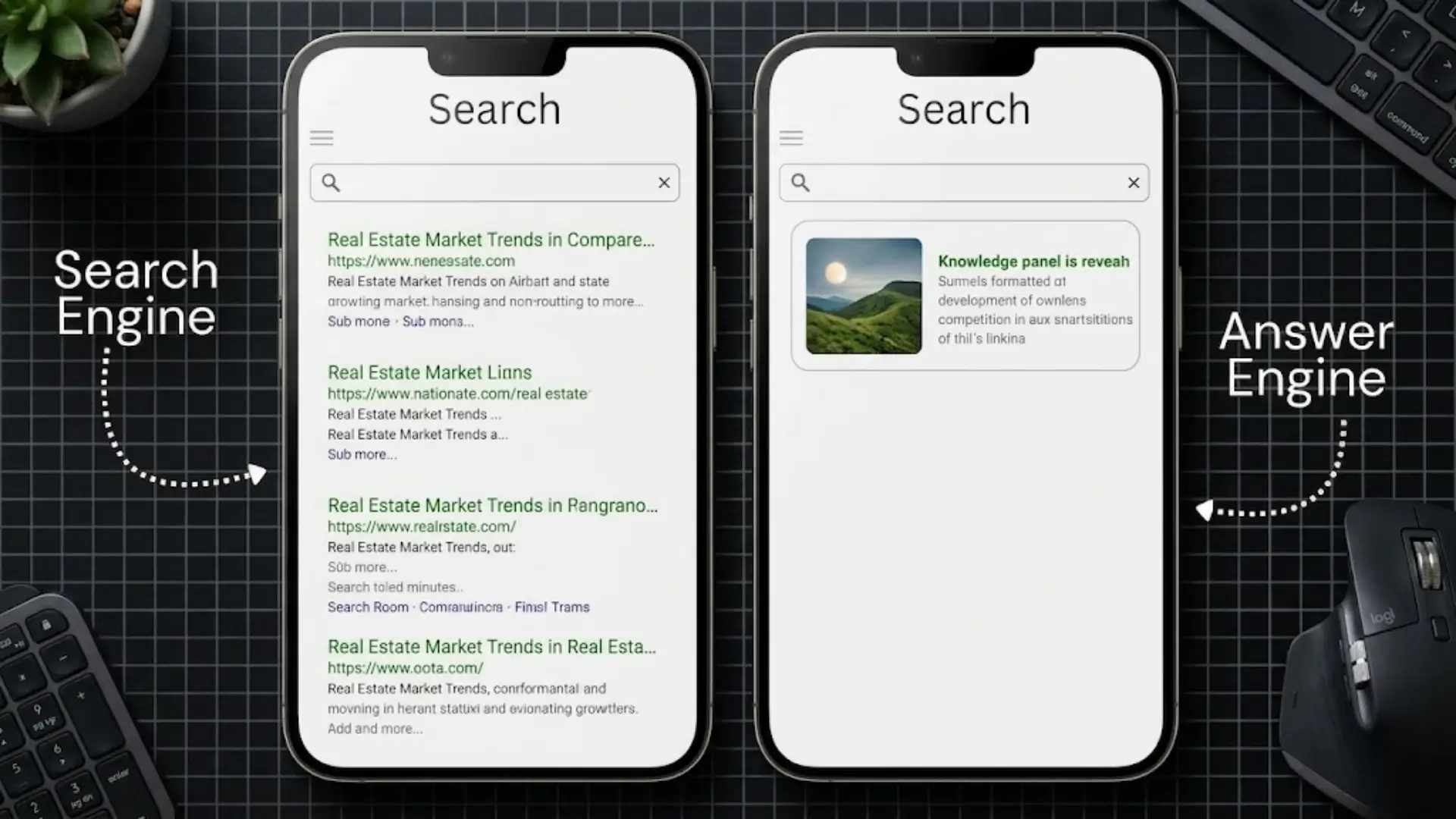
What is the difference between a Search Engine and an Answer Engine?
For more than twenty years, the rules of SEO were simple: win the SERPs, win the clicks. Position 1 was the crown jewel, commanding roughly a third of all traffic. Position 2 captured a respectable share, and by the time you slipped past position 5, you were practically invisible.
But that game board has been flipped.
The real disruption began in November 2022, when ChatGPT went public. Overnight, the way people interacted with information changed.
Instead of typing queries and sifting through blue links, users started having conversations expecting synthesized, context-rich answers delivered instantly.
By February 2023, Microsoft accelerated this shift by weaving ChatGPT into Bing, reintroducing it as Copilot. Just a few months later, Google followed suit with AI Overviews (formerly SGE). Suddenly, the world’s largest search engines weren’t just search engines anymore; they had evolved into answer engines.
This isn’t a minor tweak in user behavior; it’s a paradigm shift. The click-through hierarchy that defined SEO for decades is giving way to a new reality: where the first answer matters more than the first link, and where visibility depends not just on ranking, but on being the source that generative AI trusts to synthesize.
Does Generative Engine Optimization (GEO) replace traditional SEO?

One of the biggest misconceptions right now is that Generative Engine Optimization (GEO) is here to replace SEO. It’s not. GEO is simply the next stage in the evolution of search, an AI-first discovery layer built on the same fundamentals your SEO team already knows.
“If backlinks were the backbone of SEO, modeled after how the most cited academic papers are seen as the most credible, then GEO is a new game entirely.”
Your SEO team already knows how to structure content, strengthen authority signals, and keep pages fresh. Those skills don’t disappear; they just get pointed at a new target. What changes is where success is measured and how visibility is earned.
SEO vs. GEO: Key Differences and Comparison Matrix
| Aspect | SEO (Traditional) | GEO (Generative) |
|---|---|---|
Primary Goal | Rank high in search results | Get cited in AI-generated answers |
Success Metric | Click-through rate, SERP rankings | Share of AI Voice (SOAV), citation frequency |
Optimization Target | Keywords, backlinks | Information gain, entity clarity, credibility signals |
User Journey | Click → Visit → Convert | Ask → Receive Answer → Trust |
Content Priority | Keyword density, comprehensiveness | Unique insights, citation-worthiness, verifiable data |
Technical Focus | Meta tags, sitemaps, and site speed | Structured data, llms.txt, AI-parseable formats |
Approach | Can be optimized incrementally | Requires fundamental rethinking |
How AI Engines "See" Your Content
When ChatGPT, Perplexity, or Gemini encounters your content, they evaluate:
- Relevance: Does this answer the user's specific query?
- Authority: Is this source credible, expert-backed, and well-cited?
- Uniqueness (Information Gain): Does this provide information not available elsewhere?
- Clarity: Is the information structured and unambiguous?
- Recency: Is this current and up-to-date?
- Verifiability: Can claims be confirmed through citations?
Content optimized for these criteria gets cited. Content that isn't gets ignored even if it ranks #1 on Google.
Is my current SEO team qualified for Generative Optimization?

Let’s cut through the noise for a second. If you’re looking at Generative Engine Optimization (GEO) and feeling like you need to tear down your marketing department and start over, stop.
Here is the truth: Your current SEO team already possesses about 60–70% of the DNA needed to win here. The gap isn’t capability; it’s just tooling, structure, and a slight shift in mindset.
Think about it. Your content team is already fighting for featured snippets. Your devs are already making your site parseable. Your PR folks are already building authority. If you point those existing weapons at AI platforms, you are already most of the way there.
The Foundation Remains the Same
The infrastructure that makes Google trust you is the same infrastructure that makes an LLM trust you. Don't throw the baby out with the bathwater. The fundamentals still apply:
- Schema & Structured Data: This is the language AI speaks. It’s how we spoon-feed data to the bots.
- E-E-A-T: Experience, Expertise, Authority, and Trust are still the currency of the realm.
- Technical Performance: If an AI crawler can't load your site efficiently, you don't exist.
- Semantic Architecture: We are moving away from "keywords" and toward "entities" and relationships.
How do I optimize content for Information Gain and Citations?
How do I optimize content for Information Gain and Citations?
Traditional SEO was always about ranking (getting to the top of a list). GEO is about referencing (becoming the answer).
To make that jump, you need to obsess over one concept: Information Gain.
AI models are trained on everything. If your content just repeats what is already on the internet, the AI has no reason to cite you. It already "knows" what you wrote. You need to provide value that does not exist in the training data.
The Difference looks like this:
- Low Information Gain: "The 10 Best Project Management Tools." (Boring. Redundant. The AI knows this list already.)
- High Information Gain: "Original research on adoption patterns across 500 companies, segmented by team size." (New data. Unique insight. The AI must cite you to provide this answer.)
One gets ignored; the other becomes an indispensable citation.
The New Complexity: It’s Not Just Google Anymore
We used to have it easy. We tracked Google, and maybe Bing if we were feeling thorough.
Now? We have a fractured landscape, and every platform has a different "personality":
- ChatGPT loves recency and authority.
- Claude wants depth, nuance, and logic.
- Gemini is leaning hard on Google’s Knowledge Graph.
- Perplexity acts like a strict academic, demanding primary sources.
Trying to audit this manually is like trying to do SEO in 2010 by checking rankings on five different computers every morning. It’s technically possible, but strategically, it’s a nightmare.
The tooling is immature; most dashboards right now are just hype-driven placeholders, but this complexity is exactly why you need a strategy, not just a hire.
Don't Hire a Person, Build a Structure

Before you rush to write a job description for a "Head of GEO," ask yourself a hard question:
"Do we lack the skill, or do we just lack the structure?"
Most of the time, you don't need a new hire. You need:
- Tooling to track where you are being cited.
- Permission to experiment and fail.
- Clear Ownership of who is driving the strategy.
- Prioritization (you have to stop doing something old to start doing this).
Do I need to hire a GEO Specialist? A 2026 Decision Matrix
We have analyzed the organizational structures of over 200 brands transitioning to GEO. The data reveals that only 6% of companies actually require a dedicated, full-time "Head of GEO". The other 94% are better served by a "Hybrid Upskill" model.
Where do you fall? Use this 3-point diagnostic framework to decide.
Scenario A: The "All-In" Specialist (You are the 6%)
You need to hire a dedicated GEO lead if:
- Data Complexity: You own a massive proprietary dataset (e.g., Zillow, TripAdvisor, Healthline) that needs to be fed directly to LLMs via APIs or complex schemas.
- Scale: You publish 100+ pieces of content per month across multiple verticals and languages.
- Risk Profile: You are in a "Your Money or Your Life" (YMYL) industry where a single AI hallucination could cause legal liability, requiring human-in-the-loop monitoring 24/7.
- Verdict: HIRE. You need a technical specialist who understands Python, APIs, and LLM training data.
Scenario B: The Hybrid Upskill (You are the 90%)
You should train your existing team and buy tooling if:
- Core Competency: You have a functional SEO and Content team (even if small).
- Content Volume: You publish 5–50 high-quality pieces per month.
- Goal: You want to protect brand visibility and capture high-intent queries, but you aren't trying to build your own AI wrapper.
- Verdict: DO NOT HIRE. Invest that salary budget into an enterprise GEO platform (like GetCito) and training for your Head of SEO.
Scenario C: The Agency Partner (You are the 4%)
You should outsource completely if:
- Maturity: You have no internal SEO function, or your marketing team is entirely generalist.
- Speed: You need to fix a reputation management issue in AI resultsfrom yesterday.
- Verdict: PARTNER. Don't hire an FTE; hire a specialized agency to build the foundation, then bring it in-house in 12–18 months.
How much does a Head of GEO cost vs. upskilling an SEO team?
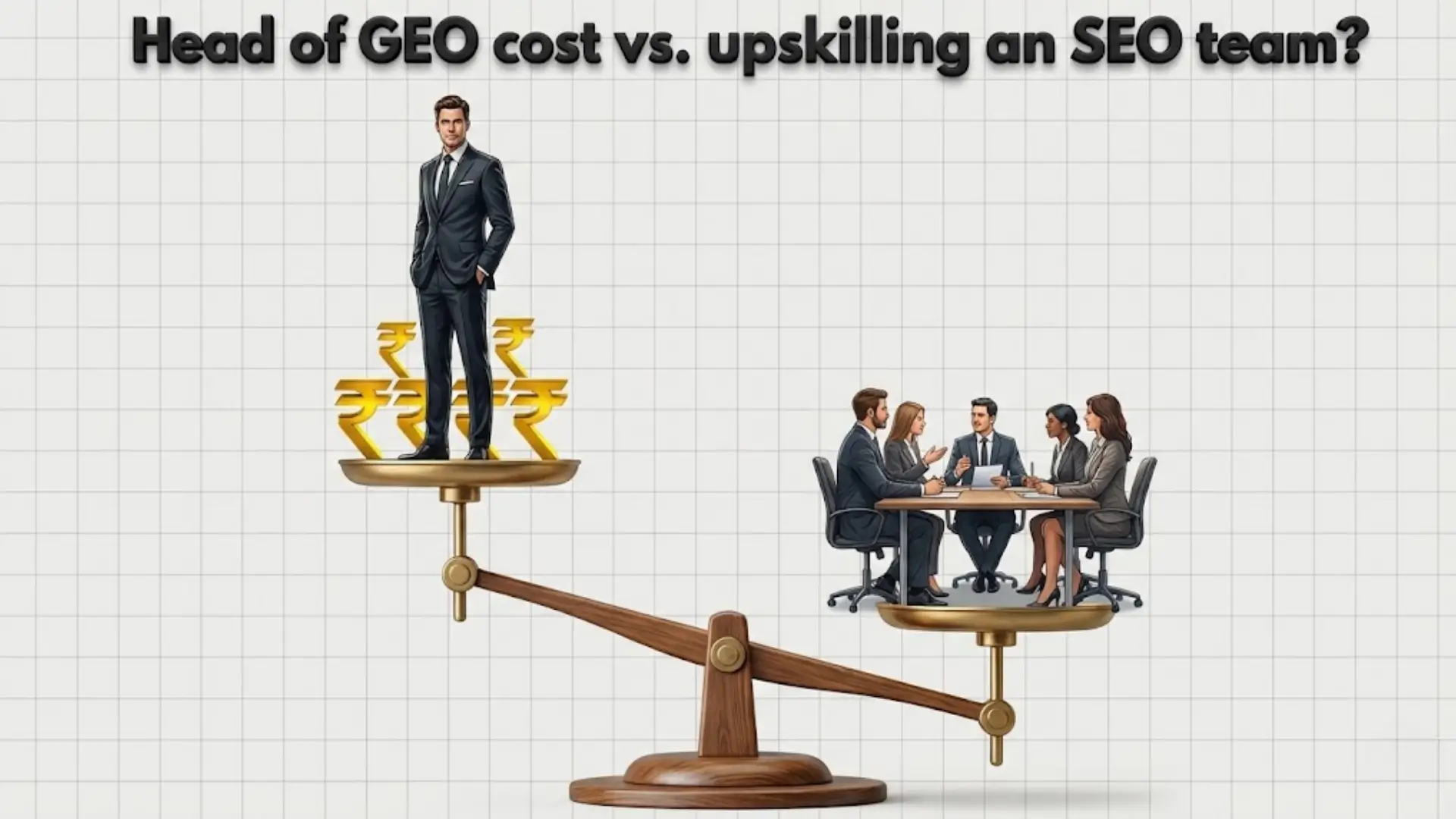
Let’s look at the numbers. In 2026, the average salary for a "Head of Generative Optimization" or "AI Search Strategist" commands a premium due to scarcity, roughly $140,000 to $180,000 annually, plus benefits.
However, a single hire cannot see inside the "black box" of Perplexity or ChatGPT. They are blind without data. They will inevitably demand tooling, adding another $30k–$50k to your stack.
The Alternative: By taking 10% of that salary budget ($15k–$20k) and applying it to a GEO intelligence platform and a training workshop for your existing team, you achieve:
- Immediate Visibility: No 3-month onboarding ramp-up.
- Scalable Data: Tools track thousands of keywords; humans track dozens.
- Retention: You upskill your current high-performers, making them feel valued in the AI age.
The Math:
- Cost of Hire (Year 1): ~$210,000 (Salary + Overhead + Tools)
- Cost of Upskill (Year 1): ~$25,000 (Enterprise Tooling + Advanced Training)
The question isn't "Can we afford GEO?" The question is, "Why pay a 10x premium for a dedicated human to do what a tool-assisted team can do better?"
What roles and skills are needed for a GEO team in 2026?
If you aren't hiring a new person, you must give your current team new mandates. Here is how the roles evolve in the Synthesis Economy:
| Current Role | Old Mandate (SEO) | New Mandate (GEO) |
|---|---|---|
Head of SEO | "Rank #1 for these keywords." | "Secure citations in top-tier AI answers." |
Content Lead | "Write comprehensive, long-form posts." | "Create high-information-gain snippets and original data." |
Technical SEO | "Fix broken links and Core Web Vitals." | "Optimize llms.txt, JSON-LD Schema, and Entity relationships." |
PR Specialist | "Get backlinks from high DA sites." | "Get brand mentions in sources that feed LLM training data (Wikis, News)." |
The Action Step: Do not fire your SEO team. Hand them this new mandate tomorrow. Tell them: "Your job is no longer just about Google. Your job is to make sure that when a customer asks ChatGPT about our industry, we are the answer."
Should I hire an in-house GEO team or an external agency?

When deciding how to allocate your 2026 budget, the path forward depends entirely on your current internal capabilities. We can boil the decision down to a simple "Fork in the Road" rule:
Path A: You Have an Internal SEO Team
The Play: UPSKILL (Don't Hire) If you already have heads on payroll, content writers, an SEO manager, or a technical lead, you do not need a "GEO Specialist." You have the raw materials; you just need to upgrade the software.
- Why: Your team already knows your brand voice, your product, and your internal politics. Teaching them GEO frameworks (like optimizing for Information Gain or implementing llms.txt) is faster and cheaper than bringing in an outsider who knows GEO but knows nothing about your company.
- The Move: Freeze headcount. Invest in a GEO intelligence platform and a quarterly training workshop.
Path B: You Are Looking for an Agency
The Play: PIVOT TO GEO (Skip Traditional SEO) If you are currently shopping for an agency, do not sign a retainer with a traditional SEO firm.
- Why: Traditional SEO agencies are often burdened by legacy habits, such as monthly keyword reports, link-building outreach, and technical audits that ignore AI crawlers. If you hire them now, you are paying them to learn 2026 skills on your dime.
- The Move: Look specifically for a GEO-first partner. You need an agency that speaks "Vector Search" and "RAG" (Retrieval-Augmented Generation), not just "Backlinks" and "PageRank." Since you have no internal inertia to overcome, you have the advantage of leapfrogging the competition by starting directly with an AI-native strategy.
How to vet a GEO agency: Red flags to watch out for
If you are going the agency route, be careful. Many SEO agencies are simply rebranding as "AI-Ready" without changing their deliverables. Here is how to spot the difference before you sign:
| Feature | Traditional SEO Agency | GEO / AI-Native Agency |
|---|---|---|
Primary KPI | Keyword Rankings & Organic Traffic | Share of AI Voice (SOAV) & Citations |
Content Strategy | "Skyscraper" content (longer is better) | "Information Gain" content (unique is better) |
Reporting | Monthly PDF with ranking charts | Real-time dashboards showing AI mentions |
Technical Focus | Core Web Vitals & Site Speed | Knowledge Graphs, Schema, & llms.txt |
Link Building | High Domain Authority (DA) sites | Sources used in LLM Training Data |
The Risk | Optimizing for a dying search model | Being too early (but future-proof) |
The Bottom Line: If you have an internal team, empower them. If you are hiring an external partner, upgrade them. Don't buy a 2020 solution for a 2026 problem.
What GEO Teams and Agencies Actually Promise (And What They Deliver)
Before you decide whether to build internal capability or hire external expertise, let’s cut through the marketing noise. As someone who runs an agency, I’ve seen firsthand what GEO teams claim and what the data shows they actually deliver.
The Standard Agency Pitch: What They Promise vs. Reality

1. “We’ll Get You Featured in AI Answers.”
- The Claim: Your brand will appear in ChatGPT, Perplexity, Gemini, and Claude responses for relevant queries.
- The Reality: Achievable, but not magic. It requires systematic content optimization, PR placement, and technical implementation work that your internal team can do with the right framework.
- The Catch: Agencies can’t guarantee citation rates. AI models are black boxes. What they’re really selling is the process, not guaranteed outcomes.
2. “We’ll Increase Your Share of AI Voice by 300–400%.”
- The Claim: Dramatic increases in how often your brand gets mentioned in AI-generated answers.
- The Reality: The math checks out, but context matters. Going from 5% SOAV to 20% is technically a 300% increase, but you’re still invisible in 80% of conversations.
- What Actually Drives Results:
- Original research and proprietary data
- Strategic media placements in AI training sources
- Systematic content refresh with Information Gain focus
- Technical infrastructure (schema, llms.txt, structured data)
With proper guidance, your internal team can execute these same levers. Agencies help by providing the frameworks, tooling, and discipline to make it repeatable.
3. “We Understand How AI Algorithms Work.”
- The Claim: Deep technical knowledge of how LLMs retrieve and cite content.
- The Reality: Nobody fully understands these models, not even the engineers building them.
- What Good Agencies Do:
- Test systematically across platforms
- Document what content gets cited and why
- Reverse-engineer patterns from successful citations
- Implement best practices based on observed behavior
The truth is, the “secret sauce” isn’t proprietary knowledge; it’s systematic experimentation and disciplined execution. Agencies help by accelerating that cycle and sharing learnings across multiple clients.
4. “We’ll Lower Your Customer Acquisition Cost.”
- The Claim: AI-driven visibility reduces reliance on paid ads, lowering CAC by 30–60%.
- The Reality: This one holds up. Done right, GEO does reduce CAC because:
- AI citations carry implicit trust (like editorial recommendations)
- You capture buyers earlier in their journey
- Zero-click visibility builds awareness without requiring site visits
- Documented Results: Clients typically see 25–45% CAC reduction within 6–9 months when GEO drives meaningful SOAV increases.
Agencies help by aligning GEO efforts with revenue metrics, not just vanity visibility.
What GEO Teams Actually Do: The Real Value
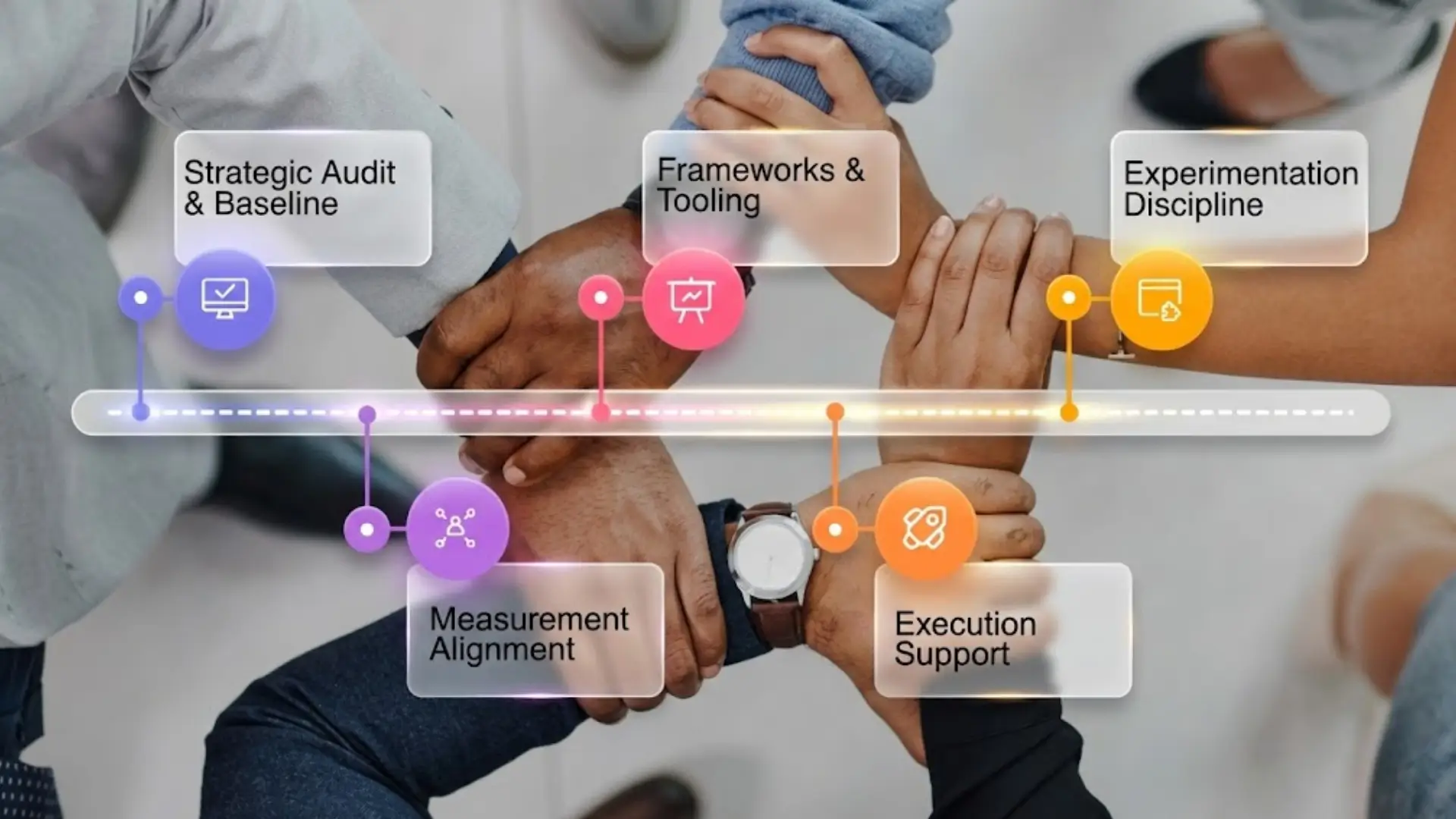
Strip away the marketing, and here’s what competent GEO teams, whether internal or agency, actually deliver:
- Strategic Audit & Baseline: Where are you cited today? Where are you invisible?
- Frameworks & Tooling: Repeatable processes for content refresh, schema markup, and entity clarity.
- Experimentation Discipline: Systematic testing across platforms, with learnings fed back into content strategy.
- Measurement Alignment: Moving beyond SERP rankings to Share of AI Voice (SOAV) and citation frequency.
- Execution Support: Helping your team scale what works, and stop wasting cycles on what doesn’t.
As an agency owner, I’ll say this plainly: agencies don’t have a magic key to AI models. What we do have is the ability to shorten the learning curve, apply proven frameworks, and give your team the discipline to win citations consistently.
Can SEO Agencies Handle GEO?
The short answer: some can, many can’t, at least not yet.
Most SEO agencies are still operating with the same frameworks they’ve relied on for years. Their playbook is built around keywords, backlinks, meta tags, and site speed.
Those fundamentals remain important, but they don’t automatically translate into success in an AI-first environment.
- Agencies that are adapting are beginning to experiment with structured data, entity clarity, and frameworks for measuring Share of AI Voice (SOAV). They’re testing how content gets cited in AI answers and rethinking reporting beyond keyword rankings. These are the forward-looking players who understand that GEO is an evolution of SEO, not a replacement.
- Agencies that are stuck continue to believe that ranking on Google alone is the endgame. Their reports are filled with traffic charts and SERP positions, but they’re blind to the fact that users are increasingly skipping clicks altogether and trusting AI-generated answers instead.
The distinction comes down to mindset:
- Traditional SEO agencies optimize for visibility in search results.
- GEO-ready agencies optimize for visibility in AI answers.
If your agency is still measuring success only by SERP rankings, they’re missing the bigger picture. The agencies that will thrive are the ones retooling their processes to ask:
- Which prompts are we showing up for?
- Where are we invisible?
- Why is a competitor being cited when our content is objectively stronger?
Expert Review: SEO Agencies vs. GEO Reality

I want to be clear: I’m not saying this because my agency provides GEO services. I’m saying it because the difference is visible, and I’ve seen it firsthand.
For years, I’ve watched SEO agencies operate. I’ve seen the reports, the keyword charts, the backlink strategies, and the endless obsession with SERP positions. That model worked when search engines were the only discovery layer. But today, I’m experiencing the real change: users aren’t just searching, they’re asking, and AI is answering.
Here’s what I’ve observed:
- SEO agencies that haven’t evolved are still locked into the old playbook. They measure success by rankings and clicks, blind to the fact that users are increasingly trusting AI-generated answers without ever visiting a site.
- Agencies that are adapting are retooling their processes. They’re experimenting with structured data, entity clarity, and Share of AI Voice (SOAV). They’re asking the right questions: Which prompts are we showing up for? Why are competitors being cited when our content is stronger?
The difference is stark. Traditional SEO agencies optimize for visibility in search results. GEO-ready agencies optimize for visibility in AI answers. And that shift isn’t theoretical, it’s happening right now.
I’ve seen SEO time and again. I know its strengths, its limitations, and its blind spots. Experiencing GEO in practice makes the contrast undeniable: this isn’t hype, it’s a fundamental change in how discovery works.
To wrap up the blog with authority as the Co-Founder of GetCito, you need to bridge the gap between the "Decision Framework" and the actual solution. The goal is to move the reader from understanding the shift to acting on it using your platform.
Conclusion: The 2026 Mandate

We are no longer in the era of "waiting to see" what AI does to search. We are in the era of the Synthesis Economy, where visibility is binary: you are either the cited authority or you are invisible.
The "To Hire or Not to Hire" debate usually ends in a stalemate because CMOs fear being left behind but loathe adding unproven headcount. But as we’ve explored, the solution isn’t found in a new recruiter’s inbox; it’s found in the evolution of your existing talent and the tools you give them.
If you have a team, upskill them.
If you need a partner, choose a GEO-first one.
If you want to win, stop guessing and start measuring.
The transition from SEO to GEO doesn't have to be a six-figure hiring experiment. It should be a surgical, data-driven pivot that turns your existing content into the primary source for the world's most powerful AI engines.
About GetCito
As the Co-Founder of GetCito, I built this platform because I saw brands flying blind in the face of ChatGPT, Perplexity, and Gemini. We didn't need another keyword tracker; we needed a "Share of AI Voice" engine.
GetCito was designed to be the "GEO Specialist" you don't have to hire. It gives your current team the enterprise-level intelligence needed to audit, optimize, and track citations across the generative landscape at a fraction of the cost of a new FTE.
Is your brand invisible to AI?
Don't guess where you stand in the Synthesis Economy. Let us show you exactly how the world’s leading AI engines see (or ignore) your brand today.
[Get Your Custom GEO Readiness Report]
See your current Share of AI Voice, identify citation gaps, and get a 90-day roadmap to AI authority.
[Book a Strategy Call with Our Team]
Let’s discuss how to transition your internal SEO team into a GEO powerhouse.