

Introduction: Why Prompt Volume Is the New Keyword Volume
For two decades, keyword search volume was the heartbeat of SEO. You picked a keyword, looked up its monthly volume in a tool like Ahrefs or Semrush, and made content decisions based on what you saw. The number wasn't perfect, but it was a workable proxy for demand.
That model is quietly breaking. today.
When someone asks ChatGPT, "What's the best CRM for a 12-person agency that mostly works with e-commerce clients?" they aren't typing a keyword. They're having a conversation. There's no single keyword to look up, no neat little volume number to optimize against. Multiply that one question by the billions of prompts now flowing through ChatGPT, Gemini, Claude, Perplexity, and Google's AI Mode every month, and you have an entirely new measurement problem.
This is the problem the Prompt Volume Checker tries to solve.
But here's where most articles on this topic go wrong. They either:
- Oversell prompt volume as a precise metric that will replace keyword research, or
- Dismiss it entirely as guesswork that marketers should ignore.
Both miss the truth. Prompt volume is not a perfect metric. It cannot be, given the current state of AI search. But when you understand how it's estimated and what its real strengths are, it becomes one of the most valuable directional signals available for understanding demand in generative search.
This guide explains how prompt volume actually works, where the estimates come from, how to validate them, how to use them well, and just as importantly, where they break down. By the end, you'll know enough to use prompt volume confidently without being misled by it.
What Is Prompt Volume?
Prompt volume is the estimated number of times users submit a particular question, topic, or query to an AI tool over a given period, typically a month.
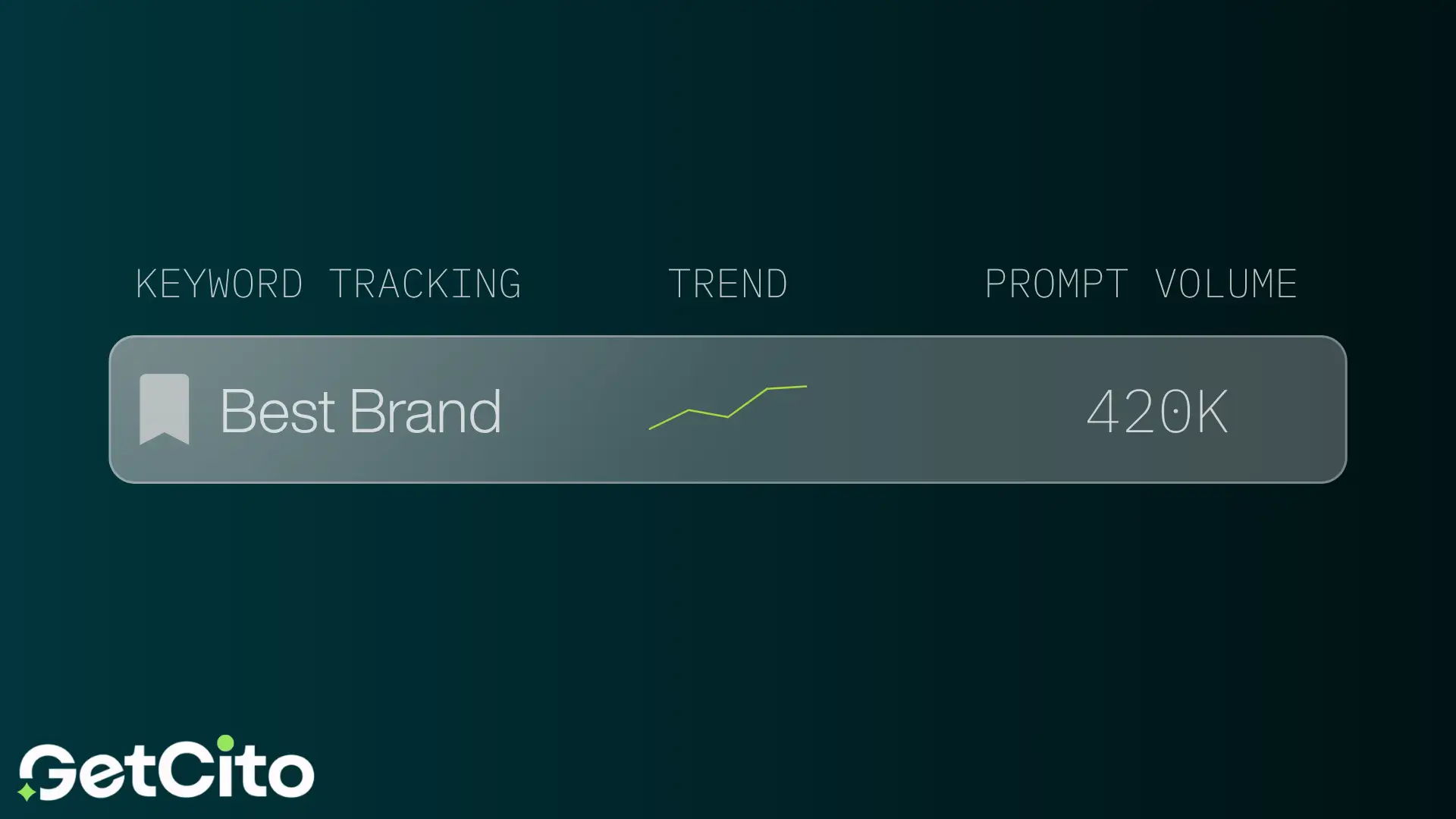
It's the conceptual successor to keyword search volume. Where Google Keyword Planner tells you that roughly 12,100 people search "best running shoes" each month, a prompt volume tool tries to tell you roughly how many people ask ChatGPT, Gemini, or Perplexity something equivalent.
Some tools call it Prompt Query Volume (PQV). Others use AI Search Volume or Conversational Search Volume. The terminology varies, but the underlying idea is the same: a measure of demand inside AI-powered answer engines.
A few things distinguish it from keyword volume:
- It covers AI platforms, not search engines. Prompt volume specifically measures activity inside tools like ChatGPT, Gemini, Claude, Perplexity, and AI Overviews not Google's traditional blue-link results.
- It works at the topic or intent level, not the literal phrase level. Because prompts vary enormously, most tools cluster similar prompts into topics rather than counting exact strings.
- It is always an estimate. No tool has direct access to AI platforms' query logs, so every number you see is modeled.
That last point is the most important, and it's the one we'll return to several times in this article.
Prompt Volume vs Traditional Search Volume
The two metrics try to measure similar things, demand for a topic, but they behave very differently. Understanding the distinction matters because applying SEO mental models to prompt volume is one of the fastest ways to make poor strategic decisions.
| Dimension | Keyword Search Volume | Prompt Volume |
|---|---|---|
Source platform | Search engines (Google, Bing) | AI engines (ChatGPT, Gemini, Claude, Perplexity, AI Overviews) |
Input format | Short, keyword-driven queries | Long, conversational, often multi-sentence |
Data origin | Search engine logs (partially shared via Keyword Planner, GSC) | Modeled from panels, clickstream, and search extrapolation |
Granularity | Exact keywords | Topics, intents, prompt clusters |
Specificity of intent | Often ambiguous | Usually explicit |
Stability over time | Relatively stable monthly patterns | Highly volatile; shaped by AI product changes |
Accuracy | Reasonably reliable for relative comparisons | Directional only |
Click outcomes | Drives traffic to ranked pages | May not produce any click; AI answers in place |
Notice the contrast in input. A keyword like "running shoes flat feet" might break out into hundreds of distinct prompts in AI: "I have flat feet and shin splints, what shoe should I get for marathon training?" or "Best stability running shoes under $150 for overpronators." Each of those is a real query, a real human typed. None of them is a "keyword" in the SEO sense. This is why SISTRIX, in its Prompt Research methodology, clusters over 62 million observed user queries into roughly 1.4 million topic groups, rather than trying to count individual prompts.
The shift from keyword to prompt is not cosmetic. It changes how you think about demand entirely.
Why Prompt Volume Matters for GEO and AI Search
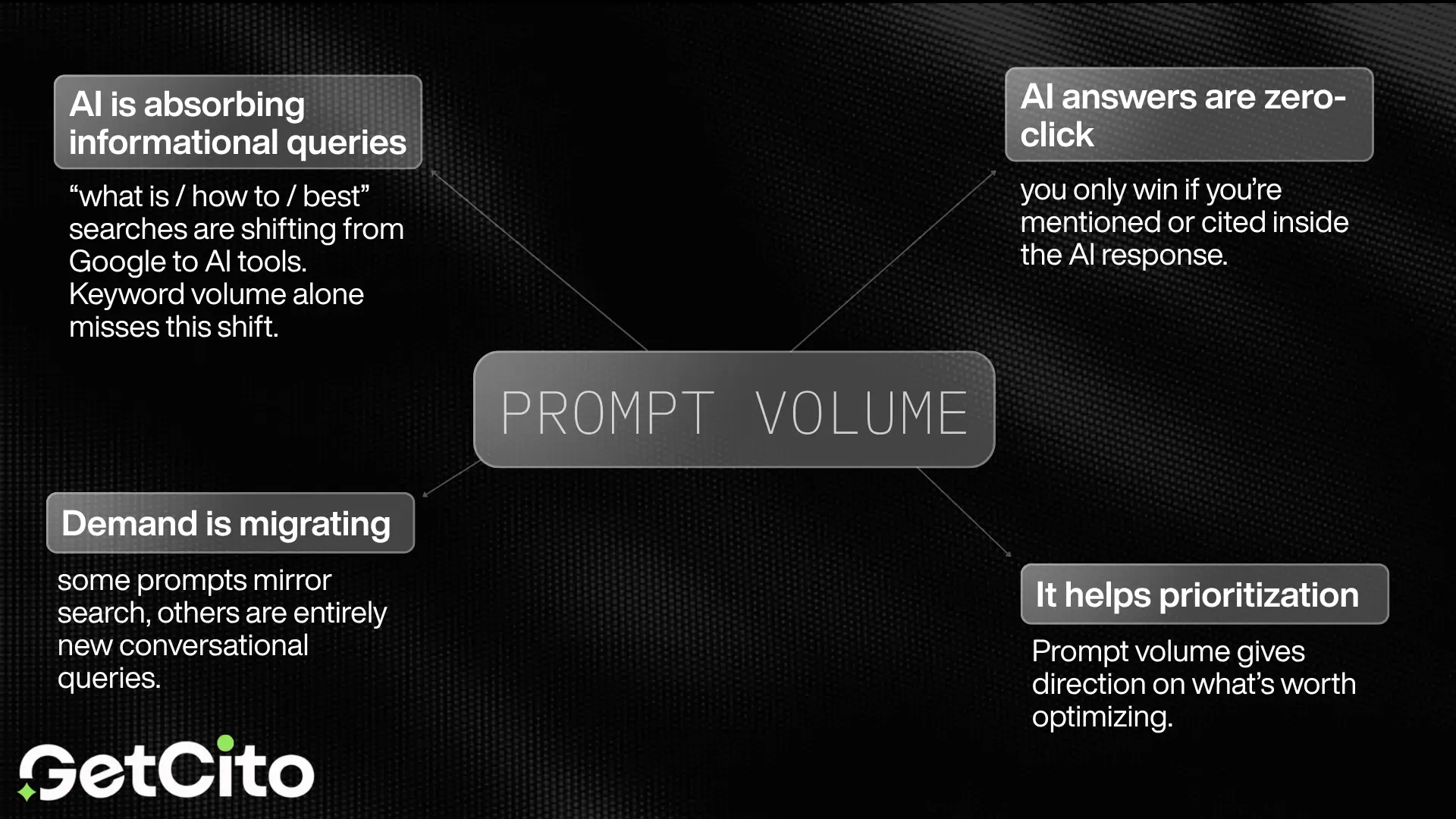
If you're invested in Generative Engine Optimization (GEO) or Answer Engine Optimization (AEO), prompt volume is the closest thing you have to a TAM signal for AI search. It tells you, roughly, where attention is moving.
There are four specific reasons it matters:
- AI is absorbing informational queries.
A growing share of "what is," "how do I," and "which is best" questions never reach Google’s SERP anymore. They’re asked directly to ChatGPT or Perplexity. And even when typed into Google, AI Overview often delivers the answer before a click happens. If your content strategy is still anchored to keyword search volume alone, you're optimizing against a shrinking surface area. - AI answers are zero-click by default.
AI answers a question without sending the user to your site; the only way you "win" is by being mentioned, cited, or recommended inside the answer itself. Knowing which topics are being asked at scale tells you where it's worth fighting to be cited. - Demand is migrating, not just appearing.
Many AI prompts have direct analogs in Google search. Others are entirely new conversational, multi-step, comparative. Prompt volume lets you see which topics now have meaningful AI activity versus which are still primarily search-engine driven. - It powers prioritization, not just measurement.
A list of 800 possible prompts your brand could optimize for is useless without some way to rank them. Prompt volume, even directionally, makes that list workable.
The keyword here is directionally. Treat prompt volume as a compass, not a GPS.
Why Prompt Volume Is So Difficult to Measure
Here's the unglamorous truth: nobody outside of OpenAI, Google, Anthropic, and a handful of other AI companies has direct access to AI prompt logs. And those companies don't publish their data.
That single fact creates almost every measurement challenge in the field.
The honest summary, well captured in Search Engine Land's analysis of AI visibility, is that no provider can know the true frequency of prompts unless they hold a private user sample, and even that wouldn't be representative. Everything else is reconstruction.
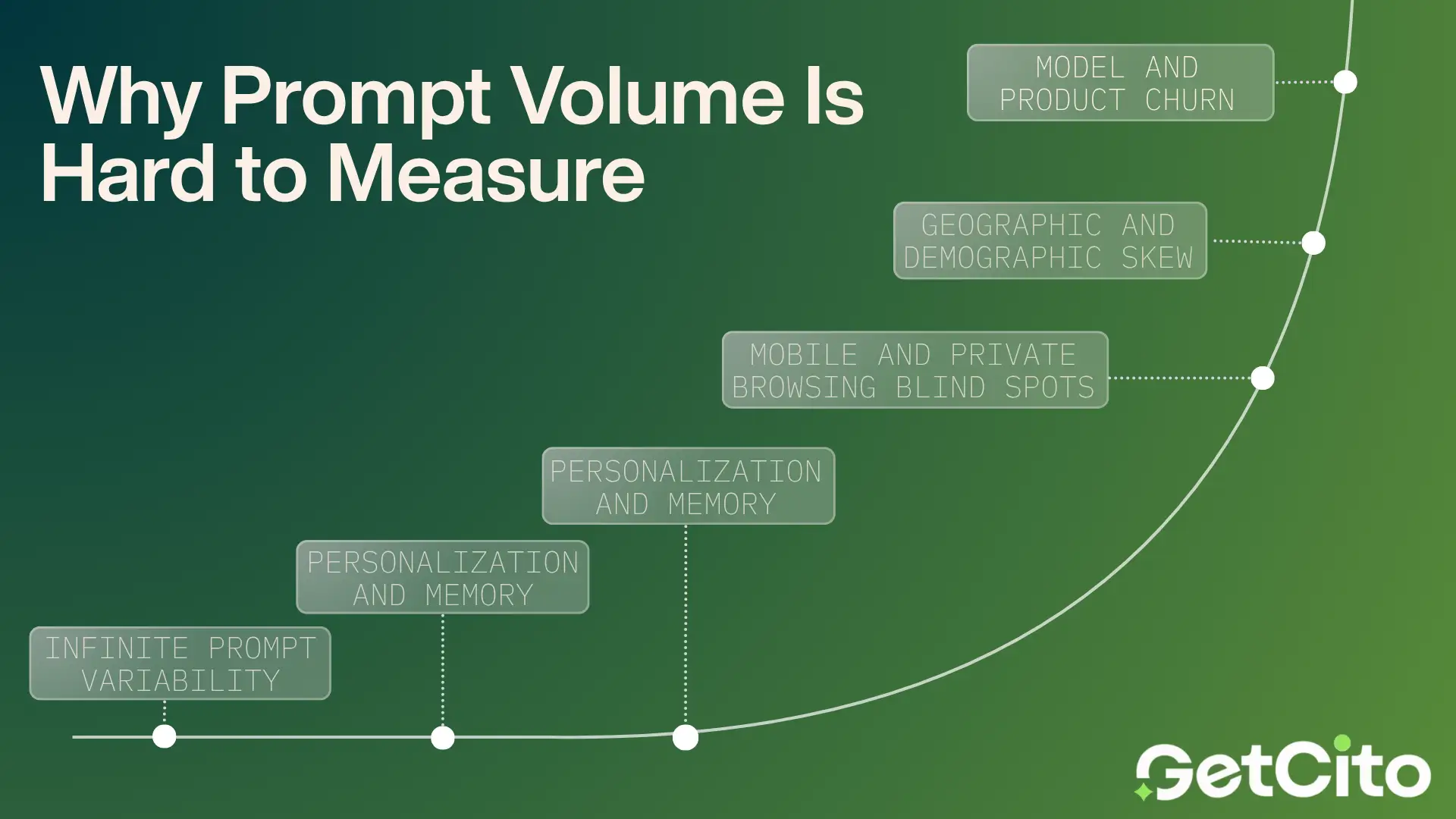
Beyond the data access problem, several structural challenges make prompt volume hard to pin down:
- Infinite prompt variability.
A single underlying intent ("I want a good CRM for my agency") can be expressed in thousands of valid prompt formulations. Counting them individually is impossible; clustering them into topics is the only practical approach, but clustering introduces interpretation. - Multi-turn conversations.
Many prompts are follow-ups inside ongoing chats. A user might first ask about "CRM options," then drill into pricing, then ask about a specific brand. Should each follow-up count as a separate prompt? Tools handle this differently. - Personalization and memory.
Increasingly, ChatGPT and Gemini personalize answers based on past context. The same prompt yields different responses for different users, which complicates any attempt to measure citation rate or brand visibility at scale. - Mobile and private browsing blind spots.
Panel-based measurement is heavily biased toward desktop users with browser extensions installed. Mobile, app-based AI usage, and incognito sessions are largely invisible. - Geographic and demographic skew.
Most panels overrepresent tech-savvy, English-speaking users. As Conductor and others have pointed out, panel participants are typically more technical and more incentivized than the general population, which skews the topics that look "popular." - Model and product churn.
AI tools change behavior week by week. SISTRIX's April 2026 citation drift study found that across six countries, 54–59% of cited domains shift week over week, and ChatGPT in particular replaces about 74% of cited domains each week. That kind of instability bleeds into any measurement system built on top.
None of this means prompt volume is useless. It means precision claims should be treated with skepticism.
How Prompt Volume Tools Estimate Demand
If no one has the source data, how do tools produce numbers at all?
In practice, they combine several techniques. Different vendors weigh them differently, but the toolkit is broadly similar.
| Method | What It Does | Strengths | Weaknesses |
|---|---|---|---|
Browser-extension panels | Tracks AI usage from a panel of opted-in users via extensions | Real prompts, real users | Tech-savvy bias, desktop-only, ethical concerns |
Clickstream data | Buys aggregated browsing data from third-party providers | Large-scale, multi-platform | Demographic skew, limited transparency |
Search volume extrapolation | Maps known Google keywords to likely AI equivalents | Cheap, broad coverage | Assumes AI demand mirrors search demand |
Topic clustering on observed prompts | Group millions of real prompts into topic-level demand estimates | Reduces the variability problem | Topic boundaries are model-defined |
Statistical modeling | Combines multiple signals into a single estimate using ML | Smooths individual source weaknesses | Black-box risk; hard to audit |
Real-time prompt re-running | Sends prompts to AI models at intervals to capture responses | Direct observation of AI behavior | Measures response, not user demand |
Most credible tools blend at least three of these. SISTRIX, for example, anchors its Prompt Research in over 62 million real user queries clustered into topic groups, then layers on real Google traffic data and AI platform usage signals. Evertune's Prompt Volumes feature uses a 25-million-user demographically weighted panel called Everpanel, with adjustments for prompt diversity, demographic representation, and platform-specific behavior. Getcito and OmniSEO take similar multi-source approaches, blending real-time prompt tracking, search data, and modeled signals. Profound, often credited with launching the first prompt volume product at scale, uses a similar combination of panel data and modeling.
The methodology details matter less than the underlying point: every prompt volume number you see is a model output, not a count. It is the AI-search equivalent of a public opinion poll, useful when interpreted correctly, dangerous when treated as ground truth.
How Accurate Is Prompt Volume?
The short answer: more accurate for direction than for magnitude.
A more careful answer requires breaking accuracy into three different questions.
Is it accurate as an absolute number? No. If a tool tells you a topic gets 4,820 prompts per month on ChatGPT, do not take the 4,820 literally. The true number could plausibly be half that or twice that. As Fabian Jaeckert and others have noted, extrapolating large numbers from small panels multiplies every measurement error and bias along the way. Pseudo-precise figures invite false confidence.
Is it accurate for relative comparisons? Mostly yes. The same modeling errors that distort absolute numbers tend to apply consistently across topics within a tool, which makes relative ranking far more reliable. If Tool X says Topic A has roughly 5x the volume of Topic B, that ratio is likely to hold even if the absolute numbers are off.
Is it accurate for trend detection? Yes, with caveats. Tracked over time inside a single tool, prompt volume can reveal real shifts in demand, emerging topics, declining ones, and seasonal patterns. Just don't compare numbers across tools using different methodologies; their definitions of a "prompt" and their estimation models are not interchangeable.
The most defensible position is the one Search Engine Land and several other industry analyses have converged on: prompt volume is a forecast, not a fact. Use it the way a strategist uses any forecast with judgment, in combination with other signals, and never as the sole input to a decision.
How to Validate Prompt Volume Data
You should never accept a single tool's prompt volume number on faith. The good news is that validation is straightforward if you know what to look for.
| Validation Signal | What It Tells You | How to Check |
|---|---|---|
Cross-tool agreement | Whether multiple methodologies converge | Compare numbers across 2–3 tools; look at rank-order agreement, not absolute matches |
Google search volume correlation | Whether prompt demand tracks the underlying topic interest | Pull keyword volume for related terms; flag huge mismatches |
Manual prompt testing | Whether AI engines actually engage meaningfully with the topic | Run your top prompts through ChatGPT, Gemini, and Perplexity yourself |
Customer language alignment | Whether prompts reflect how real buyers talk | Compare against sales calls, support tickets, and community posts |
Citation behavior | Whether AI cites any domain consistently for the topic | Re-run prompts weekly; observe citation stability |
Sales-team validation | Whether the team is hearing the same questions | Quick gut-check with reps and CS |
The last two are especially underused. Customer-facing teams are one of the strongest sources of qualitative validation. If your support team is fielding the same question weekly, you can be confident there's real demand for that prompt regardless of what any tool says. Conversely, if a tool insists a topic has high prompt volume, but no one in your business has ever heard a customer ask it, treat the estimate with skepticism.
Manual testing is also non-negotiable. Run your prioritized prompts through three or four AI engines yourself. Look at:
- Whether the AI gives a substantive answer at all.
- Which sources does it cite?
- Whether your brand appears.
- How consistent are the answers across re-runs?
This is grunt work, but it's the closest thing to ground truth available right now.
How Marketers Should Use Prompt Volume
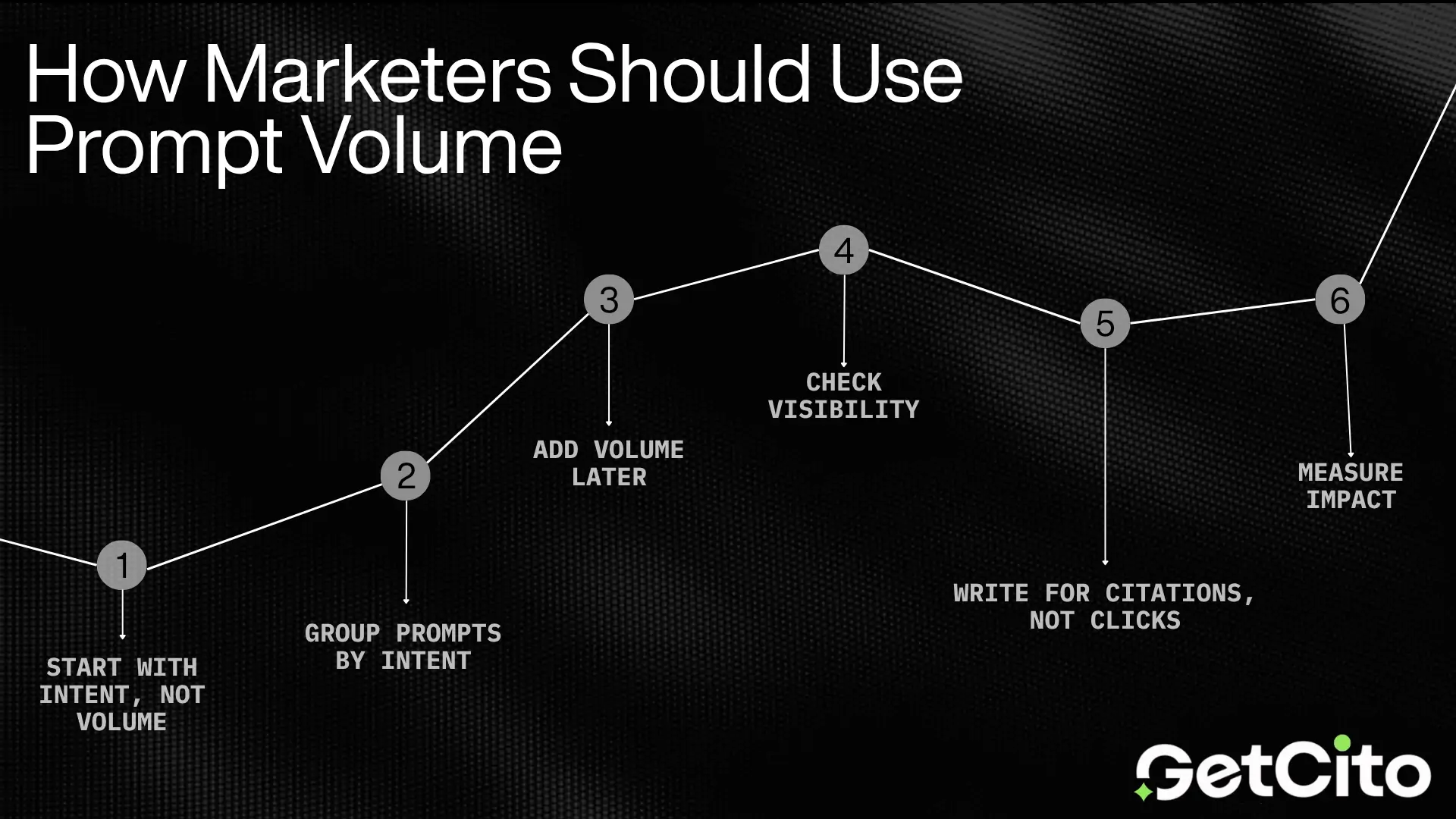
Used properly, prompt volume is a prioritization layer, not a strategy layer. Here is the workflow that actually holds up in practice.
- Step 1: Start with intent, not volume.
Map the questions your target buyer asks across their journey awareness, evaluation, decision, and post-purchase. Use customer conversations, sales calls, and community research as your raw material. Prompt volume comes later. - Step 2: Cluster prompts into topic groups.
Don't optimize for individual phrasings. Group prompts by intent: "comparison questions," "pricing questions," "integration questions," and so on. This is exactly what serious tools do under the hood, and it should be your default mental model. - Step 3: Layer prompt volume on top.
Now use prompt volume to rank topic groups. Which clusters appear most often? Which are growing? Which shows seasonality? The output is a prioritized roadmap. - Step 4: Validate with visibility data.
For each priority topic, check who's currently being cited. Are competitors winning? Are AI engines using third-party sources you could plausibly displace? Are they citing your own domain inconsistently? - Step 5: Build content for the citation, not the click.
This is the deepest mental shift. In AI search, the goal is often not to win a click but to be the cited source inside an AI-generated answer. Content needs to be structured so AI engines can extract and attribute it cleanly. - Step 6: Measure outcomes the right way.
Track citation share, brand mention rate, and AI referral traffic, not just prompt volume. Prompt volume tells you where to play; visibility tells you whether you're winning.
The trap to avoid is treating prompt volume as the score. It isn't. It's the playing field.
Common Mistakes to Avoid
Most teams stumble on the same predictable issues when they first incorporate prompt volume into their workflows. Here are the ones worth flagging.
- Treating estimates as facts. A prompt volume number is a model output. Citing it in a board deck as "the topic has 3,400 monthly prompts" implies a precision that doesn't exist. Use ranges or rank orders.
- Comparing numbers across tools. Two tools using different methodologies will produce different numbers for the same prompt. Neither is "right." Stay inside one tool for trend tracking, or use cross-tool comparisons only for rank-order validation.
- Optimizing for individual prompts. Because prompts are so varied, chasing single-phrase volume is a losing game. Optimize for intent clusters, not exact strings.
- Ignoring AI citation drift. Even when you "win" a citation for a prompt this week, you may lose it next week as AI engines reshuffle sources. SISTRIX's data showing 74% weekly domain churn on ChatGPT is a sobering reminder that visibility in AI is far less stable than rankings in Google.
- Skipping manual validation. No matter how slick a tool's dashboard, you should still run the actual prompts through the actual AI engines yourself. The dashboards are abstractions; the AI responses are the reality.
- Building a strategy on a single metric. Prompt volume is one signal. Citation share, brand mention frequency, sentiment, and referral traffic are others. A strategy resting on prompt volume alone is fragile.
- Confusing prompt volume with prompt value. A high-volume topic with low buyer intent is worth less than a low-volume topic at a decision moment. Volume is not the same as value.
Prompt Volume vs Visibility Metrics
This is the section many marketers wish came first. Prompt volume answers the question "where is demand?" Visibility metrics answer the question "Are we winning?" You need both, and they pair specific weaknesses in each other.
| Metric | What It Measures | What It Doesn't Tell You |
|---|---|---|
Prompt Volume | Estimated demand for a topic in AI search | Whether your brand is mentioned, cited, or recommended |
Citation Share | Percentage of AI answers that cite your domain | Whether the topic has a meaningful underlying demand |
Brand Mention Rate | The frequency at which your brand name appears in AI responses | Source attribution or click outcomes |
Share of Voice (AI) | Your brand's mention share vs competitors for a topic set | Whether you're being mentioned positively |
AI Referral Traffic | Visits to your site from AI engines (ChatGPT, Perplexity, etc.) | The full reach of citations that don't produce clicks |
Sentiment in AI Answers | Whether mentions of your brand are positive, neutral, or negative | Whether the AI is recommending you |
The strategic point: prompt volume is a demand metric, and visibility metrics are performance metrics. They should be tracked side by side. A topic with high prompt volume and zero citation share is an opportunity. A topic with low prompt volume and 100% citation share is a defended position you might be over-investing in. The combination tells you where to push, where to defend, and where to walk away.
What Makes a Good Prompt Volume Tool?
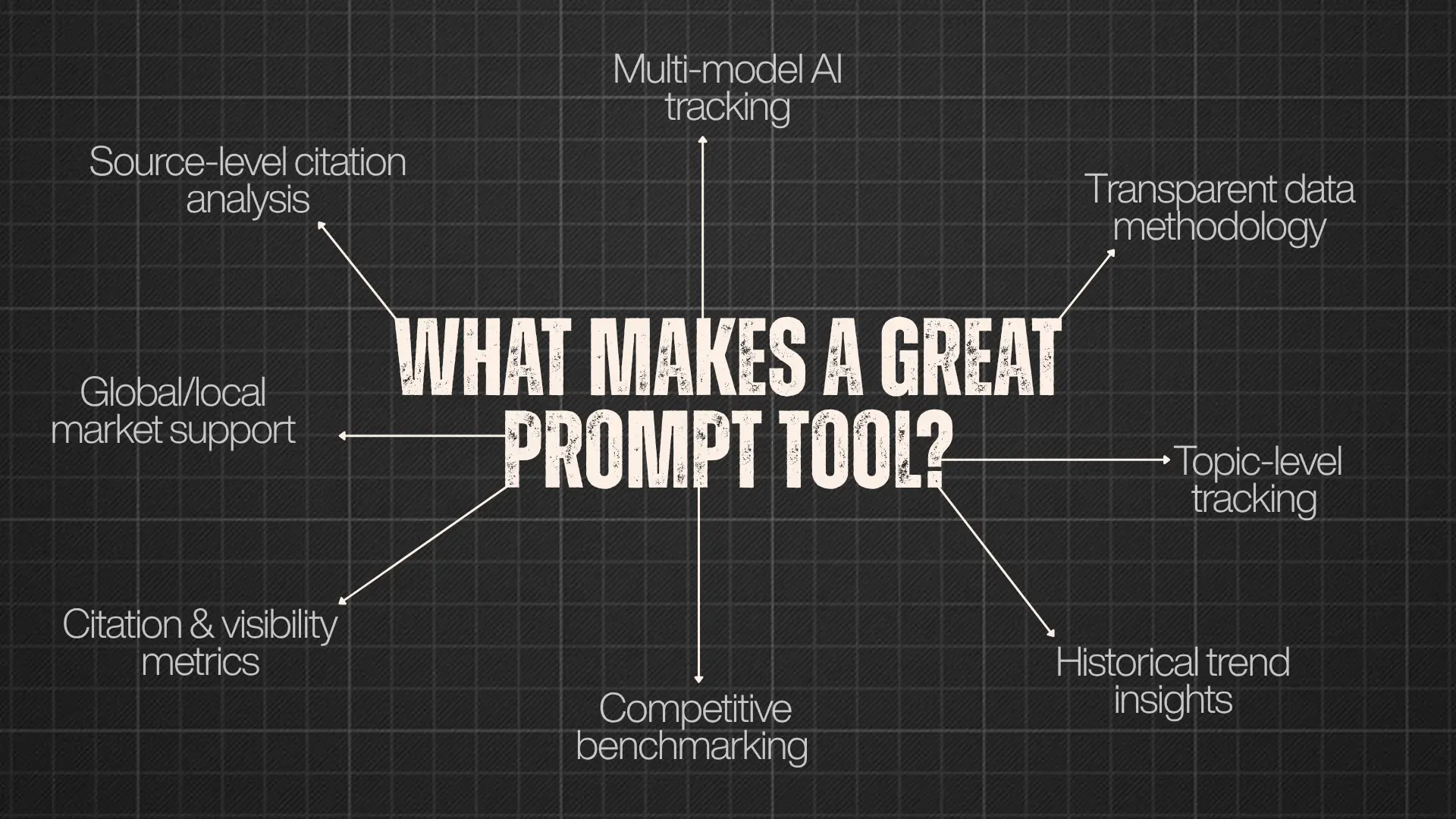
The market for prompt volume tools is crowded and getting more so. Before picking one, evaluate it on a few specific criteria.
- Multi-model coverage. Look for tools that track across ChatGPT, Gemini, Claude, Perplexity, and, at a minimum, AI Overviews. Single-engine tools give you a partial picture; demand and citation behavior vary substantially across platforms.
- Methodology transparency. Any vendor that won't explain how their numbers are generated should be a hard pass. You need to know whether the data comes from panels, clickstream, modeling, or some combination, and what the known limitations are.
- Topic-level clustering, not just literal prompts. A tool that only tracks exact prompt strings is fighting yesterday's war. Demand lives at the topic level.
- Historical trend data. A point-in-time snapshot is far less useful than the ability to see how a topic's prompt volume has moved over weeks and months.
- Competitive benchmarking. Knowing your citation share is useful. Knowing it relative to three competitors on the same topic set is far more useful.
- Integrated visibility metrics. A tool that gives you prompt volume but no citation, sentiment, or share-of-voice data forces you to stitch the picture together yourself.
- Local market support. AI behavior varies by country and language. A tool that only measures English-language prompts in the US has limited utility for global teams.
- Source-level analysis. When AI engines cite domains, you want to know exactly which ones. This is how you identify content gaps and citation opportunities.
A tool that nails the top three or four of these criteria is genuinely useful. A tool that markets itself on slick dashboards but is opaque about methodology is, charitably, a distraction.
How GetCito's AI Prompt Volume Checker Helps
GetCito's AI Prompt Volume Checker was built around the principles laid out in this article: directional honesty, topic-level clustering, multi-model coverage, and clear methodology.
It helps marketing teams answer practical questions:
- Which topics in our industry have meaningful prompt volume across ChatGPT, Gemini, Claude, and Perplexity?
- How is that volume trending over time?
- For each priority topic, who is currently being cited us, our competitors, or third-party sources we could outrank?
- Where is the gap between demand and our current visibility?
The Checker is designed to be one input into a serious GEO strategy, not a magic prioritization machine. The numbers are presented as estimates, the methodology is documented, and the tool is paired with citation tracking and brand mention analysis, so prompt volume never sits in isolation.
The point of the tool is not to convince you that prompt volume is precise. It's to make it useful, honestly, transparently, and in combination with the other signals, you need to actually move the needle in AI search.
If you're starting your GEO measurement program, the right sequence is roughly: map customer intent, cluster into topic groups, use the Checker to prioritize, validate with manual prompt testing, and then track visibility metrics over time. The Checker is one piece of that workflow, not a replacement for any of it.
Final Thoughts
Prompt volume sits at an awkward stage of maturity. The metric is real, the signal is meaningful, and the strategic question it answers, "where is demand moving in AI search?" is one every modern marketing team needs to address. But the data underlying it is modeled, the methodologies vary across vendors, and the AI search ecosystem itself is unstable enough that any specific number deserves skepticism.
The right posture is neither evangelism nor dismissal. Treat prompt volume the way a smart investor treats analyst forecasts: useful, directional, occasionally wrong, and always to be triangulated against other inputs. Pair it with citation share, manual testing, customer language research, and visibility tracking, and it becomes one of the most useful tools you have for navigating AI search.
Pair it with nothing, and it becomes another vanity dashboard.
The teams that win in AI search over the next few years will not be the ones with the most precise prompt volume data. They will be the ones with the best judgment about how to use imperfect data. Prompt volume, used with that kind of judgment, is genuinely powerful.