

A notification on your phone can crash your company's servers or cause you to miss a competitor stealing your biggest clients.
It sounds backwards: alerts and dashboards exist to keep you informed. However, a decade of building tracking tools for metrics, pricing changes, and market fluctuations reveals a consistent truth across engineering manuals and business intelligence: a bad alert is a psychological hazard that actively degrades your team's performance.
The industry assumes that total visibility equals total control. In reality, total visibility produces total paralysis. Most teams monitoring AI search are collecting the right data on the wrong schedule, and then alerting on the one layer of it that does not matter.
That is not a criticism of anyone's discipline. It is a consequence of borrowing rank-tracking habits and pointing them at a surface that behaves nothing like a search engine results page. The result is a dashboard nobody opens and a Slack channel everybody mutes.
This guide covers what actually changes inside AI answers and how fast, how to pick a review rhythm your team can sustain, and how to build alerts that survive contact with a busy week.
The short answer
Collect daily. Review weekly. Alert only on multi-run confirmed outcome changes.
If you take nothing else from this piece:
- Separate collection frequency from review frequency. Your tooling can query prompts every day. Your team should not look at the output every day. These are two different decisions and conflating them is the root cause of most monitoring failures.
- Do not alert on wording. Google's AI Overviews change roughly every two days, but consecutive versions score 0.95 out of 1.0 on semantic similarity. The surface churns; the answer does not. Alerting on rephrasing is alerting on nothing.
- Confirm across runs before you page a human. Large language models are not deterministic. One check proves nothing in either direction.
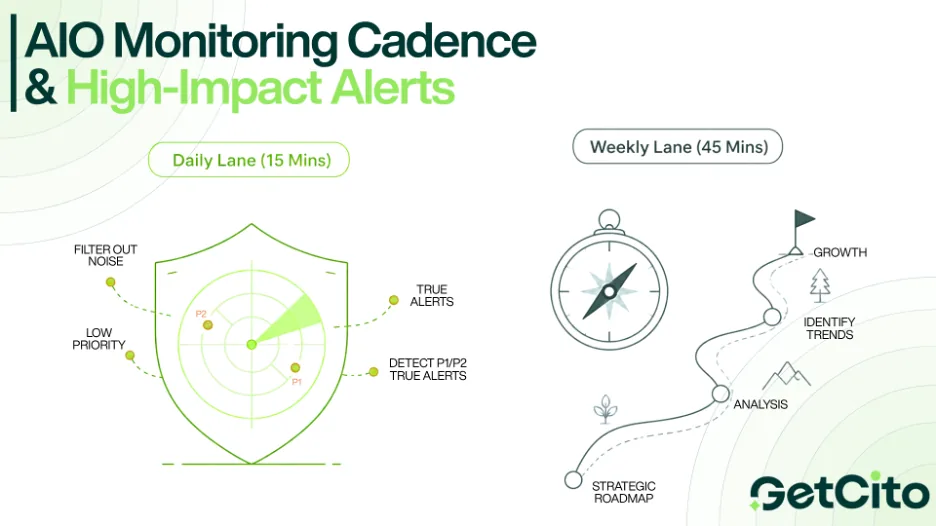
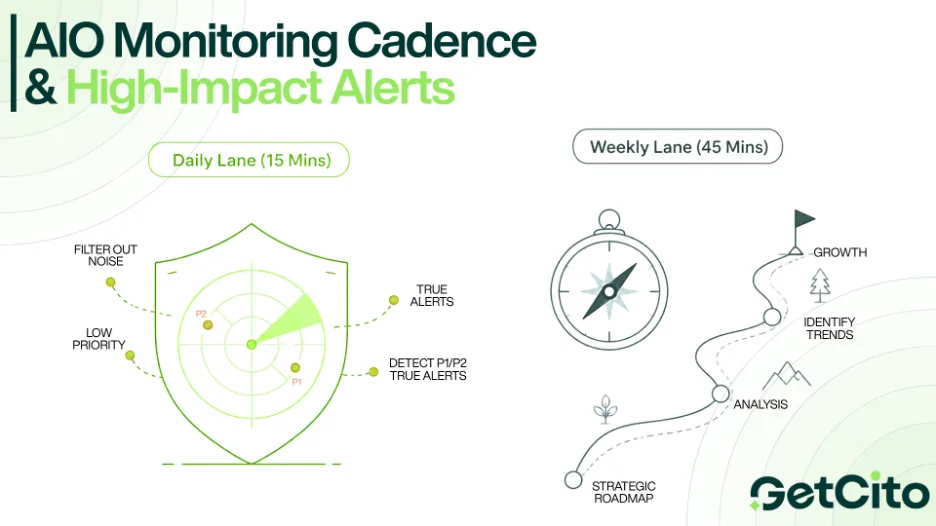
- Run two lanes: a 15-minute daily exception lane for confirmed high-severity events, and a 45-minute weekly strategy lane for cluster trends.
- Give every alert a runbook, or demote it to a log. If you cannot write down what a person should do when it fires, it is data, not an alert.
The 47-Alert Postmortem: Why Most Marketing Alerts Fail
Before setting up a single alert, I require every new client to read one specific engineering postmortem:
An engineer inherits a legacy monitoring system where the on-call rotation receives 47 alerts per 24-hour shift. Of those, 44 require zero human action; they are minor server spikes, temporary blips, and pure noise. Conditioned by weeks of false alarms, the team learns to swipe them away on reflex.
Then alert number 45 arrives: a critical memory leak. The engineer assumes it is more static, dismisses it, and the system crashes twice.
This case study popularised a crucial monitoring metric that applies directly to marketing dashboards: action rate. If fewer than 50% of your alerts require actual human intervention, you do not have a safety net; you have a noise generator training your team to ignore critical signals.
Why open a marketing article with an engineering failure? Because AI search is about to put your marketing team in that same on-call seat.
The AI Search Battlefield: Answer Engines Recommend, They Don't Rank
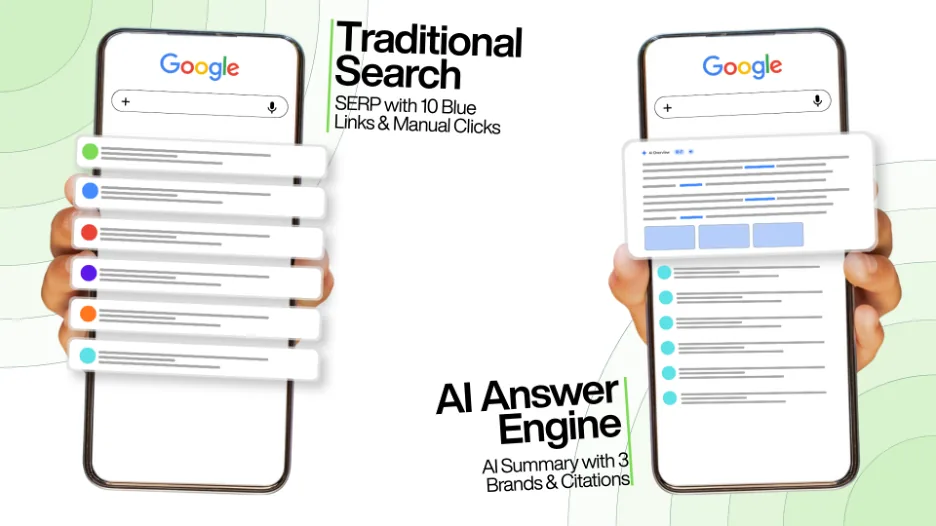
Traditional search functioned like a library card catalogue; it pointed you to the right aisle, but you still had to find the book and read it yourself.
Answer engines like ChatGPT, Google AI Overviews, Perplexity, and Gemini act like high-end personal shoppers. They process the available data, cross-reference sources, and present buyers with a single synthesised recommendation. If your brand isn't included in that recommendation, you aren't just ranked lower; you are invisible.
Furthermore, this personal shopper changes its mind constantly:
- High Volatility: Ahrefs' analysis of 43,000+ keywords found a 70% chance an AI Overview changes between consecutive checks, with the average answer persisting for only ~2.15 days.
- Unstable Rankings: Authoritas data shows AIO ranking volatility scores at 0.68, compared to 0.49 for traditional organic rankings.
Faced with this instability, most teams attempt to track every prompt, engine, and competitor daily. That reactive instinct builds the marketing equivalent of a noisy 47-alert system, training your team toward learned helplessness rather than actionable insights.
The Operational Framework: Daily Exceptions vs. Weekly Strategy
Cadence acts as a tax on human attention. Requiring teams to review minor AI visibility fluctuations daily leads to burnout and learned helplessness within a month. Conversely, monitoring on a purely weekly schedule creates blind spots, allowing competitors to dominate critical revenue prompts for days undetected.
A dual-lane operating model balances these trade-offs by separating urgent exceptions from strategic decision-making:
| Cadence | Time Budget | Primary Focus | Key Actions |
|---|---|---|---|
Daily Lane | 15 minutes | Urgent Exceptions (P1/P2 Alerts) |
|
Weekly Lane | 45 minutes | Strategic Decisions across Prompt Clusters |
|
How Fast AI Answers Change and Why Single Checks Lie
AI search results do not change weekly; they shift roughly every two days. However, a single query check often presents a false signal in both directions.
For example, a B2B payroll software client panicked when a 9:00 AM check showed their brand had vanished from ChatGPT for "best payroll software for startups", a primary revenue driver. By 2:00 PM, a second check returned the exact original answer. Nothing had fundamentally changed; the system had simply captured a mid-shuffle output.
Three core dynamics explain this behaviour:
- Cosmetic Churn vs. True Instability: Despite a 70% refresh rate in AI Overviews, Ahrefs' data reveals a 0.95 semantic similarity between consecutive versions. While ~45.5% of cited URLs swap during refreshes, the underlying meaning remains stable. Most daily changes are superficial rewording or source rotations rather than structural drops.
- LLM Non-Determinism: Large language models are inherently non-deterministic. The identical prompt submitted from the same account can yield different results across separate runs. Benchmarks from QAnswer show same-output consistency rates ranging between 70% and 95% depending on the model and prompt type, meaning a single query snapshot proves nothing.
- Geographic Variance: AI answers adapt based on user location. Testing by AEO Agency using proxy servers across the US, UK, Canada, Australia, and New Zealand confirmed that ChatGPT results shift for both obviously and non-obviously geo-dependent queries, and a separate study on ChatGPT and Israel-related queries found answers changed in tone, framing, and cited sources between Israel, the US, Turkey, and Spain. AI visibility is never a single global metric.
Core Monitoring Principles
- Collection frequency ≠ review frequency: Allow automated tools to run daily checks, but restrict human review to confirmed exceptions.
- Require multi-run confirmation: Never trigger an alert based on a single query run. Genuine shifts persist across 2–3 consecutive checks.
- Localize tracking: Pin monitoring parameters to specific target sales regions rather than headquarters locations.
Core Terminology Definitions
| Term | Definition | Key Metric Consideration |
|---|---|---|
Mention | The inclusion of your brand name in an AI answer, with or without an attached hyperlink. | Tracks raw brand awareness within AI outputs. |
Citation | The direct inclusion of your website URL as an underlying source. | Measures direct search engine trust and traffic pathways. |
Share of Voice (SOV) | The percentage of queries within a defined prompt cluster that reference your brand versus direct competitors. | Benchmarks total category dominance across key themes. |
Sentiment | The contextual framing (positive, neutral, or negative) surrounding your brand in the answer. | Mitigates positioning risks (e.g., being cited as "expensive" or "outdated"). |
Note: Mentions and citations move independently. A brand name often remains in an answer even after its domain citation is removed, and vice versa. Comprehensive monitoring must track both metrics simultaneously.
AIO Monitoring Cadence: When Daily Beats Weekly (and Vice Versa)
Choose a daily cadence when the cost of being wrong is high and underlying answer changes occur frequently. Choose a weekly cadence when volatility is low, and execution speed is naturally slower.
| Business Situation | Recommended Cadence | Strategic Rationale |
|---|---|---|
High-Visibility Category (frequent "best X for Y" transactional queries) | Daily (restricted to a small prompt subset) | Mitigates immediate pipeline and revenue risks caused by sudden recommendation drops. |
Active Campaign Execution (new content launches, PR initiatives, product releases) | Daily (during active campaign windows) | Capitalizes on ~2-day answer persistence to provide immediate feedback on campaign effectiveness. |
Executive Reporting & Stakeholder Requests (e.g., "Are we being recommended in AI search?") | Weekly baseline + daily exceptions | The weekly view illustrates macro trends, while daily exception checks catch sudden brand-risk incidents. |
Lean Marketing Teams (2–8 team members with limited operations capacity) | Weekly (default setting) | Protects core team focus; relies on automated P1 alerts to manage urgent exceptions. |
High Reputation Risk (strict regulatory environments, review controversies, repositioning) | Daily (targeted risk alerts) | Prevents negative framing from persisting in front of prospects across multiple answer refresh cycles. |
Pro Tip: If you are unsure which structure to implement, establish a weekly baseline first. Add a daily exception lane exclusively for high-risk "money prompts." This captures the majority of optimization benefits without levying a heavy attention tax on your team.
What to Monitor: Alert on Symptoms, Never Causes
In Site Reliability Engineering (SRE), the core alerting philosophy dictates: page on symptoms, keep cause-level signals as debugging aids.
For example, a restaurant manager does not want a pager to sound every time a line cook drops a spoon or an oven drops two degrees (causes). The pager should sound when a table's food takes 45 minutes to arrive (symptom). One properly configured symptom alert replaces dozens of noisy, self-correcting cause notifications.
Applied to AI Optimization (AIO), alerts must focus exclusively on outcomes that demand human intervention within 24 to 72 hours.
Symptom-Based Alerts (Outcomes That Matter)
Trigger an immediate alert when:
- Brand presence disappears from a high-value money prompt or strategic cluster.
- A key competitor replaces your brand in core recommendation answers (e.g., "best" or "top" queries).
- Negative sentiment spikes in answers visible to active prospects.
- Domain citation is dropped, even if the text mention remains intact.
- Answer intent shifts unfavorably (e.g., moving from "recommended option" to "risky alternative").
Cause-Level Noise (Do Not Alert)
Do not trigger alerts for:
- Phrasing or wording changes: A 0.95 semantic similarity baseline confirms that rewording is normal LLM behaviour, not a strategic drop.
- Single-run fluctuations: LLM non-determinism means a single anomaly is rarely a confirmed shift.
- Isolated non-commercial prompts: Low-intent fluctuations belong in weekly trend reports.
- Minor data deltas without clear next steps: If an alert does not require immediate, actionable intervention, move it to the weekly review.
Best Practice 1: Define Severity Tiers (Preventing Daily Cadence Chaos)
Why Severity Tiers Matter
Cadence is ultimately a framework for managing human attention, and human attention degrades in measurable ways when overstimulated.
This breakdown mirrors alarm fatigue in healthcare: when ICU monitors constantly beep for non-lethal events, medical staff develop learned helplessness and mentally filter out the noise. In marketing and business intelligence, this appears in MTTA (Mean Time to Acknowledge) metrics. Teams that initially respond to alerts within two minutes gradually drift to fifteen minutes or more over several months. The system cries wolf until neurological habituation sets in.
Cross-industry data illustrates the severity of alarm fatigue:
- A Vectra AI survey revealed that 62% of security-operations alerts are ignored.
- Subsequent research confirmed that 61% of operational teams admitted to ignoring alerts that later proved critical.
To prevent this failure mode, adopt incident-management frameworks (such as PagerDuty's model) to enforce a strict boundary between urgent human interruptions and passive data notifications.
Implementation: The Three-Tier Alert System
Structure your monitoring system using three distinct severity tiers:
| Severity Level | Action SLA | Delivery Channel & Behaviour | Typical Trigger Events |
|---|---|---|---|
P1: Critical (Page) | Within 24 Hours | Interrupts workflow (SMS/PagerDuty/Direct Call). Bypasses standard Slack channels. |
|
P2: Urgent (Notification) | Within 72 Hours | High-priority Slack or email notification. Targeted assignment. |
|
P3: Informational (Log) | Weekly Review | Passive digest/dashboard log. Reviewed during weekly meetings without real-time alerts. |
|
Response Time Rationale: The 24/72 Rule
The operational SLAs correspond directly to AI answer persistence:
- Because AI Overviews refresh approximately every 2 days, leaving a P1 issue unaddressed for a week allows negative or inaccurate framing to sit in front of prospective buyers through 3 to 4 full answer cycles. A 24-hour SLA aligns response efforts with the answer engine's refresh cycle.
- The 72-hour window for P2 alerts accommodates strategic content updates and technical fixes that require production time rather than an immediate same-day hotfix.
Failure Mode: Without formal severity tiers, daily monitoring devolves from "check everything" into "check nothing", recreating high-noise engineering outages within marketing operations.
Case Study: Rapid Mitigation of Negative AI Framing
A legal-services firm discovered negative sentiment surfacing across its core prompt cluster ("top business law firms for startups", "best startup attorneys") due to an old review controversy ingested by the AI model.
Because the incident triggered a P1 Alert:
- The managing partner was notified by the following morning.
- A targeted rebuttal page featuring updated proof points was published within 48 hours.
- The corrective content flipped the model's framing back to positive over subsequent answer refresh cycles.
Under a standard monthly reporting model, the negative sentiment would have remained visible to active buyers for weeks undetected.
Best Practice 2: Right-Size Coverage (Prompts × Engines × Competitors)
Why Coverage Right-Sizing Matters
Over-expanding monitoring parameters creates operational noise that masks critical signals.
In one enterprise deployment, a mid-market SaaS client tracked 340 prompts across six engines from day one to achieve "total visibility." Within six weeks, internal engagement dropped to a 0% open rate on their weekly reports. After pruning coverage to 40 prompts across three core engines, the team immediately began addressing P2 alerts within 24 hours.
More data does not increase security; excessive data creates operational blindness.
Implementation: Minimum Viable Coverage (MVC)
For SMB and mid-market teams, start with a Minimum Viable Coverage framework and expand parameters only after performance data validates them.
| Coverage Dimension | Recommended Baseline | Tactical Allocation & Rules |
|---|---|---|
Prompt Portfolio | 25–50 prompts total |
Rule: Always isolate branded queries from unbranded queries to prevent artificial baseline inflation. |
Run Multiplier | 2–3 runs per check | Mitigates LLM non-determinism by averaging output variances across identical requests. |
Target Engines | 2–3 engines max | Focus on primary surfaces based on market share:
Note: Treat Google AI Mode and Google AI Overviews as separate surfaces due to their low citation overlap (~14%). |
Geographic Scope | Top 1–2 target markets | Localise queries to target sales regions to account for regional source variations. |
Competitor Tracking | 3–5 direct competitors | Limit tracking strictly to primary competitors encountered in direct sales cycles. |
Best Practice 3: Use Delta Thresholds and Burn Rates (Not Absolute Numbers)
Why Delta Thresholds Matter
Static thresholds fail as soon as ambient conditions shift.
In traditional engineering, an alert configured for "server latency > 500ms" signifies a major incident at 3:00 AM on a Tuesday, but exceptional performance during a peak shopping event. Static lines in the sand lack context.
AI visibility is entirely contextual. Baselines vary dramatically by prompt, and a ~70% refresh rate between consecutive checks means change is the default state of answer engines. Absolute rules (e.g., "alert if brand mentions drop below 10") either fire continuously or never fire at all.
Implementation: SRE Deltas & Visibility Burn Rates
SRE principles resolve this using deltas against established baselines and burn rates:
- The Burn Rate Concept: Engineering teams accept a 99.9% uptime SLA, leaving an "error budget" of ~43 minutes of downtime per month. An alert fires not because a single error occurred, but because the rate of errors will exhaust the monthly budget ahead of schedule.
- Applied to AI Search: Fluctuations in Share of Voice (SOV) represent expected churn. A human should be paged only when the trajectory indicates a loss of presence across a revenue cluster at a rate that threatens baseline visibility.
| Monitoring Level | Focus & Mechanics | Alert Trigger Conditions |
|---|---|---|
Prompt Level (High-Risk / Money Terms Only) | Evaluates direct recommendation flips on single high-intent terms. | The answer shifts from "Recommended" → "Not Mentioned", confirmed across 2–3 consecutive runs. |
Cluster Level (Recommended Default) | Tracks aggregate performance across related prompt groups (same buyer intent). | Net decline across the cluster exceeds the target burn-rate threshold. |
Cohort Level (Weekly Digest) | Monitors macro trends in Share of Voice and citations against competitor sets. | Multi-week drift in overall category dominance or citation prevalence. |
Baseline Alert Configuration Framework
- P1 (Critical): Brand removed or negative sentiment introduced on any high-intent money prompt (multi-run confirmed).
- P2 (Urgent): A competitor gains material presence across a prompt cluster week-over-week.
- P3 (Informational): Share of Voice trends drift over a 4-week trailing window.
Tactical Example: Avoid setting alerts for general citation loss, as ~45% of cited URLs swap during routine refreshes. Instead, set alerts for: "Target landing page URL replaced on a core money prompt." General citation churn is ambient noise; losing a high-converting landing page citation is an actionable event requiring immediate content re-optimisation.
Best Practice 4: Tune Alerts Ruthlessly (Runbooks, Deduping, Deletion Budgets)
Why Alert Tuning Matters
Unmaintained alerts naturally degrade over time. Prompts evolve, search models update, and organisations accumulate obsolete monitoring rules that remain active simply because their original creators left the company.
Google's SRE Handbook establishes a fundamental rule: Every page must be actionable. If a notification does not demand a concrete human decision, it should never interrupt a human.
Implementation: Five Rules for Alert Hygiene
- Enforce the Runbook Rule: Every P1/P2 alert must link directly to a standardised runbook defining the issue and the precise steps required for resolution. If a clear response workflow cannot be documented, the alert is classified as passive data and demoted to a weekly log.
- Non-Actionable (No Runbook): "AI visibility dropped across category terms."
- Actionable (Has Runbook): "Money prompt lost target domain citation → Refresh target landing page, incorporate schema/FAQ updates, re-verify within 72 hours."
- Deduplicate Cluster Events: If eight prompts within a single cluster experience the same shift simultaneously, synthesise them into a single incident with an event count of eight. Suppress repeat notifications for 24 hours unless new telemetry emerges.
- Route by Operational Ownership:
- P1 Alerts: Escalated directly to Communications/Reputation Lead and Primary Channel Owner (SEO/Content).
- P2 Alerts: Directed to the functional SEO/Content Execution Team.
- P3 Alerts: Aggregated exclusively in the weekly reporting channel.
- Maintain a Quarterly Deletion Budget: Systematically delete or re-architect at least 10% of active alerts every quarter, prioritising high-frequency, low-actionability rules.
- Audit Action Rate Quarterly: Calculate the percentage of generated alerts that resulted in direct human intervention. If the overall action rate drops below 50%, aggressively prune monitoring parameters until signal strength is restored.
Best Practice 5: Make Your AIO Monitoring Auditable (Timestamps, Change Logs, and Pilot Validation)
Why Auditability Matters for AI Visibility
Monitoring isn't just about spotting fluctuations, it is about proving those shifts are real, repeatable, and worth budget allocation. Executives will eventually demand proof that your AI optimisation (AIO) strategy is delivering measurable ROI. Subjective statements like "it feels like our visibility is improving" are where monitoring initiatives go to die.
There is also a critical methodological reason for auditability: with AI search answers refreshing roughly every two days and varying run-to-run due to LLM non-determinism, an un-timestamped observation is unfalsifiable. Even major research institutions studying AI Overview behaviour explicitly caveat that data reflects answers exclusively at the exact time of collection. If academic researchers require strict timestamps, your marketing operations require them too.
How to Implement an Auditable Monitoring System
To build an accurate, defensible record of your brand's AI search presence, structure your data collection around three core practices:
- Store Timestamped Query Snapshots: Save raw, time-stamped JSON and visual snapshots for every prompt run to document exact query times, engine versions, and regional locations.
- Maintain a Unified Change Log: Track operational inputs alongside observed outputs in a centralised log. Map your inputs (content refreshes, PR releases, schema updates, or site structure shifts) directly against your outputs (persistent changes in brand mentions, domain citations, share of voice, or sentiment).
- Execute 30-Day Validation Pilots: Run a structured testing cycle before attributing any brand visibility gain to a specific tactic.
Executing the 30-Day Validation Pilot
- Baseline Phase (Days 1-10): Draw samples of target prompt clusters from primary engines, with 2-3 runs per day. Record baseline Share of Voice (SOV), frequency of citation, and sentiment scores.
- Intervention Phase (Day 11): Targeted Content Updates, Schema Fixes / Digital PR Campaigns. Document in your master change log exact changes, live URLs and timestamps.
- Validation Phase (Days 12-30): Monitor target prompt clusters for sustained visibility changes, filtering out cosmetic churn. Verify that the performance deltas meet your P1/P2 resolution criteria.
Example: The Executive Summary Framework
Use this structured format for weekly leadership updates to directly answer the question: "Is our AI search strategy working?"
- Critical Events (P1/P2): Highlight the top 3 high-impact answer shifts observed during the week.
Example: Lost primary citation for target landing page on the money prompt "best payroll software for startups." - Strategic Interventions: Document exact optimisations deployed to address the issue.
Example: Updated target landing page content, incorporated updated proof points, and implemented structured FAQ schema. - Measured Impact: Report verified movement across core metrics.
Example: Citation successfully restored across ChatGPT and Google AI Overviews within 48 hours; Share of Voice increased +8%. - Next Steps: Outline upcoming priorities based on cluster trends.
Example: Expand optimisation strategy to secondary category prompts and refresh technical documentation sources.
Resolving Critical P1 Alerts: Automate the Draft, Retain Human Approval
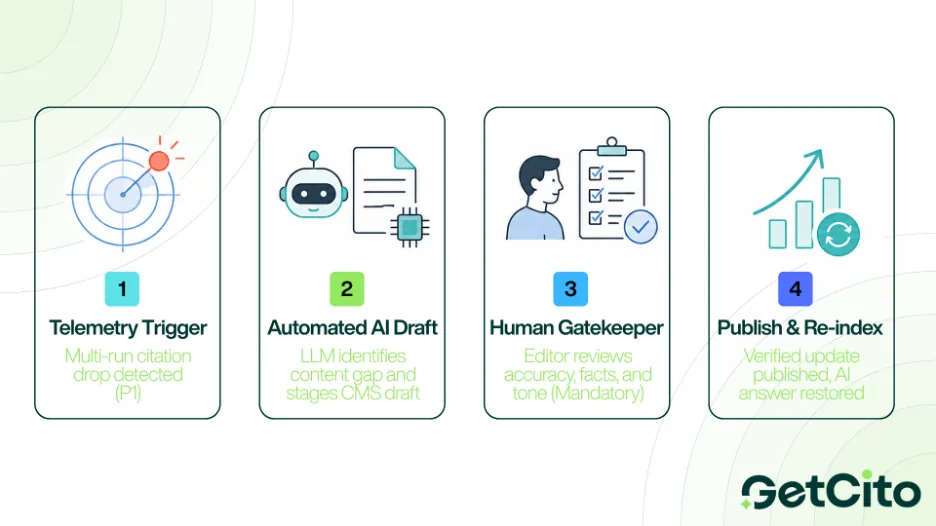
When a critical P1 alert fires, such as losing your primary AI citation on a revenue-driving money prompt, the response workflow itself can quickly become an operational bottleneck. Taking three or four days to draft, review, and publish counter-content creates unnecessary delays, negating the value of a fast monitoring system.
Modern LLM-driven automation resolves this delay by reading alert telemetry, analysing missing context on target pages, drafting optimised updates, and staging changes directly in your Content Management System (CMS). Unlike fragile legacy automation, LLM workflows adapt flexibly to unstructured data and changing layouts.
The Operational Law: Automate Execution, Retain Oversight
- Keep Humans in the Loop: Fully autonomous content generation risks publishing hallucinated facts, inaccurate specs or unverified claims, turning a loss of visibility into a corporate liability.
- Design for Graceful Failure: Set up automated flows to hold and escalate decisions to a human review queue when system confidence drops or new edge cases are found.
- Remove Operational Friction: AI automation should ease research, gap analysis, and drafting so human experts only need to focus on speedy, high-judgment publication decisions.
Complete AIO Monitoring Operating Framework
Building an effective AI Optimisation (AIO) program requires combining smart coverage, clear severity tiers, delta-based thresholds, and strict alert hygiene into a sustainable operational rhythm.
Core Technical Architecture
- Coverage Parameters: 25-50 total prompts (branded and unbranded terms remain separate), 2-3 primary AI search engines, 1-2 key geographic markets, 3-5 direct competitors, 2-3 checks per prompt.
- Severity Tiers: P1 critical alerts require a 24-hour SLA response time, P2 urgent notifications should be handled within a 72-hour SLA, and P3 informational logs need to be directed to weekly review digests.
- Delta Thresholds: Be aware of net trajectory/burn rates vs your baseline. Not just on a surface level change of verbiage, but across brand presence, domain citations, sentiment, multi-run confirmation.
- Alert Hygiene & Tuning: Require runbook for each alert, consolidate cluster-level shifts into individual incident tickets, route alerts by functional ownership, require a 10% quarterly alert deletion budget, and audit for a minimum 50% action rate.
- Audit & Verification: Timestamped execution snapshots, log operational inputs with observed visibility outputs, and run 30-day baseline-to-intervention validation pilots.
- Response Automation: Automate data extraction, content drafting with explicit human approval before publishing.
Operational Rhythm
- Daily Exception Lane (15 Minutes): Review verified P1 and P2 alerts, filter out ambient noise, and assign clear single-owner action items.
- Weekly Strategic Lane (45 Minutes): Analyse broader prompt cluster trends, evaluate major wins and risk factors, and adjust prompt coverage budgets.
Relying on manual spreadsheets to handle multi-run sampling, deduplication, and timestamping often leads to human error. Streamlining these workflows with purpose-built AIO monitoring tools ensures time-stamped tracking, automated alert consolidation, runbook attachment, and self-assembling executive reporting.
Evaluating Personal Action Rates and Cognitive Bandwidth
Beyond AI search monitoring, evaluate your day-to-day digital environment, including Slack channels, inbox notifications, and project management pings. Ask one fundamental question: What is your personal action rate?
If you routinely dismiss 90% of incoming notifications without taking action, your workflow suffers from the same dynamics as the 47-alert postmortem. You are operating in a high-noise environment where critical signals are easily overlooked.
Executing a Personal 10% Deletion Budget
To reclaim your team's cognitive bandwidth and restore high signal strength:
- Enforce a Weekly Deletion Budget: Audit active channels, automated reports, and notifications. Delete or mute at least 10% of your lowest-value alerts every week.
- Mute Low-Impact Channels: Silence high-volume, non-actionable communication channels that generate passive ambient noise.
- Decommission Unused Dashboards: Eliminate complex analytics dashboards that team members do not actively review or use to make business decisions.
A noisy or inaccurate alert creates more risk than having no alert at all. Reducing operational noise is one of the highest-leverage monitoring decisions you can execute this quarter.
Preserving Human Judgment in an Automated Landscape
AI tools monitor AI engines, produce draft optimisations, and publish content to influence those same engines, and the risk is that marketing workflows become closed-loop machine-to-machine interactions.
In a fully automated landscape, your most valuable competitive advantage is your human judgement – your ability to discern what really deserves attention and what is factually true about your brand. And guard that editorial and strategic judgement as appropriate.
Next Steps & Operational Resources
Access the Minimum Viable Monitoring Checklist
Download the comprehensive operational toolkit in a single document, which includes:
- The 25–50 Prompt Portfolio Template: Pre-built clusters covering money, category, and reputation terms with branded/unbranded isolation.
- Severity Tier Framework: Standardised definitions for P1, P2, and P3, with target SLAs and delivery routing.
- Standardised Runbook Template: A plug-and-play document layout to ensure every alert remains strictly actionable.
- Weekly Strategic Review Agenda: A 45-minute structured workflow designed for analysing cluster trends, wins, and risk factors.
See the Framework Operationalised End-to-End
Book a 20-minute walkthrough to see how automated monitoring workflows handle time-stamped change tracking, multi-run sampling, alert deduplication, and self-assembling weekly reports:
- Custom Severity Setup: Calibrate P1/P2/P3 alert tiers specifically to your target markets and competitors.
- Runbook & Threshold Configuration: Attach custom runbooks and multi-run delta thresholds to eliminate false positives.
- Noise Reduction Guarantee: Establish a streamlined monitoring system that protects your team's cognitive bandwidth and ensures critical signals are never ignored.
Conclusion: Operationalizing Sustainable AI Search Visibility
The key to mastering AI search visibility is finding that sweet spot between speed and human judgement. By avoiding reactive daily checks and instead linking your monitoring to time-stamped snapshots, multi-run delta thresholds, and actionable severity tiers, you can build a defensible system that safeguards brand equity without overwhelming your team. AI answer engines are revolutionising how customers find businesses, and an auditable high-signal monitoring framework will keep your strategy clear, repeatable and tied directly to measurable ROI.
A robust, revenue-driving AI Optimisation strategy is founded on replacing subjective guessing games with an auditable, symptom-based monitoring system. Strict severity tiers, tracking multi-run deltas, and eliminating ambient noise means your team can protect important brand recommendations without succumbing to alert fatigue. AI search engines are always updating recommendations, so your best edge is human supervision backed by reliable telemetry.
Ready to operationalize your AI search presence? Book a walkthrough with GetCito.