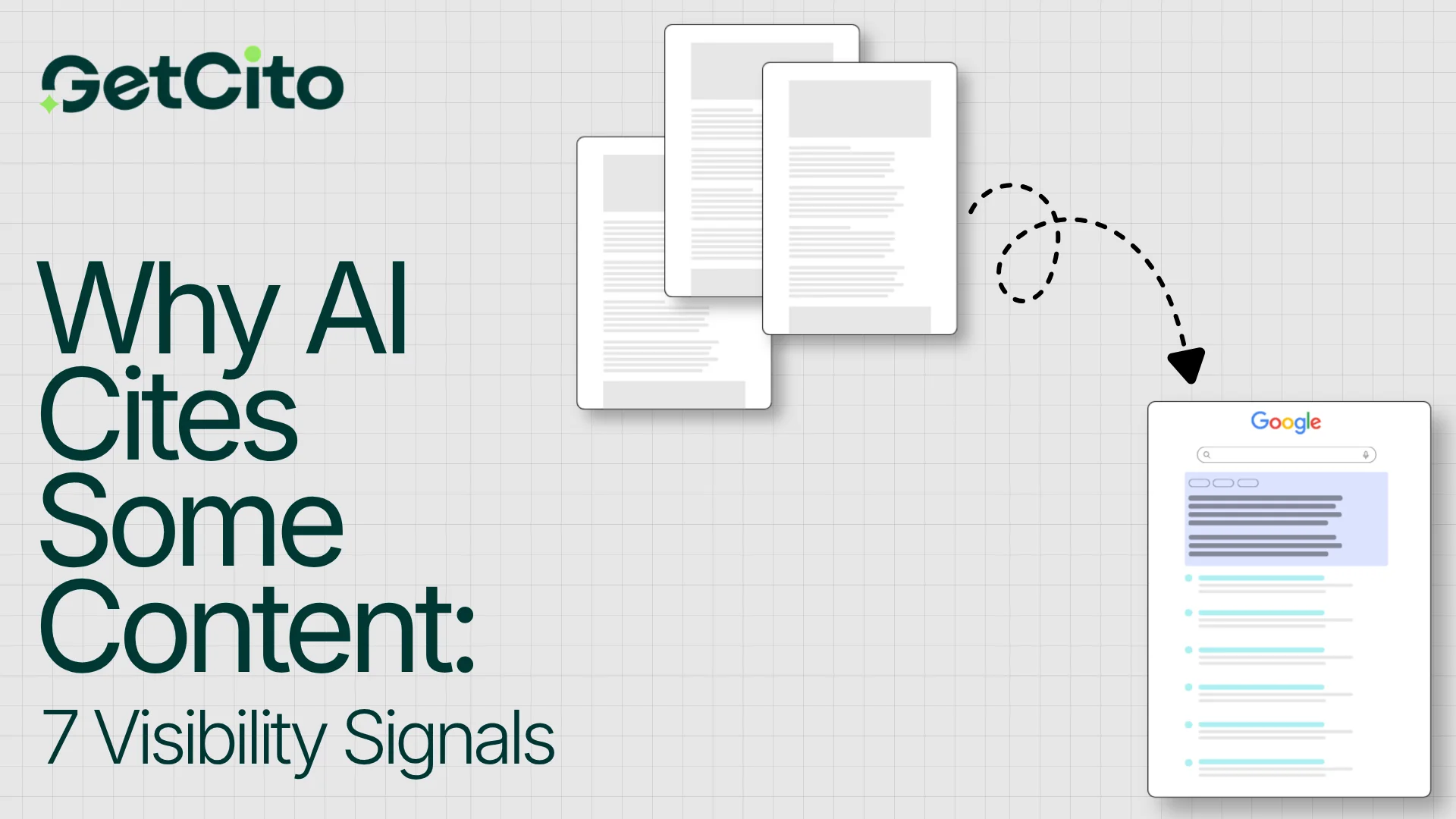


Every AI engine treats your content differently than a human reader. It doesn't read your pages top-to-bottom. It breaks them down into fragments. From that moment on, the page as a whole ceases to exist to the AI. Every fragment is judged entirely on whether it can stand alone.
AI engines cite content that is retrievable, extractable, and attributable, in that order. Before an AI answer ever mentions your brand, your content must survive a three-step gauntlet: the system has to retrieve the right passage, extract a clean statement from it, and trust the source enough to attribute it.
Here are the five signals that separate cited content from ignored content.
Signal 1: Extractable, Self-Contained Statements
An AI engine can only cite a sentence that makes sense on its own. Retrieval systems pull fragments out of your page and drop them into an answer with none of your surrounding context. A statement that depends on the paragraphs above it will not be cited.
The practical technique is BLUF: Bottom Line Up Front. Answer the question directly in the first sentence or two of every section, then elaborate with detail, examples, and evidence.
Two rules to enforce this:
- Name the subject explicitly: Replace backward-pointing pronouns ("it," "this," "the platform") with the actual noun. A sentence that starts "This improves visibility" is uncitable out of context; "Structured FAQ sections improve AI visibility" is citable anywhere.
- One idea per paragraph: Mixed-topic paragraphs dilute relevance to every query. Build "Lego bricks" of knowledge so that any single paragraph can be lifted out and still carry its full meaning.
Signal 2: Original Data and Statistics
AI models cannot generate original data, so they gravitate toward sources that provide it. Specific, verifiable statistics with named sources are disproportionately extracted because a number with an attribution is a perfectly self-contained information unit.
How to implement it:
- Publish proprietary numbers: Survey results, internal benchmarks, or category studies are your strongest citation assets.
- Attribute every figure: "63% of marketers" is weak; "63% of marketers, according to [Named Study, Year]" is extractable.
- Put numbers in the text: AI crawlers often cannot read data locked inside interactive charts or widgets. State the key figures in plain prose alongside any visualization.
Signal 3: Attributed Expert Quotes
Direct quotations from named authorities give AI something specific and attributable to extract. A quote carries its own source, its own claim, and its own boundaries. They answer the AI's implicit question: "who says so?"
How to implement it:
- Quote named people with credentials: Avoid anonymous "experts say" constructions. Use full names and titles.
- Keep quotes tight and declarative: One clear claim per quote. A rambling three-sentence quote is harder to extract than a single sharp assertion.
- Interview real practitioners: Original quotes exist nowhere else on the web, making your page the mandatory citation for that perspective.
Signal 4: Structure That Chunks Cleanly
Clear structure is the instruction set for how AI systems segment your content. AI pipelines split pages into chunks, and structural boundaries (headings, paragraphs, list items) are where the cleanest cuts land.
| Element | What it does for AI extraction |
|---|---|
Question-based headings | Matches the literal form of user queries so the section directly aligns with the question asked. |
FAQ sections | Pre-packaged question-answer pairs act as ready-made citations for an AI model. |
Definition boxes | Standalone, extractable definitions are highly likely to win "what is X" queries. |
Comparison tables | Structured data is reliably reconstructed by AI; writing the same comparison in prose forces the model to guess your structure. |
Signal 5: Trust and Authority Signals (E-E-A-T)
Experience, Expertise, Authoritativeness, and Trustworthiness (E-E-A-T) influence both traditional rankings and AI citations. AI systems prefer sources that demonstrate credibility through concrete, checkable signals.
On-page trust signals:
- Named authors: A byline linked to a bio with verifiable expertise outperforms anonymous content.
- Transparent sourcing: Cite your own sources properly. Citing other authoritative studies makes your own content more trustworthy.
- Dates and methodology: Include publish dates, update dates, and a sentence on how any original numbers were measured.
Off-page trust signals:
- Third-party mentions: Industry publications, reviews, and directories reinforce that your brand is a real, referenced entity.
- Consistent naming: Refer to your brand, products, and frameworks the same way everywhere. If the web uses different names for your brand, the AI's understanding becomes fragmented.
Signal 6: Information Gain (Providing Net-New Value)
Large Language Models (LLMs) are essentially prediction engines trained on the general consensus of the internet. If your content merely summarizes what ten other top-ranking pages have already said, the AI has no reason to cite you. It will simply generate the standard, consensus answer from its pre-trained weights. To earn a citation, your content must offer Information Gain: a unique perspective, framework, or insight that breaks the consensus and forces the AI to reference your specific page.
How to implement it:
- Name your frameworks: Don't just describe a generic step-by-step strategy; package it into a proprietary, branded concept (e.g., instead of "writing for AI," call it "The Fragment-First Drafting Method"). AI systems love to extract and define specifically named methodologies.
- Argue the counter-narrative: When users ask nuanced questions, AI engines often synthesize the topic by presenting both the accepted norm and alternative viewpoints. By arguing a well-reasoned, contrarian stance, your page becomes the mandatory citation for the "other side" of the debate.
- Use hyper-specific examples: General advice is easily generated by AI from scratch. However, highly niche, real-world applications (e.g., "How a mid-sized B2B logistics firm used this tactic to double leads") provide unique contextual evidence that the AI must cite to include.
Signal 7: High Entity Density and Semantic Relationships
AI engines don't read words like humans do; they use Natural Language Processing (NLP) to map out entities (specific people, organizations, concepts, or tools) and the relationships between them. When a model builds an answer, it cross-references its internal knowledge graph. A page that contains a high concentration of relevant, clearly connected entities signals deep, comprehensive topical authority, making it a prime target for extraction.
How to implement it:
- Optimize for entity co-occurrence: If you are writing about a core topic, the AI expects to see its surrounding ecosystem of terminology nearby. For example, a passage about "vector search" should naturally include tightly coupled entities like "embeddings," "nearest neighbor," and "similarity algorithms" in close proximity.
- Establish explicit relationships: Write sentences that serve as clear factual links between two entities. Instead of writing, "Our new integration speeds up data processing," write, "The Relific AI-R platform integration accelerates data pipeline processing." This gives the AI a concrete, extractable relationship.
- Don't over-simplify the jargon: While your writing should be highly readable, aggressively "dumbing down" content by removing industry-specific terminology strips out the exact entities the AI is scanning for. Use the precise, technical terms your industry uses, and then provide clean definitions (as noted in Signal 4) right next to them.
Tracking Your Success: Measuring AI Citations with GetCito
Optimizing for generative engines is only half the battle; the other half is measuring whether your efforts actually work. Unlike traditional SEO, where you can simply check your keyword ranking position on a static search page, AI engines deliver dynamic, personalized, and conversational answers. This makes tracking your brand's visibility and citation rate a completely different challenge.
This is where emerging Generative Engine Optimization (GEO) tools like GetCito (formerly AI Monitor) come in. GetCito is an open-source platform specifically built to track and optimize brand visibility across major AI-driven search engines, including ChatGPT, Google AI Overviews, Gemini, and Perplexity.
Here is how you can use a dedicated GEO tool like GetCito to measure the impact of your content formatting:
- Prompt Tracking: You can't track a static "keyword" anymore; you have to track how an AI answers a specific user prompt over time. GetCito allows you to schedule prompts and record exactly how different AI engines respond, letting you see if your structural changes (like adding a BLUF paragraph or an FAQ block) successfully earned you a citation.
- Citation vs. Mention Analysis: There is a critical difference between an AI simply naming your brand (a mention) and actually linking to your page as an authoritative source (a citation). GetCito parses AI responses to extract exactly which domains and sources are being cited, helping you understand if your E-E-A-T signals are translating into actual traffic.
- Competitor Benchmarking: If an AI engine isn't citing your page, whose page is it citing? By tracking your brand alongside competitors for the exact same prompts, you can reverse-engineer the original data or unique information your competitors are using to win the citation.
By actively monitoring your prompt visibility and citation rates, you stop treating AI search as an unpredictable black box and start managing it as a measurable, data-driven marketing channel.
A Final Check: Can the Crawler See Your Page?
Even with perfect formatting, your content might be invisible to AI. Modern sites built on client-side rendering frameworks often ship a near-empty HTML shell, relying on JavaScript to build the page in the browser.
AI bots operate quickly and often skip JavaScript entirely, grabbing only the raw HTML. If your text only appears after JavaScript runs, the crawler sees an empty page. Ensure your site uses server-side rendering so your text and headings exist in the raw HTML before the crawler ever arrives.