

You rank on Google. So why isn't ChatGPT naming you?
Try this before your next marketing meeting. Open ChatGPT, Perplexity, or Gemini and type the question your best customer asked before they found you. It might be "Which CSR platform suits a mid-sized Indian company?" or "Which certified translation service in Singapore will the immigration authority accept?" Read the answer and count the brands.
Suppose yours is missing, and a competitor you consider smaller is named twice with a link to its website. That gap is what this article is about.
A strong Google ranking does not close that gap on its own, for three reasons:
- Other assistants run their own systems: Google's AI features draw on Google's Search index, but ChatGPT, Perplexity and Claude use their own crawlers and retrieval.
- AI answers lean on third-party sources. Across three GetCito client datasets from July 2026, 93% to 98% of the citations in AI answers pointed to websites other than the brand's own.
- The answer changes between runs: The same prompt can return a different list of brands each time it is asked.
Most teams respond by buying a dashboard. Three months later, they have a well-charted version of the same gap. Monitoring can tell you that you are absent from artificial intelligence (AI) answers. It cannot tell you why, and it does not publish the page, earn the mention, or fix the crawler rule that changes the answer.
We are GetCito, a GEO (Generative Engine Optimization) agency, and we work on both halves of the problem. We measure AI answers with our own open-source platform, and our fractional team executes the content, citation, and technical changes the measurements point to. Below, we walk through that process step by step, then show what two client engagements look like in numbers, with the caveats those numbers need.
What Does A GEO Agency Do?
A GEO agency works to increase how often, and how accurately, AI systems mention and cite a brand when buyers ask questions in its category. The work has three parts:
- Measure what AI answers say today.
- Diagnose why they say it.
- Change the content and sources those answers draw on.
GetCito does all three. We began in 2023 as AI Monitor and now operate as GetCito Private Limited, incorporated in India in January 2026. We run two things side by side:
- A GEO platform: Our AI visibility platform runs buyer prompts through AI engines on a schedule and records how each answer mentions, cites, and describes a brand and its competitors. The self-hosted core is open source on GitHub under the MIT licence and free to run. Its current version (v9) builds on Elmo, another MIT-licensed project that the licence credits. The open-source version supports ChatGPT, Google AI Mode, Google AI Overviews, Perplexity, Gemini, Microsoft Copilot, and Grok.
Self-hosted users bring their own API keys and run every engine themselves, so coverage is only limited by which APIs they connect. Managed plans include per-engine analysis, reporting, and reconciliation against baseline, so standard plans cover ChatGPT, Perplexity, Gemini, and AI Overviews, with AI Mode and Copilot available as enterprise add-ons.
- A fractional GEO team: Our team turns the platform's findings into published content, earned mentions, schema markup, and technical fixes, then tracks what changed.
You can use our platform on its own, take strategy plans for an in-house team, or choose fully managed GEO services.
How Is GetCito Different From A GEO Monitoring Tool?
A monitoring tool reports what AI answers say. GetCito combines that measurement with a team that diagnoses the cause and executes the response.
Visibility tools are useful. They are also where many AI visibility programmes stall. The findings land on an internal team that already has a full backlog, and the dashboard keeps reporting the same gaps.
| Typical GEO or SEO monitoring tool | GetCito (tool plus agency) | |
|---|---|---|
Visibility data | Tracks mentions or rankings for prompts you supply | Tracks mentions, citations, competitors, and sentiment for prompts matched to real buyer queries |
Diagnosis | Flags that a gap exists | Traces which domains and page types AI answers cite, and why competitors are chosen |
Strategy | General recommendations | A prioritised roadmap tied to specific prompts, platforms and sources |
Execution | Left to your team | A fractional GEO team ships content, mentions, community work, schema and technical fixes |
Measurement | A dashboard | A dashboard plus monthly reporting that connects changes to the work shipped |
Our workflow runs in seven steps, covered in order below:
- Query discovery
- AI visibility audit
- Source analysis
- Competitor research
- Strategy
- Execution
- Measurement and iteration
On our published Growth and Scale plans, the execution team includes a GEO strategist, a content writer paired with a frontend developer, a backlink and brand mention acquisition specialist, and a community manager.
Step 1: How GetCito Finds the AI Queries Your Buyers Actually Ask
GetCito starts from real buyer queries rather than an invented keyword list, then narrows them to the prompts that matter commercially for the brand.
Before any query work, we learn the client's products, ideal customers, markets, and real competitors, and which claims the business can substantiate. We also request access to Google Search Console and GA4 (Google Analytics 4) where they exist. Nothing gets written that the business cannot stand behind.
AI search is conversational. Buyers write full questions, add constraints ("for a 200-person company", "that ICA accepts", "under ₹50,000") and ask follow-ups. A traditional keyword list misses most of that phrasing.
We draw on our proprietary dataset of real AI chatbot queries, alongside prompt exploration and search volume data, and use it in three stages:
- Category mapping: We list the topics, problems, products, use cases, and buying stages relevant to the brand. For a CSR (corporate social responsibility) software company, that runs from "what is Schedule VII" through "how to track volunteer hours" to "best CSR platform for a Fortune 500 company".
- Query matching: We match the category map against the query data to find how people actually phrase those needs. This step often surfaces comparison and "which should I choose" questions that no one on the client side had written down.
- Segment layering: We refine the set by persona, use case, geography, intent, and category. A Singapore translation company and an Indian jewellery brand need different query universes even when the intent looks similar.
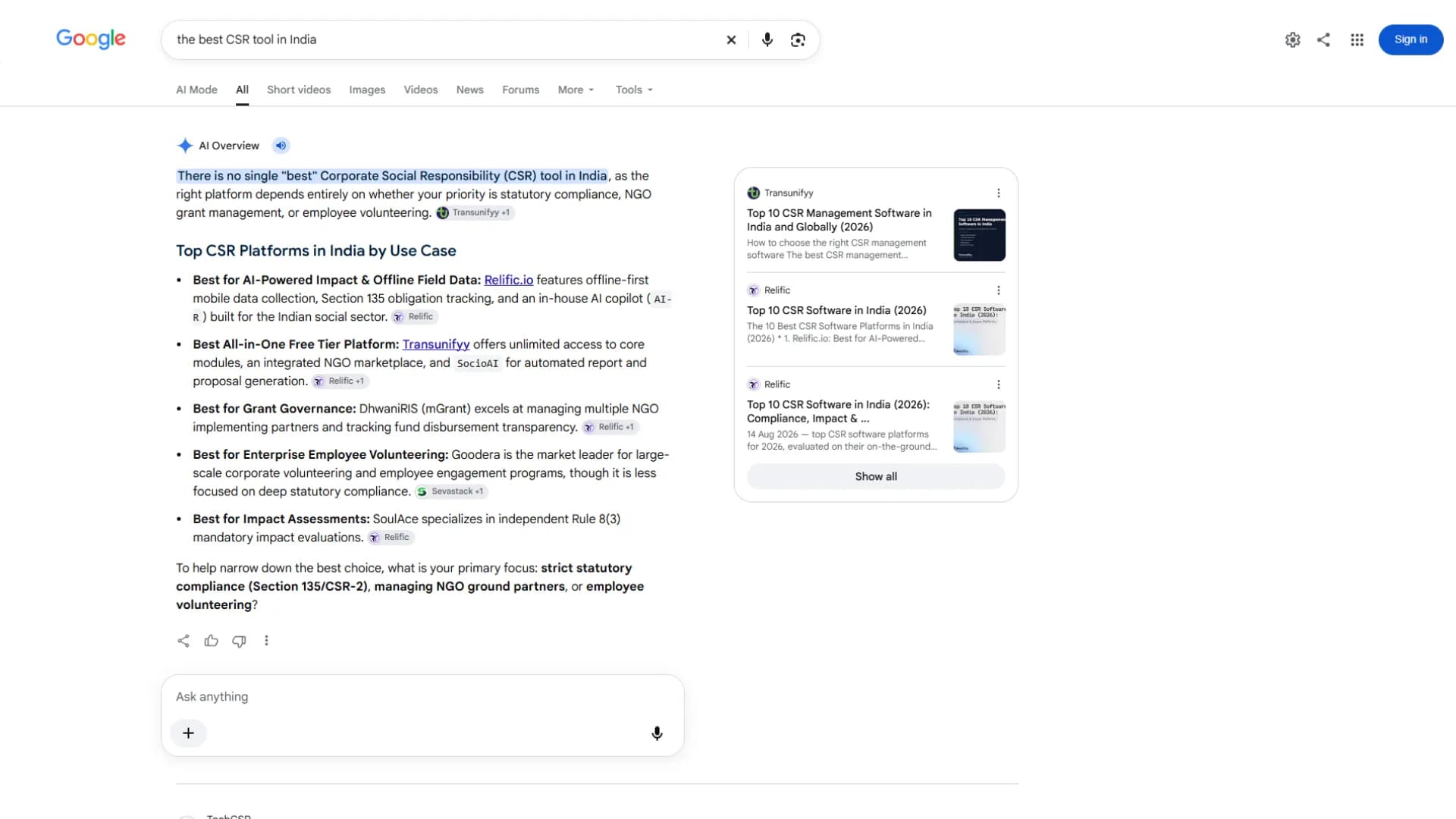
Here is why this matters. When Relific, an AI-powered CSR platform, came to us, Relific's buyers were asking AI tools which CSR tools to use for compliance, the best CSR tool in India, how CSR platforms compared for large companies, and how to automate sustainability data collection. Relific was largely missing from those answers. A generic keyword list would not have exposed that gap.
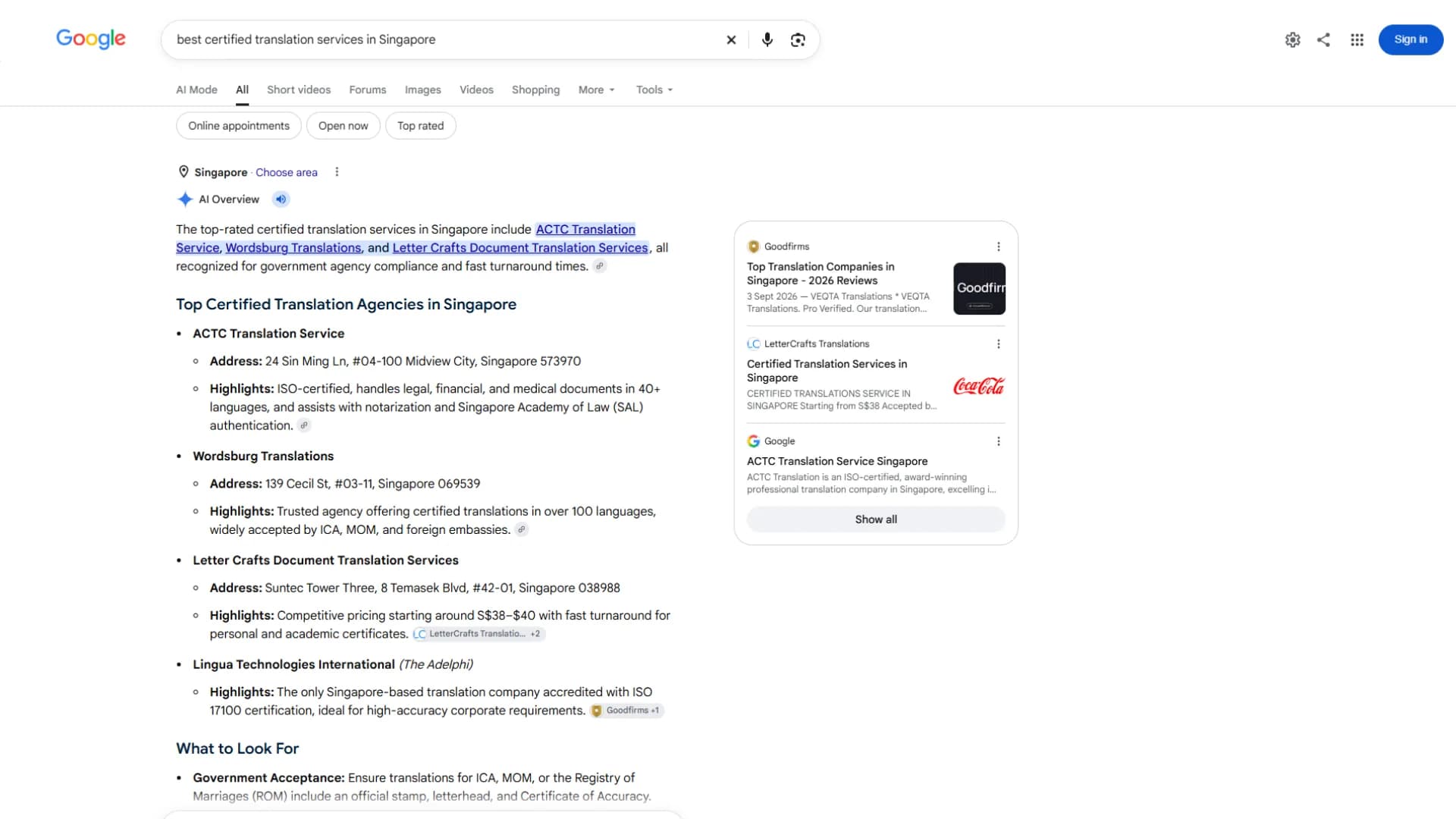
For LetterCrafts, a Singapore-certified translation company, the tracked set includes prompts such as "best certified translation services in Singapore" and "how to get notarized translation for ICA submission". ICA is Singapore's Immigration & Checkpoints Authority. These are the questions people ask shortly before they buy.
One boundary applies. Google's guidance on generative AI search says that creating separate content for every variation of how people might search, mainly to manipulate rankings or AI responses, violates its scaled content abuse spam policy. The query universe decides priorities. It does not decide page count.
Step 2: How GetCito Audits AI Visibility And Sets A Baseline
GetCito runs each priority prompt repeatedly across the major AI platforms and records where the brand appears, how it is described, whether its website is cited, and which competitors appear instead.
Our standard plans cover ChatGPT, Perplexity, Gemini, and Google AI Overviews. Enterprise engagements extend to Google AI Mode, Claude, Microsoft Copilot, DeepSeek, and Meta AI. For brands that sell in specific markets, we run the prompts from the relevant location.
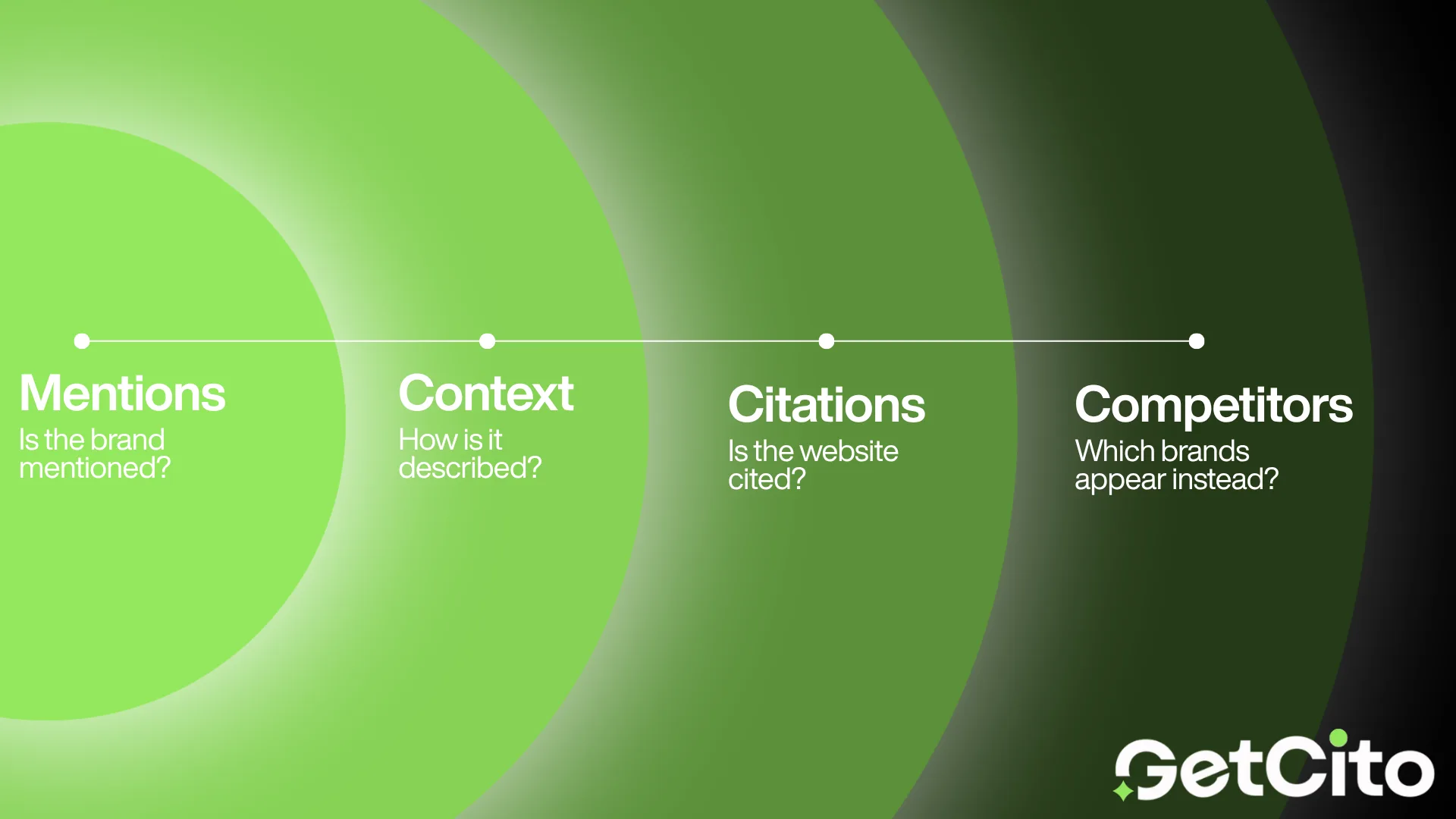
The audit examines four things:
- Brand mentions: does the brand appear in the answer at all?
- Context: how is the brand described? Is it recommended, listed as an alternative, or described inaccurately?
- Domain citations: is the brand's own website linked as a source, or is the brand only named?
- Competitor visibility: which brands appear instead, and on which prompts and platforms?
Why single AI rankings are the wrong measure
AI answers are not a stable list. In a study by SparkToro and Gumshoe.ai, hundreds of volunteers ran 12 recommendation prompts through ChatGPT, Claude, and Google's AI results a combined 2,961 times in November and December 2025. The researchers found less than a one-in-100 chance that ChatGPT or Google's AI would return the same brand list twice. They also found that how often a brand appears across many responses is more consistent than its position in any single one.
That is why we report frequency across many runs rather than a single position. In one July 2026 reporting period, we tracked an Indian industrial equipment manufacturer on 51 prompts, which produced 15,245 evaluated answers. The client held a 21% share of voice, first among its tracked competitors, while its overall AI visibility across all evaluated answers stood at 7%.
What the client receives: a baseline showing where the brand appears, where it does not, which competitors appear instead, and which sources AI systems rely on for each priority prompt. Every later result is measured against this baseline.
Step 3: How GetCito Finds The Sources AI Systems Cite
For each priority query, GetCito collects the domains that AI answers cite, then asks why those sources were chosen instead of the client's website.
This step changes how most brands think about AI visibility. The table covers three July 2026 reporting periods from our client accounts, with categories named and brands anonymised.
| Category (India, July 2026) | Tracked prompts | Evaluated answers | Total citations in answers | Unique cited domains | Brand's own domain share of citations |
|---|---|---|---|---|---|
Smart home fitness | 66 | 1,734 | 9,839 | 1,131 | 7% |
Lab-grown diamond jewellery | 72 | 17,154 | 110,012 | 4,631 | 2% |
Industrial air pollution control | 51 | 15,245 | 88,052 | 5,201 | 2% |
Across these three accounts, 93% to 98% of the citations in AI answers pointed somewhere other than the brand's own website, and each answer set drew on more than a thousand distinct domains. A brand that only optimises its own pages is competing for a small fraction of the sources that shape its category.
When we analyse a cited source, we look at three groups of signals.
Domain and authority signals: We check whether cited pages come from established publications, category specialists, or sites with strong topical depth. We compare their content quality, freshness, structured data, and topical relevance with the client's closest equivalent page. Often the cited page answers the exact question in its first paragraph, while the client's page answers it halfway down, after a sales pitch.
Community and forum presence: Reddit, Quora, and niche forums matter in some categories and barely register in others. There is a documented reason they can matter: OpenAI and Reddit announced a partnership in May 2024 that brings Reddit content into ChatGPT and other OpenAI products. Google's guidance also notes that its AI features can show what is being said about products and services in blogs, videos, and forum discussions. We check whether community sources actually appear for a client's prompts before recommending community work. Our guide to using Reddit for generative engine optimization covers that work in more depth.
Knowledge graph entities and comparison lists: Third-party comparison articles, "best of" lists and review pages often supply the shortlist an AI answer repeats. Consistent entity information also matters. When the same company name, category, founders, products, and locations appear across authoritative profiles, AI systems are more likely to recognise the brand and describe it correctly.
93% to 98% of the citations shaping your category point somewhere other than your own site. A free AI visibility audit shows you exactly which domains those are for your priority prompts, and which competitors they cite instead of you. Request your free audit.
Step 4: Why Competitors Appear In AI Answers Instead Of You
GetCito identifies the prompts, platforms, sources, and content formats behind a competitor's AI visibility, then maps each finding to a specific action.
For every priority prompt cluster, we document:
- which queries competitors appear for
- which platforms surface them
- which domains mention or cite them
- which content formats are retrieved (comparison pages, how-to guides, pricing pages, reviews)
- which third-party sources carry their visibility
- where the client has a measurable gap, and which action can close it
Here is how that looks in the GetCito dashboard for Relific, a CSR software company in India. Between 25 August and 23 September 2026, we tracked Relific against Benevity, CSRBOX and Goodera on the questions its buyers ask AI tools. The prompt-level view told a different story from any single score:
- "Which CSR software is best for Indian companies": Relific appeared in 70% of answers across the period and in 100% of the latest run, up from roughly 55% in mid-September.
- "Best CSR Software: Compare Top Solutions in India": Relific appeared in 67% of answers across the period but ended at 63%, level with Benevity and behind Goodera at about 75%.
- Volatility on the same prompt: CSRBOX fell from about 67% to about 13% on that comparison prompt in the final week, a reminder that AI answer sets can shift quickly.
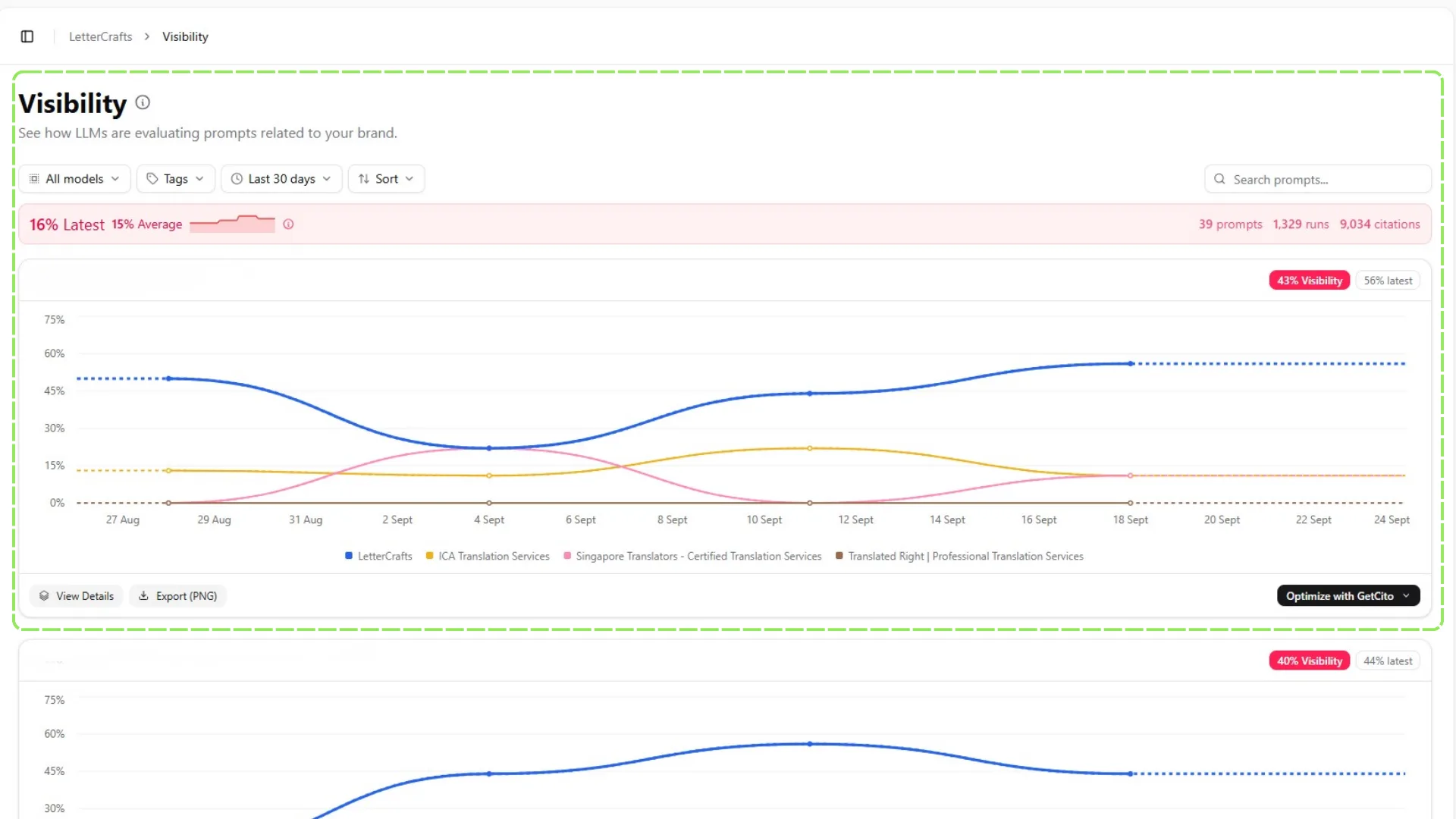
A brand can lead on one buyer question and trail on a near-identical one. That is why GetCito maps competitor visibility prompt by prompt rather than reporting one headline number.
This is how findings typically translate into work:
| What the analysis finds | What it usually indicates | What GetCito does |
|---|---|---|
A competitor is cited from a "best of" article the client is absent from | That list is a retrieval source for the prompt | Pitch the publisher with verifiable product information and a case for inclusion |
A competitor's own guide is cited for a how-to prompt | The competitor answers the question directly and clearly | Create or rework a client page with an answer-first, properly sourced treatment |
Forum threads are cited repeatedly | Community discussion shapes the answer | Plan authentic, disclosed participation in those communities |
The brand is mentioned but described inaccurately | Entity information is inconsistent across the web | Correct profiles, organisation schema and third-party listings |
A prompt cluster sits at 0% | No relevant content and no third-party coverage | Build a content and citation plan for that cluster |
Our analysis of how products get picked by LLMs but overlooked by Google explores why AI shortlists and search rankings can diverge.
Step 5: How GetCito Decides What To Fix First
GetCito ranks every gap by commercial value, size, and effort, then turns the ranking into a roadmap with owners and timelines.
A prompt at 0% visibility with strong purchase intent outranks a prompt at 40% with weak intent.
We score each gap on a simple matrix before it enters the roadmap:
| Prompt cluster | Intent | Current visibility | Effort | Priority |
|---|---|---|---|---|
Coloured diamonds | High purchase | 0% | Medium | P1 |
Custom rings | High purchase | 0% | Medium | P1 |
“What is a lab-grown diamond” | Informational | 30% | Low | P3 |
Care and cleaning | Post-purchase | 45% | Low | P4 |
High-intent, low-visibility clusters with achievable effort rise to the top; well-covered or low-intent prompts wait.
Step 6: GEO Execution, The Work That Changes The Answer
GetCito's execution covers on-page, off-page, and technical GEO. For Google's AI features, that means strong SEO fundamentals. For ChatGPT, Perplexity and Claude, it also means meeting the access and retrieval requirements each company documents.
The starting point is Google's own position. Google says its generative AI features are rooted in its core Search ranking and quality systems, and that from Google Search's perspective, optimising for generative AI search is still SEO. We agree, and we tell clients so. Other assistants run their own crawlers and retrieval systems, which is why GEO still needs separate measurement and technical checks. Our SEO, GEO, and AEO blueprint explains how the three disciplines fit together.
On-page GEO: making content easy to retrieve, quote and attribute
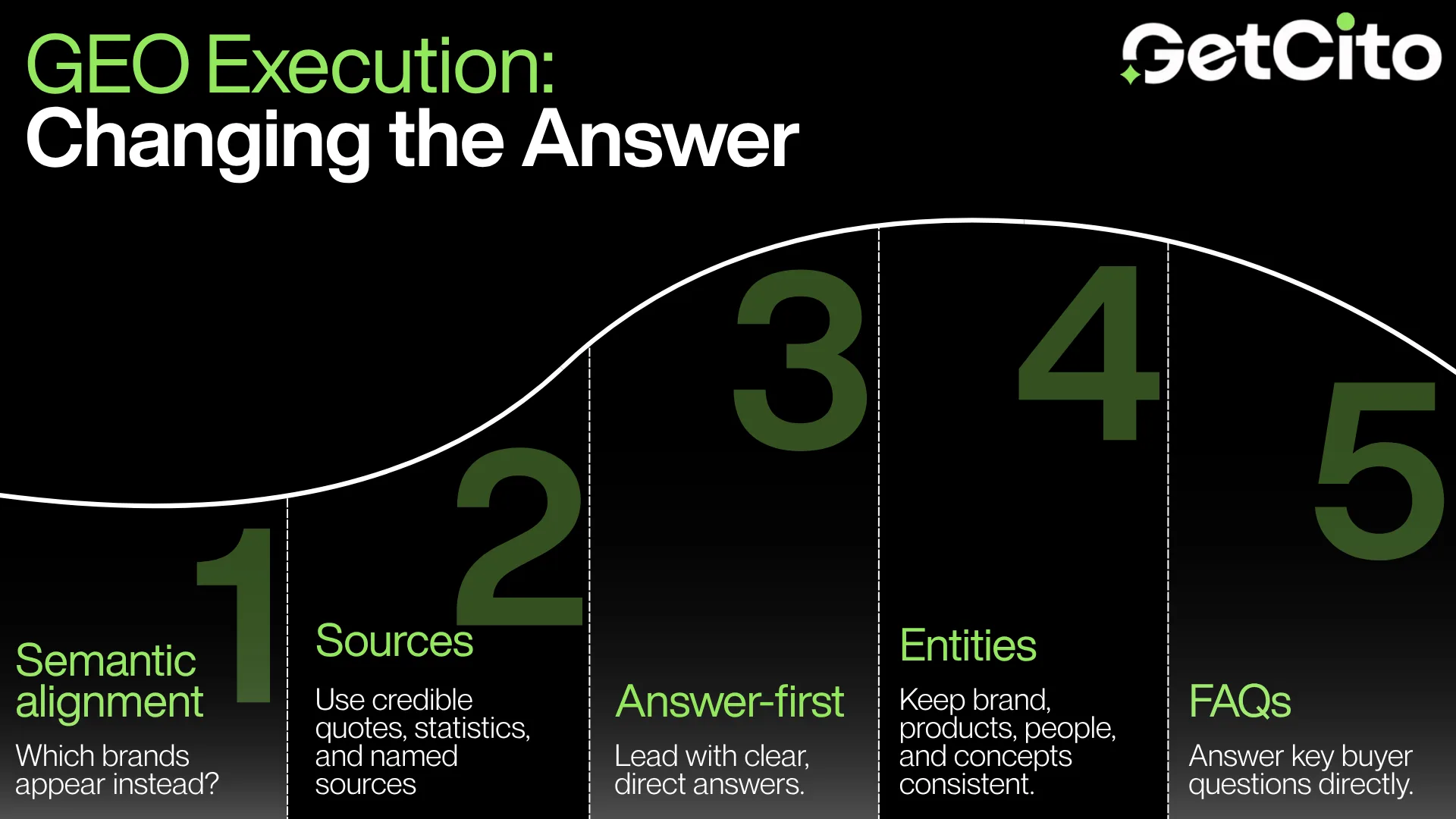
The objective is to make a client's content easy for AI systems to understand, retrieve, quote and attribute, while keeping it genuinely useful to the person reading it.
Semantic alignment: We convert buyer queries and page passages into embeddings, which are numerical representations of meaning, and measure the cosine similarity between them: a score for how close two pieces of text are in meaning. We use this as a diagnostic, not a ranking formula. A low score on a page that should answer a priority query usually means the page talks around the topic without addressing the buyer's actual question. Google notes that AI systems understand synonyms and general meaning, so there is no need to capture every phrasing of a query. The fix is missing substance, not inserted phrases.
Quotes, statistics, and attribution: The foundational GEO paper by Aggarwal and colleagues, accepted to KDD 2024, reported that its optimisation methods lifted a source's visibility in generative engine responses by up to 40% in controlled experiments, with effectiveness varying by domain. Adding citations, quotations, and statistics were among the strongest methods. We apply the principle, never the shortcut: every statistic traces to a named primary source, and we never fabricate quotes or numbers.
Answer-first structure: Each section of a page we write opens with a direct answer to the question it targets, then follows with explanation, evidence, and an example. Google states there is no requirement to break content into tiny pieces for its AI systems and no ideal page length. We use answer-first structure because it helps readers, and because a clear, self-contained answer is easier for any system to quote accurately. It is not a Google-specific trick.
Entity optimisation: We make sure the brand, its products, its people and its key concepts are represented consistently across on-site copy, organisation and product schema, author pages and external profiles. For Relific, the first phase of work was an entity and knowledge graph audit that mapped everything from product-level capabilities to the ESG mandates the platform supports into formats machines could interpret.
FAQ blocks: We answer specific questions from the query universe directly, in the language buyers use, on the pages where those questions belong. We do not generate FAQ sections for every conceivable variation.
What this looks like in client work:
- For LetterCrafts, we write long-form guides built on published guidance from Singapore's ICA, Ministry of Manpower (MOM) and Singapore Academy of Law (SAL). One guide corrects the common "government-approved translator" misconception by separating ICA's notarisation standard from MOM's certified-translation standard.
- For Relific, our Theory of Change and monitoring and evaluation pillar page corrected two errors still repeated across many Indian CSR blogs:
- The OECD-DAC evaluation criteria have numbered six since December 2019, when coherence was added.
- The Companies (CSR Policy) Amendment Rules notified on 20 September 2022 changed the Rule 8(3) cap on impact assessment spending from 5% of CSR expenditure or ₹50 lakh, whichever is less, to 2% or ₹50 lakh, whichever is higher.
Accuracy that competitors lack is a practical way to become the source worth citing.
Off-page GEO: building presence in the sources AI uses
AI systems do not rely only on a company's own website, as the citation data in Step 3 shows. Off-page GEO builds the brand's presence in the sources those systems actually use.
Citation source building: We earn relevant mentions and citations in industry publications, niche websites, directories, and news sources that appear in the client's source map.
Reddit and Quora: Community participation only works when it is useful and transparent. Our community managers answer real questions, disclose affiliation, and follow each community's rules. Google's guidance is direct about the alternative: seeking inauthentic mentions across the web is not as helpful as it might seem, because Google's generative AI features depend on both its quality ranking systems and its spam-blocking systems.
Wikipedia and Knowledge Panels: We treat these as opportunities for brands that already qualify, and we never promise them. Wikipedia's notability guideline for organisations requires significant coverage in independent, reliable sources; press releases and self-published material do not count. Wikipedia's conflict of interest guideline and the Wikimedia Foundation's terms of use require paid editors to disclose their employer, client, and affiliation. Where a brand meets the bar, we help it assemble the independent sources and engage through the proper disclosed channels.
Comparison lists and reviews: Third-party comparison articles and review platforms often supply the shortlist an AI answer repeats. We pursue inclusion in relevant lists with verifiable information, and help clients build genuine review volume on the platforms their buyers use:
- G2 or Capterra for software companies
- Trustpilot or Google reviews for consumer and local businesses
PR and podcasts. Earned media and expert appearances widen the footprint of credible, independent references to a brand. Relific's 2026 programme included a podcast alongside LinkedIn and email outreach. PR does not guarantee AI citations; it adds to the independent evidence AI systems can encounter.
Technical GEO: AI crawler access, rendering and schema
If AI systems cannot access or parse a page, no content improvement will help it. We check crawler access platform by platform, against each company's own documentation.
| Company | Crawler for search or answers | Crawler for model training | User-initiated fetcher |
|---|---|---|---|
OpenAI | OAI-SearchBot | GPTBot | ChatGPT-User (robots.txt may not apply) |
Anthropic | Claude-SearchBot | ClaudeBot | Claude-User |
Perplexity | PerplexityBot (not used for training) | None listed | Perplexity-User (generally ignores robots.txt) |
Google | Googlebot | Google-Extended token (Gemini training and grounding) | Separate user-triggered fetchers, listed in Google's crawler documentation |
What each company's documentation says:
- OpenAI. OpenAI's crawler documentation says OAI-SearchBot surfaces websites in ChatGPT's search features. Sites that opt out of OAI-SearchBot will not be shown in ChatGPT search answers, though they can still appear as navigational links. The settings are independent, so a site can allow OAI-SearchBot while disallowing GPTBot, the crawler whose content may be used to train OpenAI's foundation models.
- Anthropic. Anthropic's crawler documentation says ClaudeBot collects content that could contribute to model training. Anthropic says disabling Claude-User may reduce a site's visibility in user-directed web search, and disabling Claude-SearchBot may reduce a site's visibility and accuracy in user search results.
- Perplexity. Perplexity's crawler documentation recommends allowing PerplexityBot for a site to appear in Perplexity's search results.
- Google. To appear in Google's generative AI features, a page must be indexed and eligible to show in Search with a snippet, and the site must be included in Search generative AI features in Search Console. Google-Extended controls whether content may be used for Gemini model training and for grounding in Gemini Apps and Vertex AI. Google says Google-Extended does not affect a site's inclusion in Google Search and is not a ranking signal.
A common and costly mistake is blocking search crawlers while trying to block training crawlers. A visibility-first robots.txt for a marketing site often looks like this, adjusted to each client's content and training-data policy:
User-agent: OAI-SearchBot
Allow: /

User-agent: Claude-SearchBot
Allow: /

User-agent: Claude-User
Allow: /

User-agent: PerplexityBot
Allow: /

User-agent: GPTBot
Disallow: /

User-agent: ClaudeBot
Disallow: /
This is a policy choice, not a universal recommendation. Blocking GPTBot and ClaudeBot keeps content out of model training, which some brands prefer, but it also means the content won't inform what these models say when they answer without live search. A brand that wants maximum long-term presence in model knowledge may choose to allow the training crawlers. We set the default per client, based on their content and training-data policy, and explain both sides before deciding.
llms.txt: where we stand: llms.txt is a proposed Markdown file, published by Jeremy Howard of Answer.AI on 3 September 2024, that gives language models and agents a curated map of a site's content. It is a proposal, not a ratified standard. Google says Google Search does not use llms.txt or similar files, and that creating them for other services neither helps nor harms visibility in Google Search.
Our own research, the LLM SEO Files framework, included llms.txt as one layer of a file-based approach to AI-optimised content. Given Google's published position, we treat llms.txt as an optional, low-cost addition for non-Google systems and AI agents. It is not a ranking requirement, and we do not sell it as one.
Rendering and JavaScript: Google says it can process JavaScript content as long as it is not blocked. Not every AI crawler publicly documents whether it renders JavaScript, so we make sure core content, prices, specifications, and answers are present in the initial HTML.
Schema, speed, canonicalisation and consolidation: Google says structured data is not required for its generative AI features, but remains worth using because it supports eligibility for rich results. Google's guidance also recommends good page experience and reduced duplicate content. We implement accurate JSON-LD (JavaScript Object Notation for Linked Data) schema that matches visible content, fix canonical tags, and merge thin or overlapping pages into single authoritative ones.
How much work ships each month
At the time of writing, our published Growth plan includes, each month:
- five human-written content pieces created or refreshed
- structured data and technical GEO work on 10 to 15 pages
- 10 hours of brand mention acquisition
- 20 hours of domain citation optimisation
- four hours of Reddit, Quora and niche forum management
Step 7: How GetCito Measures AI Visibility Progress
GetCito tracks visibility at prompt level across repeated runs and compares it with the baseline every month. Prompts that moved get defended, prompts that did not get re-diagnosed, and new competitor movements get added to the plan.
Clients track progress in our dashboard, which lists the AI-driven queries tied to the brand, its products, and its competitors. Clients can filter those queries or add their own. The metrics we report include:
- Share of voice against tracked competitors, overall and by prompt
- Overall AI visibility across all evaluated answers
- Brand citations and brand citation share: how often the client's domain is linked, relative to all citations in the answer set
- Unique cited domains: how widely answers draw sources in the category
- Prompt-level visibility, including clusters stuck at 0%
- Sentiment and context of mentions
- AI crawler activity and AI-referred sessions, tracked as a trend against baseline. AI-referred traffic is an early, lagging signal in most categories: it builds only after citations accumulate, so we read its direction month over month rather than its absolute size in any single period.
Each month, the client also receives a report through our AI search analytics service. It covers an executive summary, authority and technical signals, website infrastructure, keyword performance, visibility and search query performance, and areas of opportunity.
For Google's AI surfaces, we pair our own data with Google's. Google recommends the Generative AI performance report in Search Console to see how content performs in its generative AI features.
One point deserves plain language. Google cautions site owners about third-party tools that claim to use internal Google metrics, and states that no third-party tool has access to its internal ranking or AI systems. Our data comes from simulated queries and observed answers, not from inside any AI platform. That difference matters when you interpret the numbers.
What Evidence Supports GetCito's Claims?
GetCito's claims can be checked against published research, public open-source code, independent reviews, and documented client data.
- Published research: Avinash Tripathi's paper, "A Strategic Outlook on LLM SEO: Using File-Format Logic to Guide AI-Optimized Content Design", dated 31 July 2025, is available on SSRN (the Social Science Research Network). It proposes a file-based framework for AI-optimised content and reports an experiment using more than 100 prompts across ChatGPT, Perplexity and Google AI Overviews, run from five countries.
- Open-source code: GetCito's AI visibility platform is public on GitHub under the MIT licence, where it had 413 stars and 93 forks on 23 September 2026.
- Independent reviews: GetCito holds a 4.3 out of 5 average from 17 reviews on G2 as of 23 September 2026.
- Third-party backing and recognition: GetCito is backed by Alchemist Accelerator and Google for Startups. Its work includes the ASIA Framework (2026), the YesUsers #1 GEO Consultant recognition, and 10,000+ professionals trained.
- Client range: We work with mid-market and enterprise companies in SaaS (software as a service), manufacturing, consumer goods, jewellery and professional services.
- Transparent baselines: Every engagement starts with a measured baseline across the agreed engines and is reported against it monthly.
Client Results: Two Engagements In Numbers
GetCito reports client outcomes as prompt-level movement against a measured baseline, with the run counts and platform caveats those numbers need.
Relific (CSR software, India)
- Baseline: At kickoff, Relific was largely missing from the AI answers its buyers relied on, including "which CSR software is best for Indian companies" and "best CSR platform for large companies."
- What we shipped: An entity and knowledge graph audit, a Theory of Change and monitoring-and-evaluation pillar page, and a podcast, LinkedIn and email outreach programme.
- Outcome (25 August to 23 September 2026): On "which CSR software is best for Indian companies," Relific rose from roughly 55% in mid-September to 70% across the period and 100% in the latest run, tracked against Benevity, CSRBOX and Goodera.
- Caveats: Figures are frequency across repeated runs, not a single ranking. AI answer sets shift quickly, as CSRBOX's fall from about 67% to 13% on a comparison prompt in the same window shows.
LetterCrafts (certified translation, Singapore)
- Baseline: We track prompts such as "best certified translation services in Singapore" and "how to get notarized translation for ICA submission," the questions people ask shortly before they buy.
- What we shipped: Long-form guides built on published guidance from Singapore's ICA, MOM and SAL, including one that separates ICA's notarisation standard from MOM's certified-translation standard.
- Outcome: Reported monthly against the LetterCrafts baseline across the agreed engines.
- Caveats: As above, results are reported as frequency across many runs.
How Long Does GEO Take To Show Results?
In our experience most clients see early traction in 6 to 8 weeks and significant visibility gains over 3 to 6 months. Neither is guaranteed.
| Window | What typically happens | What you should see |
|---|---|---|
Weeks 1 to 2 | Business discovery, query universe, baseline audit, source map | A documented baseline and a prioritised roadmap |
Weeks 2 to 8 | Technical fixes, first content refreshes, first mention and community work | Early changes in mentions or citations on some target prompts |
Months 3 to 6 | Sustained content, citation building, entity corrections | Share-of-voice movement on priority prompt clusters |
After 6 months | Iteration on what moved and what did not | Compounding gains, plus defence of positions already won |
Outcomes depend on:
- Starting visibility: a brand at 0% on a prompt usually moves more slowly at first
- Category competitiveness
- Website quality, content quality and domain authority
- Query selection
- Technical accessibility
- Existing third-party coverage
- How quickly approvals and implementation happen on the client side
- Changes the AI platforms make to their own systems
See What AI Says About Your Brand Today
Whether or not you work with us, the first step is the same: find out what AI systems say about your brand today, on the prompts your buyers actually use, and which sources those answers rely on.
If you would like us to run that check, request a free AI visibility audit. We run up to 10 of your priority prompts across ChatGPT, Perplexity, Gemini and Google AI Overviews, multiple times each, and return a baseline within a few business days as a shareable report. You will see where your brand appears, the competitors named instead of you, the domains those answers cite, and the gaps worth closing first.